Author: admin

  • The Easy Trick to Guess If a Spanish Word Is Masculine or Feminine

     You learn:

    casa = house

    Then Spanish asks:

    👉 la casa

    You learn:

    libro = book

    And suddenly:

    👉 el libro

    But why?

    Why is a house feminine and a book masculine?

    And do you really need to memorise the gender of every Spanish noun separately?

    Not always. 😉

    There are some useful patterns that can help you make a good guess.

    And if you’re a beginner, this little shortcut can save you a lot of memorisation.

    Let’s see how it works.


    🧠 The Lazy Student’s Spanish Gender Hack

    When you learn a new Spanish noun, don’t immediately try to memorise it by itself.

    Instead, look at the ending of the word.

    Ask yourself:

    “What does this word end in?”

    That ending can give you a clue about whether the noun is usually masculine or feminine.

    Think of it like:

    WORD → LOOK AT THE END → FIND THE PATTERN → GUESS → CHECK

    It’s simple.

    And once you start noticing these patterns, Spanish vocabulary becomes much easier to organise in your head.


    🔵 First: The Masculine Clues

    Spanish masculine nouns commonly use:

    👉 EL

    Here are some useful patterns for beginners.


    🔵 1. Words Ending in -o

    This is one of the most useful patterns.

    Many Spanish nouns ending in -o are masculine.

    Examples:

    el libro — the book
    Pronunciation: el LEE-broh

    el perro — the dog
    Pronunciation: el PEH-rroh

    el teléfono — the telephone
    Pronunciation: el teh-LEH-foh-noh

    So when you see:

    -o → often EL

    Your brain can make a quick guess.


    🔵 2. Words Ending in -ma

    Here’s an interesting one.

    Some Spanish words ending in -ma are masculine.

    Examples:

    el problema — the problem
    Pronunciation: el proh-BLEH-mah

    el sistema — the system
    Pronunciation: el sees-TEH-mah

    el programa — the program
    Pronunciation: el proh-GRAH-mah

    This is a useful pattern because beginners often assume that words ending in -a must be feminine.

    But that’s not always true.

    More on that in a moment. 👀


    🔵 3. Many Words Ending in -aje

    Words ending in -aje are commonly masculine.

    Examples:

    el viaje — the trip
    Pronunciation: el VYAH-heh

    el mensaje — the message
    Pronunciation: el men-SAH-heh

    el paisaje — the landscape
    Pronunciation: el pah-ee-SAH-heh

    🧠 Remember:

    -aje → often EL


    🔵 4. Words Ending in -or

    Many nouns ending in -or are masculine.

    Examples:

    el color — the color
    Pronunciation: el koh-LOR

    el profesor — the teacher/professor
    Pronunciation: el proh-feh-SOR

    el calor — the heat
    Pronunciation: el kah-LOR

    Again:

    -or → often EL


    🎯 Quick Challenge #1

    Don’t scroll down immediately.

    Which one do you think is correct?

    ___ libro

    A) la libro
    B) el libro

    Look at the ending.

    libro → -o

    What’s your answer?

    👇

    👇

    👇

    ✅ Answer: EL libro

    Correct!

    The ending -o is commonly masculine.

    So:

    🇪🇸 el libro


    🔴 Now Let’s Look at Feminine Clues

    Many feminine Spanish nouns use:

    👉 LA

    And just like masculine nouns, there are some endings that can help you make a quick guess.


    🔴 1. Words Ending in -a

    This is probably the most famous Spanish gender pattern.

    Many nouns ending in -a are feminine.

    Examples:

    la casa — the house
    Pronunciation: lah KAH-sah

    la mesa — the table
    Pronunciation: lah MEH-sah

    la palabra — the word
    Pronunciation: lah pah-LAH-brah

    So:

    -a → often LA

    This is one of the first patterns Spanish beginners should learn.


    🔴 2. Words Ending in -ción

    Words ending in -ción are commonly feminine.

    Examples:

    la información — information
    Pronunciation: lah een-for-mah-SYON

    la conversación — conversation
    Pronunciation: lah kon-bair-sah-SYON

    la educación — education
    Pronunciation: lah eh-doo-kah-SYON

    🧠 Easy clue:

    -ción → often LA


    🔴 3. Words Ending in -dad

    Many nouns ending in -dad are feminine.

    Examples:

    la ciudad — city
    Pronunciation: lah see-oo-DAHD

    la verdad — truth
    Pronunciation: lah bair-DAHD

    la libertad — freedom
    Pronunciation: lah lee-bair-TAHD

    So:

    -dad → often LA


    🔴 4. Words Ending in -tad

    This is another useful feminine pattern.

    Examples:

    la amistad — friendship
    Pronunciation: lah ah-mees-TAHD

    la libertad — freedom
    Pronunciation: lah lee-bair-TAHD

    When you see this type of ending, LA is often a good first guess.


    🔴 5. Words Ending in -tud

    Many nouns ending in -tud are feminine.

    Examples:

    la juventud — youth
    Pronunciation: lah hoo-ben-TOOD

    la actitud — attitude
    Pronunciation: lah ak-tee-TOOD

    🧠 Remember:

    -tud → often LA


    🎯 Quick Challenge #2

    What do you think?

    ___ información

    A) el información
    B) la información

    Look at the ending:

    -ción

    What’s your guess?

    👇

    👇

    👇

    ✅ Answer: LA información

    Because -ción is commonly feminine.


    🤯 The Trap: Not Every -A Word Is Feminine!

    Here’s where Spanish gets interesting.

    You might think:

    “If a word ends in -a, it must be LA.”

    Not quite.

    Remember:

    These are patterns, not perfect rules.

    For example:

    el problema — the problem

    el sistema — the system

    el programa — the program

    They end in -a, but they’re masculine.

    That’s why you shouldn’t blindly apply the rule.

    Instead:

    Use the ending as a clue.

    Then learn the correct article with the word.


    🧠 The Best Way to Memorise Spanish Nouns

    Here’s the habit that will save you a lot of time.

    Don’t learn:

    ❌ casa = house

    Learn:

    ✅ la casa = house

    Don’t learn:

    ❌ libro = book

    Learn:

    ✅ el libro = book

    Don’t learn:

    ❌ problema = problem

    Learn:

    ✅ el problema = problem

    Your brain starts storing:

    ARTICLE + NOUN

    as one unit.

    This makes speaking Spanish much easier later.


    🎮 The 5-Second Spanish Challenge

    From now on, whenever you learn a new Spanish noun, pause for just five seconds.

    Ask:

    “EL or LA?”

    Then look at the ending.

    Make your guess.

    Check the answer.

    Repeat.

    That’s it.

    You don’t need to turn vocabulary learning into a huge grammar session.


    🌟 Want More Essential Spanish?

    If you’re just starting Spanish, learning noun gender is useful—but you also need some everyday words you can actually use.

    👉 [5 Essential Spanish Words for Beginners]

    Learn five simple Spanish words that every beginner should know and start building your everyday vocabulary.


    🎯 Mini Spanish Gender Quiz

    Okay, time to see whether you’ve actually learned the patterns.

    Try these before checking the answers.

    1. ___ casa

    A) el
    B) la

    2. ___ libro

    A) el
    B) la

    3. ___ conversación

    A) el
    B) la

    4. ___ problema

    A) el
    B) la

    5. ___ ciudad

    A) el
    B) la

    Write down your answers.

    Ready?

    👇

    👇

    👇

    🏆 Answer Key

    1. la casa ✅

    -a → often LA

    2. el libro ✅

    -o → often EL

    3. la conversación ✅

    -ción → often LA

    4. el problema ✅

    ⚠️ Exception to the simple -a → LA pattern.

    5. la ciudad ✅

    -dad → often LA


    🏅 What’s Your Score?

    🔥 5/5

    Excellent!

    You’re already spotting Spanish gender patterns.

    👍 3–4/5

    Very good!

    You’re getting the idea. Keep practising.

    💪 1–2/5

    No worries.

    Go back to the ending patterns and try the quiz again.

    😄 0/5

    Don’t give up!

    Spanish gender takes practice, and now you know exactly where to start.


    📌 Spanish Gender Cheat Sheet

    Save this section for your next Spanish study session.

    🔵 Often Masculine → EL

    -o → el libro
    -ma → el problema
    -aje → el viaje
    -or → el profesor


    🔴 Often Feminine → LA

    -a → la casa
    -ción → la conversación
    -dad → la ciudad
    -tad → la amistad
    -tud → la juventud


    ⚠️ One Golden Rule to Remember

    Don’t say:

    ❌ “-o always means masculine.”

    Don’t say:

    ❌ “-a always means feminine.”

    Instead say:

    ✅ “This ending gives me a clue.”

    That’s the smarter way to learn.

    Spanish has exceptions, and you’ll gradually learn them as you encounter more vocabulary.


    🚀 The Lazy Student’s Formula

    If you want the whole lesson in one sentence:

    Look at the ending → make a guess → check it → remember the noun with EL or LA.

    That’s your shortcut.

    And the more Spanish you read, the more often you’ll start recognising these patterns automatically.


    🧠 One Final Test

    No looking back.

    What would you guess?

    ___ programa

    A) la programa
    B) el programa

    Think about the ending.

    -a

    Your first instinct might be:

    👉 LA

    But remember our exception!

    👇

    👇

    👇

    🎯 Correct Answer: EL programa

    This is exactly why the pattern is a clue, not a guaranteed rule.

    And now you’ll probably remember:

    🇪🇸 el programa

    much more easily. 😉


    ❤️ Final Takeaway

    You don’t need to memorise every Spanish noun gender in one sitting.

    Start with the common patterns.

    Notice the endings.

    Make your best guess.

    Then check.

    And always try to learn:

    EL + noun

    or

    LA + noun

    rather than learning the noun by itself.

    For example:

    el libro 📖
    la casa 🏠
    el viaje ✈️
    la conversación 💬
    el problema 🤔


    🔵🩷 What About LOS and LAS?

    So far, we’ve looked at:

    👉 EL — masculine singular
    👉 LA — feminine singular

    But what happens when there is more than one noun?

    That’s where:

    👉 LOS
    👉 LAS

    come in! 🎯

    The pattern is actually very simple.

    🔵 LOS
    Masculine + Plural

    Use LOS when you have more than one masculine noun.

    Examples:

    el libro → los libros
    the book → the books

    el perro → los perros
    the dog → the dogs

    el viaje → los viajes
    the trip → the trips

    el profesor → los profesores
    the teacher → the teachers

    So remember:

    EL → LOS

    Singular → Plural

    🔴 LAS
    Feminine + Plural

    Use LAS when you have more than one feminine noun.

    Examples:

    la casa → las casas
    the house → the houses

    la mesa → las mesas
    the table → the tables

    la flor → las flores
    the flower → the flowers

    la conversación → las conversaciones
    the conversation → the conversations

    So remember:

    LA → LAS

    Singular → Plural

    🧠 The Complete Pattern

    Now you can see the full Spanish definite article pattern:

    🔵 EL → masculine + singular
    🔵 LOS → masculine + plural

    🔴 LA → feminine + singular
    🔴 LAS → feminine + plural

    Think of it like this:

    EL → LOS
    LA → LAS

    Or:

    Singular → Plural

    EL → LOS
    LA → LAS

    🎯 Quick Challenge #3

    Which one is correct?

    ___ libros

    A) el
    B) los
    C) las

    Look at the noun:

    libros → plural + masculine

    👇

    👇

    👇

    ✅ Answer: LOS libros

    Because:

    el libro → los libros

    🔴 Quick Challenge #4

    What about:

    ___ casas

    A) el
    B) los
    C) las

    Look at the noun:

    casas → plural + feminine

    👇

    👇

    👇

    ✅ Answer: LAS casas

    Because:

    la casa → las casas

    📌 Complete Spanish Definite Articles Cheat Sheet

    Now you know all four:

    🔵 EL → Masculine + Singular
    el libro — the book

    🔴 LA → Feminine + Singular
    la casa — the house

    🔵 LOS → Masculine + Plural
    los libros — the books

    🔴 LAS → Feminine + Plural
    las casas — the houses

    🧠 The Easy Formula

    Gender + Number = Correct Article

    Masculine + Singular
    ➡️ EL

    Feminine + Singular
    ➡️ LA

    Masculine + Plural
    ➡️ LOS

    Feminine + Plural
    ➡️ LAS

    So instead of memorising four unrelated words, remember two simple changes:

    EL → LOS
    LA → LAS

    That’s it! 😄

    🎮 One Final Practice

    Try these:

    1. ___ perros
      A) el
      B) los
      C) las

    2. ___ flores
      A) el
      B) los
      C) las

    3. ___ libro
      A) el
      B) la
      C) los

    4. ___ casas
      A) la
      B) los
      C) las

    👇

    👇

    👇

    🏆 Answers

    1. los perros ✅
    2. las flores ✅
    3. el libro ✅
    4. las casas ✅

    Now you’ve got the complete basic pattern:

    🇪🇸 EL → LOS
    🇪🇸 LA → LAS

    Singular becomes plural, while the gender stays the same.

    Keep practising these four articles with new vocabulary, and choosing the correct Spanish article will become much more automatic! 🇪🇸✨

    The more you practise, the faster these choices will become natural.
    🇪🇸 ¡Buena suerte y feliz aprendizaje!

  • The 1-Minute Rule for French Articles- The Secret Trick to Guess If a French Word Is Masculine or Feminine

    Have you ever learned a French word and immediately asked yourself:

    “Is it LE or LA?” 😵‍💫

    You are not alone.

    In French, nouns have a grammatical gender.

    So instead of simply learning:

    maison = house

    you need to remember:

    la maison = the house

    And instead of:

    livre = book

    you learn:

    le livre = the book

    But here’s the interesting part:

    You can often make a good guess just by looking at the ending of the word. 👀

    And it takes less than a minute to learn the basic pattern.

    Let’s test your French instinct.


    ⏱️ The 1-Minute Rule

    When you see an unfamiliar French noun, follow these 4 steps:

    1️⃣ Look at the ending.

    2️⃣ Identify a common pattern.

    3️⃣ Guess LE or LA.

    4️⃣ Check the word and remember it with its article.

    Think of it like:

    WORD → ENDING → CLUE → GUESS → CHECK

    It’s not magic.

    And it’s definitely not 100% accurate.

    But it can make French vocabulary much easier to remember.


    🔵 Common Masculine Endings

    Let’s start with some endings that are often masculine.

    When you see these endings, think:

    👉 LE


    🔵 1. Words ending in -age

    Many nouns ending in -age are masculine.

    le village — village
    Pronunciation: luh vee-LAHZH

    le fromage — cheese
    Pronunciation: luh froh-MAHZH

    le voyage — trip
    Pronunciation: luh vwah-YAHZH

    🧠 Memory clue:

    -age → often LE


    🔵 2. Words ending in -ment

    Examples:

    le gouvernement — government
    Pronunciation: luh goo-vair-nuh-MON

    le changement — change
    Pronunciation: luh shahnzh-MON

    le bâtiment — building
    Pronunciation: luh bah-tee-MON

    🧠 Memory clue:

    -ment → often LE


    🔵 3. Words ending in -isme

    This one is especially useful.

    le tourisme — tourism
    Pronunciation: luh too-reesm

    le réalisme — realism
    Pronunciation: luh ray-ah-LEESM

    le journalisme — journalism
    Pronunciation: luh zhoor-nah-LEESM

    🧠 Memory clue:

    -isme → often LE


    🔵 4. Words ending in -eau

    Examples:

    le bureau — office
    Pronunciation: luh byoo-ROH

    le château — castle
    Pronunciation: luh shah-TOH

    le cadeau — gift
    Pronunciation: luh kah-DOH

    🧠 Memory clue:

    -eau → often LE


    🔵 5. Words ending in -oir

    Examples:

    le miroir — mirror
    Pronunciation: luh mee-RWAHR

    le couloir — hallway
    Pronunciation: luh koo-LWAHR

    🧠 Memory clue:

    -oir → often LE


    🎯 Quick Challenge #1

    Don’t look at the answer yet.

    Which one is correct?

    ___ village

    A) la village
    B) le village

    Think about the ending.

    -age

    Got your answer?

    👇

    👇

    👇

    ✅ Answer: le village

    Because -age is commonly masculine.

    le village

    Did you get it right? 😎


    🔴 Common Feminine Endings

    Now let’s switch sides.

    These endings are often feminine.

    So your first guess should be:

    👉 LA


    🔴 1. Words ending in -tion

    This is one of the most useful patterns for beginners.

    la nation — nation
    Pronunciation: lah nah-SYON

    la situation — situation
    Pronunciation: lah see-too-ah-SYON

    la conversation — conversation
    Pronunciation: lah kon-vair-sah-SYON

    🧠 Memory clue:

    -tion → often LA


    🔴 2. Words ending in -sion

    Examples:

    la décision — decision
    Pronunciation: lah day-see-ZYON

    la télévision — television
    Pronunciation: lah tay-lay-vee-ZYON

    la discussion — discussion
    Pronunciation: lah dees-koo-SYON

    🧠 Memory clue:

    -sion → often LA


    🔴 3. Words ending in -té

    Examples:

    la liberté — freedom
    Pronunciation: lah lee-bair-TAY

    la beauté — beauty
    Pronunciation: lah boh-TAY

    la vérité — truth
    Pronunciation: lah vay-ree-TAY

    🧠 Memory clue:

    -té → often LA


    🔴 4. Words ending in -ette

    Examples:

    la baguette — baguette
    Pronunciation: lah bah-GET

    la bicyclette — bicycle
    Pronunciation: lah bee-see-KLET

    la serviette — towel
    Pronunciation: lah sair-vee-ET

    🧠 Memory clue:

    -ette → often LA


    🔴 5. Words ending in -ance or -ence

    Examples:

    la différence — difference
    Pronunciation: lah dee-fay-RAHNS

    la chance — luck
    Pronunciation: lah SHAHNS

    la patience — patience
    Pronunciation: lah pah-SYAHNS

    🧠 Memory clue:

    -ance / -ence → often LA


    🔴 6. Words ending in -ure

    Examples:

    la culture — culture
    Pronunciation: lah kool-TUR

    la voiture — car
    Pronunciation: lah vwah-TUR

    la nature — nature
    Pronunciation: lah nah-TUR

    🧠 Memory clue:

    -ure → often LA


    🎯 Quick Challenge #2

    Which one is correct?

    ___ décision

    A) le décision
    B) la décision

    Look at the ending:

    -sion

    What’s your guess?

    👇

    👇

    👇

    ✅ Answer: la décision

    Because -sion is commonly feminine.

    la décision


    ⚠️ But Wait… There’s a Catch!

    Before you start thinking you’ve discovered a perfect French gender formula…

    There’s something important you need to know.

    These are patterns, NOT absolute rules.

    French has exceptions.

    So don’t think:

    ❌ “-age ALWAYS means masculine.”

    Think:

    ✅ “-age is OFTEN masculine.”

    For example:

    le village → masculine ✅

    But:

    la plage → feminine ❗

    And:

    la page → feminine ❗

    So the ending is a clue, not a guarantee.

    That’s why you should always check unfamiliar words when you’re learning them.


    🤯 The Tricky Part: LE, LA… or L’?

    Here’s where things get even more interesting.

    Look at this word:

    organisation

    The ending is:

    -tion

    So our first clue suggests:

    👉 feminine

    You might think:

    la organisation

    But that’s not what French normally uses.

    Why?

    Because the word begins with a vowel sound.

    French often changes:

    le / la → l’

    before a vowel sound.

    So:

    🇫🇷 l’organisation

    This is why learning French is not just about memorising one rule.

    You’re learning how different clues work together.


    🧠 The 60-Second Method in Action

    Let’s say you discover a new word:

    situation

    You don’t remember its gender.

    Don’t panic.

    Step 1

    Look at the ending.

    situation → -tion

    Step 2

    Remember the pattern.

    -tion → often feminine

    Step 3

    Make your guess.

    👉 LA

    Step 4

    Check the actual word.

    ✅ la situation

    That’s it.

    You’ve just used the 1-Minute Rule.


    🎮 Mini Quiz: Can You Beat the Rule?

    Now it’s your turn.

    Try to answer these before checking the answers.

    1. ___ gouvernement

    2. ___ liberté

    3. ___ tourisme

    4. ___ culture

    5. ___ baguette

    Write your answers somewhere.

    Ready?

    Don’t scroll too quickly! 👀


    🎯 Answers

    1. le gouvernement ✅

    -ment → often masculine

    2. la liberté ✅

    -té → often feminine

    3. le tourisme ✅

    -isme → often masculine

    4. la culture ✅

    -ure → often feminine

    5. la baguette ✅

    -ette → often feminine


    🏆 What’s Your Score?

    🔥 5/5

    Excellent!

    You’re starting to recognise the patterns.

    👍 3–4/5

    Very good.

    You just need a little more practice.

    💪 1–2/5

    Don’t worry.

    These patterns become easier when you see them repeatedly.

    😅 0/5

    French wins this round!

    But now you know exactly what to practise.


    🧠 French Gender Cheat Sheet

    Save this section for later.

    🔵 Often Masculine → LE

    -age → le village
    -ment → le gouvernement
    -isme → le tourisme
    -eau → le bureau
    -oir → le miroir


    🔴 Often Feminine → LA

    -tion → la nation
    -sion → la décision
    -té → la liberté
    -ette → la baguette
    -ance / -ence → la différence
    -ure → la culture


    ⭐ The Golden Rule

    Here’s the habit that can make a huge difference:

    Don’t learn French nouns alone.

    Instead of:

    ❌ maison = house

    learn:

    ✅ la maison = house

    Instead of:

    ❌ livre = book

    learn:

    ✅ le livre = book

    Instead of:

    ❌ voiture = car

    learn:

    ✅ la voiture = car

    Your brain starts connecting the noun with its article.

    And after enough practice, choosing LE or LA becomes much more natural.


    ⏱️ Your 5-Second French Habit

    Every time you learn a new French noun, take just 5 extra seconds.

    Ask:

    “LE or LA?”

    Then:

    Look at the ending.

    Make your guess.

    Check the answer.

    Remember the noun with its article.

    That’s it.

    You don’t need to memorise hundreds of grammar rules at once.

    You just need to notice patterns.


    🇫🇷 Want to Learn More French?

    If you’re building your basic French vocabulary, these two guides are great next steps:

    👉 [Top 5 Essential French Conversation Phrases for Beginners]

    Learn simple French expressions you can actually use in everyday conversations.

    👉 [Days of the Week in French]

    Learn Monday to Sunday in French and make everyday vocabulary easier to remember.


    📚 Want to Improve Your French Reading?

    If you’re ready to start reading simple French, beginner-friendly books can help you build vocabulary naturally.

    👉 [Top 5 French Reading Books for Beginners]

    You’ll find beginner-friendly recommendations and ideas for choosing a French book at the right level.

    🎯 One Last Challenge

    Before you leave, try this:

    ___ conversation

    Don’t look it up.

    Think about the ending.

    conversation → -tion

    So what’s your answer?

    👇

    👇

    👇

    🇫🇷 LA conversation ✅

    If you got it right, congratulations!

    You’ve just used the 1-Minute Rule.


    ❤️ Final Reminder

    French gender can feel confusing at first.

    But you don’t have to memorise everything at once.

    Look for patterns.

    Use the ending as a clue.

    Make your best guess.

    Then check.

    And most importantly:

    🇫🇷 Don’t learn French nouns alone.

    Learn them with their article.

    le livre 📘
    la maison 🏠
    le voyage ✈️
    la liberté 🗽
    la conversation 💬

    The more you see them, the more natural French starts to feel.

    Bon courage!

  • 🇪🇸 Only for Spanish Experts: What Is the Synonym of “Eficaz”?

     Think you have strong Spanish vocabulary? Let’s test it.

    You come across the Spanish word eficaz.

    What is its best synonym?

    🧠 Your Challenge

    ¿Cuál es el sinónimo de “eficaz”?

    A. Útil

    B. Efectivo

    Don’t look for the answer yet!

    Take a few seconds, choose A or B, and trust your Spanish vocabulary.

    👇

    Make your choice before continuing.


    🔓 Answer & Explanation

    ✅ Correct Answer: B. Efectivo

    Eficaz and efectivo can both express the idea of effective—something that successfully produces the desired result.

    🇪🇸 Eficaz

    Meaning: Effective

    Pronunciation: eh-fee-KAHS

    🇪🇸 Efectivo

    Meaning: Effective

    Pronunciation: eh-fek-TEE-voh

    So, in many contexts:

    eficaz → efectivo

    But what about útil?

    That’s where the distinction becomes interesting.


    🧠 Eficaz vs. Útil — What’s the Difference?

    These two words are related, but they don’t have exactly the same meaning.

    🇪🇸 Útil

    Meaning: Useful

    Pronunciation: OO-teel

    Something is útil when it helps you or serves a useful purpose.

    Example

    🇪🇸 Este libro es útil.

    🇬🇧 This book is useful.

    The book helps you learn or provides useful information.


    🇪🇸 Eficaz

    Meaning: Effective

    Pronunciation: eh-fee-KAHS

    Something is eficaz when it successfully achieves the intended result.

    Example

    🇪🇸 Este método es eficaz.

    🇬🇧 This method is effective.

    The important idea is that the method works and produces the desired result.


    🔍 The Easy Way to Remember

    Think about the difference like this:

    Útil = useful

    It helps you.

    Eficaz = effective

    It works.

    Efectivo = effective

    It can also describe something that works or produces the desired result.

    So:

    Útil ≠ exactly the same as eficaz

    while:

    Eficaz ≈ efectivo


    🗣️ See the Difference in Real Sentences

    Example 1

    🇪🇸 Este diccionario es muy útil.

    🇬🇧 This dictionary is very useful.

    The dictionary helps you find meanings and learn new words.

    Example 2

    🇪🇸 Este método de estudio es muy eficaz.

    🇬🇧 This study method is very effective.

    The method produces good results.

    Example 3

    🇪🇸 El tratamiento fue eficaz.

    🇬🇧 The treatment was effective.

    The important idea is that it achieved the intended result.


    🎯 Quick Challenge #1

    Now let’s see whether you really understand the difference.

    A dictionary helps you understand difficult Spanish words.

    Which word fits better?

    A. Útil

    B. Eficaz

    Take a second before checking.

    ✅ Answer: A. Útil

    A dictionary is useful because it helps you find information.


    🎯 Quick Challenge #2

    You use a new study technique and your Spanish improves significantly.

    Which word fits better?

    A. Útil

    B. Eficaz

    ✅ Answer: B. Eficaz

    The technique is effective because it produces the desired result.


    🇪🇸 Eficaz vs. Efectivo

    Now for the more advanced part.

    Eficaz and efectivo are very close in meaning and can often both be translated as effective.

    For example:

    🇪🇸 Una solución eficaz

    🇬🇧 An effective solution

    And:

    🇪🇸 Una solución efectiva

    🇬🇧 An effective solution

    However, Spanish usage can vary depending on context, region, and the word being described.

    That’s why advanced learners shouldn’t treat synonyms as if they are always interchangeable in every single sentence.

    🧠 Expert Tip

    When learning synonyms, don’t only memorize:

    Word A = Word B

    Instead, learn:

    Meaning + Context + Example

    That’s how you develop more natural Spanish vocabulary.


    🔥 Expert Vocabulary Challenge

    Let’s make it harder.

    Choose the word that fits best.

    1. “This tool is useful.”

    🇪🇸 Esta herramienta es ______.

    A. útil

    B. eficaz


    2. “This strategy is effective.”

    🇪🇸 Esta estrategia es ______.

    A. útil

    B. eficaz


    3. Which word is closest in meaning to eficaz?

    A. útil

    B. efectivo


    4. Which word means useful?

    A. útil

    B. eficaz


    🔓 Check Your Answers

    1. A — útil ✅

    2. B — eficaz ✅

    3. B — efectivo ✅

    4. A — útil ✅


    🏆 What’s Your Spanish Vocabulary Score?

    4/4 → 🏆 Spanish Expert

    You clearly understand the distinction.

    3/4 → 🔥 Very strong

    You have a good understanding of these words.

    2/4 → 👍 Good progress

    Review the examples once more and try again.

    0–1/4 → 📚 Keep practicing

    Don’t worry. The distinction between similar words takes practice.


    🧠 One-Minute Memory Test

    Without looking back, complete these:

    Eficaz = __________

    Efectivo = __________

    Útil = __________

    Now check:

    ✅ Answers

    Eficaz → effective

    Efectivo → effective

    Útil → useful

    If you remembered all three, you’ve mastered the basic distinction.


    💡 One Last Thing to Remember

    When you see a familiar-looking synonym in Spanish, don’t immediately assume it can replace another word in every situation.

    Ask yourself:

    What does it mean?

    What does it describe?

    How is it normally used?

    That’s the difference between simply memorizing Spanish vocabulary and actually understanding it.


    📚 Want to Test More Spanish Vocabulary?

    If you enjoyed this challenge, try another Spanish vocabulary lesson.

    👉 50+ Vocabulary Differences: Spain Spanish vs Mexico Spanish 🇪🇸🇲🇽 →


    🇪🇸 Keep Learning

    The fastest way to improve your vocabulary isn’t just memorizing long word lists.

    Learn a word → see it in context → use it yourself → test your memory.

    Keep challenging yourself with new Spanish words and expressions.

    ¡Sigue aprendiendo! 🇪🇸

    ¡Hasta pronto!

  • 5 French Words Almost Identical to English 🇫🇷

     Think you don’t know any French? You may already know more than you think!

    If you speak English, some French words will look surprisingly familiar. In this quick lesson, you’ll discover 5 French words that are identical or very similar to English—and learn how to pronounce and use them in real French sentences.

    Learn → Listen → Repeat → Test Yourself

    🇫🇷 Can You Recognize These French Words?

    Before we start, see how many you can recognize:

    Restaurant → Restaurant

    Passeport → Passport

    Hôtel → Hotel

    Important → Important

    Minute → Minute

    If you recognized most of them, you’re already off to a great start!

    But there’s a catch…

    Similar spelling doesn’t always mean similar pronunciation.

    That’s what we’re going to practice in this lesson.


    📚 What You’ll Learn

    In the next few minutes, you’ll learn:

    • 5 familiar French words
    • Their English meanings
    • Easy French pronunciation
    • Simple real-life examples
    • Useful memory tips
    • A quick vocabulary challenge

    ⏱️ Learning time: about 5 minutes


    🇫🇷 1. Restaurant — Restaurant

    French: restaurant

    English: restaurant

    Pronunciation: res-toh-rahn

    💬 How to Use It

    Just like in English, restaurant refers to a place where you go to eat.

    You’ll see this word frequently when travelling, reading French signs, or looking at menus.

    🗣️ Example

    🇫🇷 Je vais au restaurant.

    🇬🇧 I am going to the restaurant.

    🧠 Easy Memory Tip

    The spelling is almost exactly the same.

    The main thing to remember is:

    Same-looking word → French pronunciation

    ❓ Quick Check

    You’re looking for a place to eat in France.

    Which word should you look for?

    A) Passeport
    B) Restaurant
    C) Minute

    Answer: B — Restaurant ✅


    🇫🇷 2. Passeport — Passport

    French: passeport

    English: passport

    Pronunciation: pass-por

    💬 How to Use It

    Passeport means passport.

    It’s especially useful to recognize when travelling through airports or other places where travel documents are checked.

    🗣️ Example

    🇫🇷 Voici mon passeport.

    🇬🇧 Here is my passport.

    🧠 Easy Memory Tip

    Look at the two words:

    passeport → passport

    They’re not exactly the same, but they’re close enough that an English speaker can recognize the meaning quickly.

    ✈️ Travel Tip

    When travelling in a French-speaking country, recognizing familiar words like passeport can make signs and instructions easier to understand.


    🇫🇷 3. Hôtel — Hotel

    French: hôtel

    English: hotel

    Pronunciation: oh-tel

    💬 How to Use It

    Hôtel means hotel.

    You’ll notice one small difference in the spelling:

    hôtel

    The French word has a circumflex accent over the o.

    🗣️ Example

    🇫🇷 L’hôtel est près de la gare.

    🇬🇧 The hotel is near the train station.

    🧠 Easy Memory Tip

    Think:

    hôtel → hotel

    The meaning is easy to remember. Your main job is to learn the French pronunciation.

    ❓ Quick Check

    You’re looking for a place to stay.

    Which French word are you likely to see?

    A) Hôtel
    B) Restaurant
    C) Minute

    Answer: A — Hôtel ✅


    🧠 Quick Check #1

    Let’s see how well you remember the first three.

    1. What does passeport mean?

    A) Passport
    B) Restaurant
    C) Hotel

    2. Which French word means “hotel”?

    A) restaurant
    B) hôtel
    C) minute

    3. Complete the sentence:

    Je vais au ________.

    A) passeport
    B) restaurant
    C) hôtel

    ✅ Answers

    1. A — Passport

    2. B — hôtel

    3. B — restaurant

    3/3? Excellent! You’re recognizing French vocabulary already. 🇫🇷


    🇫🇷 4. Important — Important

    French: important

    English: important

    Pronunciation: an-por-tahn

    💬 How to Use It

    Here’s another French word that looks very familiar to English speakers.

    The spelling is almost identical, but the French pronunciation is different.

    🗣️ Example

    🇫🇷 C’est important.

    🇬🇧 It’s important.

    🧠 Easy Memory Tip

    Don’t automatically pronounce a familiar-looking French word the English way.

    Remember:

    important → familiar spelling, French pronunciation

    ✍️ Try It Yourself

    How would you say:

    “It’s important.”

    Think for a moment.

    🇫🇷 C’est important.


    🇫🇷 5. Minute — Minute

    French: minute

    English: minute

    Pronunciation: mee-nüt

    💬 How to Use It

    The French word minute is spelled exactly like the English word.

    It is commonly used when talking about time.

    🗣️ Example

    🇫🇷 Une minute, s’il vous plaît.

    🇬🇧 One minute, please.

    🧠 Easy Memory Tip

    The spelling is exactly the same:

    minute = minute

    But remember that the pronunciation is different from the English word.

    ❓ Quick Check

    What does minute mean?

    A) Morning
    B) Minute
    C) Month

    Answer: B — Minute ✅


    🔊 Listen & Repeat

    Now you’ve learned all five words.

    It’s time to hear them together.

    🎧 Listen to the complete recording and repeat each word aloud.

    🗣️ Your Pronunciation Practice

    restaurant

    passeport

    hôtel

    important

    minute

    First, listen normally.

    Then play the recording again and try to repeat immediately after each word.

    Don’t worry about getting the pronunciation perfect on your first attempt.


    🧠 The Secret: Familiar Words Can Still Sound French

    This is one of the most useful things to understand as a beginner.

    You may see a French word and think:

    “I already know this word!”

    Sometimes that’s true.

    But there are two things you still need to learn:

    👀 Recognition

    Can you understand the word when you see it?

    🔊 Pronunciation

    Can you say it correctly in French?

    For example:

    restaurant

    hôtel

    important

    They may look familiar, but you still need to learn their French pronunciation.

    That’s how you turn recognition into real vocabulary.


    🎯 Final 5-Word Challenge

    No looking back!

    Can you match each French word with its English meaning?

    1. restaurant

    2. passeport

    3. hôtel

    4. important

    5. minute

    A) Hotel

    B) Important

    C) Passport

    D) Restaurant

    E) Minute

    Take a few seconds and make your choices before checking the answers.


    🔓 Check Your Answers

    1 → D — Restaurant

    2 → C — Passport

    3 → A — Hotel

    4 → B — Important

    5 → E — Minute

    ⭐ How Did You Do?

    5/5 → 🇫🇷 Excellent!

    4/5 → 👏 Great job!

    3/5 → 👍 You’re making progress!

    0–2/5 → 🔄 Review the five words and try again.


    🗣️ Can You Use One of Them?

    Let’s take the easiest one:

    restaurant

    Now look at this sentence:

    🇫🇷 Je vais au restaurant.

    🇬🇧 I am going to the restaurant.

    You already recognize restaurant.

    That means you don’t have to learn every French sentence from zero.

    As you continue learning, you’ll start recognizing more and more familiar words—and understanding complete sentences will become easier.


    📚 Ready to Learn More French Words?

    You’ve just discovered 5 French words that are familiar to English speakers.

    Want to expand your beginner vocabulary?

    👉 Top 5 Essential French Phrases Every Beginners Should Know →

    Learn five more useful French words and start building your everyday French vocabulary step by step.


    🇫🇷 What Should You Learn Next?

    You’ve started building your French vocabulary. Now choose your next step.

    🗣️ Build Your French Sentences

    👉 Top 10 Essential French Verbs for Beginners →

    Learn essential French verbs such as être, avoir, aller, faire, pouvoir, and vouloir with simple everyday examples.

    📖 Start Reading in French

    👉 Top 5 French Reading Books for Beginners →

    Discover beginner-friendly French books to improve your vocabulary, reading skills, and confidence step by step.


    🇫🇷 Final Takeaway

    Learning French doesn’t always mean starting from zero.

    As an English speaker, you may already recognize more French words than you realize.

    Start by noticing familiar words, then learn their French pronunciation and usage.

    The more connections you make, the easier French vocabulary becomes.

    Keep exploring—you may know more French than you think! 🇫🇷

    À bientôt ! 👋🇫🇷

  • Être vs Avoir in French: Complete Beginner Guide

    Être vs Avoir in French: Complete Beginner Guide

     Welcome to LingoMantra!

    If you’re learning French, two verbs will follow you everywhere:

    Être = to be
    Avoir = to have

    At first, they look simple. But here’s where things get confusing.

    In English, we say:

    “I am hungry.”

    But in French, you don’t say Je suis faim.

    You say:

    J’ai faim. ✅

    = I am hungry.

    So why does French use avoir (to have) instead of être (to be)?

    That’s exactly what you’ll learn in this guide.

    By the end, you’ll know when to use être, when to use avoir, how to conjugate both verbs, and how to avoid common beginner mistakes.


    🧠 Before You Learn: Can You Guess?

    Let’s start with a quick challenge.

    Which sentence is correct?

    A. Je suis faim.

    B. J’ai faim.

    Take a few seconds before checking the answer.

    ✅ Answer: B — J’ai faim.

    In French, hunger is expressed with avoir faim.

    Don’t worry if you got it wrong. By the end of this lesson, you’ll understand exactly why.


    Être vs Avoir: The Basic Difference

    The easiest way to remember the two verbs is:

    Verb Meaning
    Être to be
    Avoir to have

    Think of it like this:

    Être = To Be

    Use être when talking about what someone or something is, describing a state, or saying where someone or something is.

    Je suis étudiant.
    = I am a student.

    Je suis fatigué.
    = I am tired.

    Elle est française.
    = She is French.

    Nous sommes à Paris.
    = We are in Paris.

    Avoir = To Have

    Use avoir when talking about what someone has, including possession, age, and certain expressions.

    J’ai un livre.
    = I have a book.

    Tu as une voiture.
    = You have a car.

    J’ai vingt ans.
    = I am twenty years old.

    💡 Important: French does not always use these verbs in exactly the same way as English.


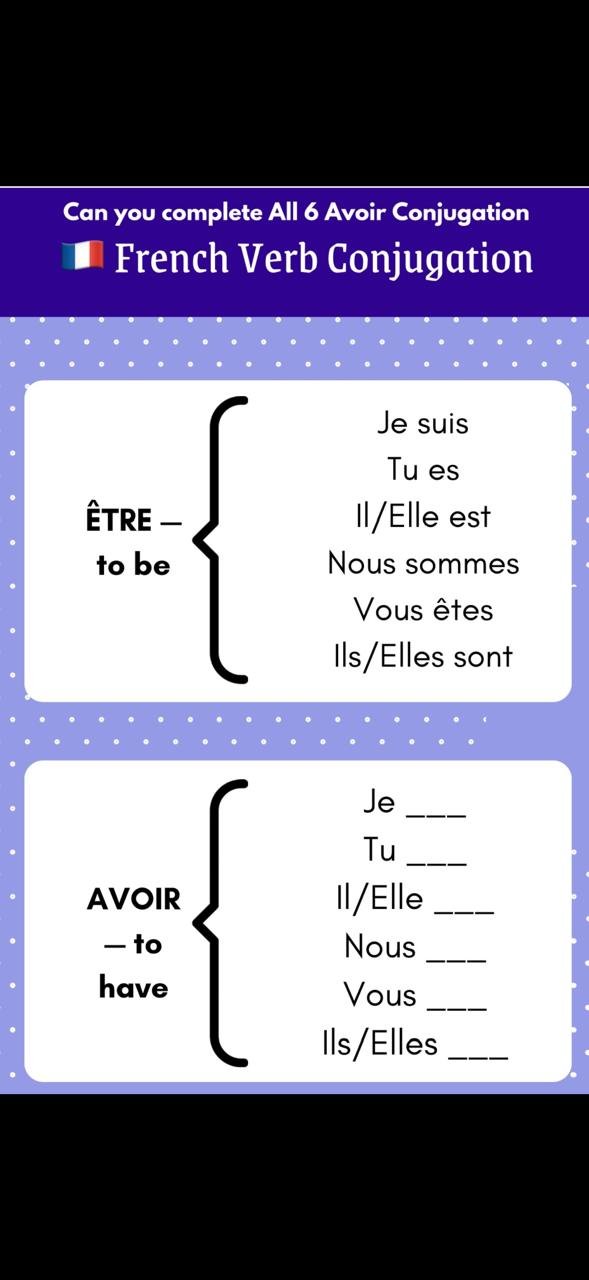
    🇫🇷 Être Conjugation

    Je → suis
    Tu → es
    Il / Elle → est
    Nous → sommes
    Vous → êtes
    Ils / Elles → sont

    Examples With Être

    Je suis étudiant.
    = I am a student.

    Tu es gentil.
    = You are kind.

    Elle est française.
    = She is French.

    Nous sommes prêts.
    = We are ready.

    Vous êtes fatigués.
    = You are tired.

    Ils sont à Paris.
    = They are in Paris.


    🎯 10-Second Être Challenge

    Don’t look back at the table.

    Complete these sentences:

    1. Je ___ français.

    2. Nous ___ étudiants.

    3. Ils ___ fatigués.

    Think about your answers.

    ✅ Answers

    1. Je suis français.

    2. Nous sommes étudiants.

    3. Ils sont fatigués.

    How many did you get right?


    🇫🇷 Avoir Conjugation

    Now let’s learn the present-tense forms of avoir.

    Subject Avoir
    Je ai
    Tu as
    Il / Elle a
    Nous avons
    Vous avez
    Ils / Elles ont

    Examples With Avoir

    J’ai un livre.
    = I have a book.

    Tu as une voiture.
    = You have a car.

    Elle a un frère.
    = She has a brother.

    Nous avons une maison.
    = We have a house.

    Vous avez une question.
    = You have a question.

    Ils ont deux enfants.
    = They have two children.


    🧠 Avoir Quick Challenge

    Complete these sentences:

    1. J’___ un chien.

    2. Tu ___ une question.

    3. Nous ___ une voiture.

    4. Ils ___ deux enfants.

    ✅ Answers

    1. J’ai un chien.

    2. Tu as une question.

    3. Nous avons une voiture.

    4. Ils ont deux enfants.


    🚨 French Doesn’t Always Think Like English

    This is where many beginners make mistakes.

    Sometimes English uses “to be”, but French uses avoir.

    Look at these examples:

    English Correct French
    I am hungry. J’ai faim.
    I am thirsty. J’ai soif.
    I am cold. J’ai froid.
    I am afraid. J’ai peur.
    I am 20 years old. J’ai 20 ans.

    🧠 Easy Memory Trick

    Remember these common expressions as complete phrases:

    J’ai faim.
    J’ai soif.
    J’ai froid.
    J’ai peur.
    J’ai 20 ans.

    Don’t translate them word-for-word from English.


    🎂 How to Say Your Age in French

    This is a very common beginner mistake.

    English:

    I am 20 years old.

    French:

    J’ai vingt ans.

    French uses avoir when expressing age.

    You can ask:

    Quel âge as-tu ?
    = How old are you?

    And answer:

    J’ai vingt ans.
    = I am twenty years old.

    💡 Remember: Don’t say Je suis vingt ans.

    Say:

    J’ai vingt ans. ✅


    🍽️ Common Expressions With Avoir

    Here are some useful expressions you should memorize as complete phrases.

    avoir faim = to be hungry

    avoir soif = to be thirsty

    avoir froid = to be cold

    avoir chaud = to be hot

    avoir peur = to be afraid

    avoir besoin de = to need

    avoir envie de = to feel like / want

    Learning these as complete expressions will make them easier to remember.


    🎯 Être or Avoir? Choose the Correct Verb

    Now let’s test your understanding.

    1. Je ___ fatigué.

    A. suis
    B. ai

    2. J’___ faim.

    A. suis
    B. ai

    3. Tu ___ une voiture.

    A. es
    B. as

    4. Nous ___ étudiants.

    A. sommes
    B. avons

    5. J’___ vingt-cinq ans.

    A. suis
    B. ai

    6. Elle ___ française.

    A. est
    B. a

    7. Nous ___ froid.

    A. sommes
    B. avons

    8. Ils ___ une maison.

    A. sont
    B. ont

    9. Tu ___ peur.

    A. es
    B. as

    10. Vous ___ prêts.

    A. êtes
    B. avez


    🚨 Can You Spot the Mistake?

    Let’s make it a little harder.

    Each sentence contains a mistake. Can you fix it?

    1. Je suis faim.

    ❌ Incorrect

    ✅ J’ai faim.

    2. Je suis 18 ans.

    ❌ Incorrect

    ✅ J’ai 18 ans.

    3. J’ai étudiant.

    ❌ Incorrect

    ✅ Je suis étudiant.

    4. Nous avons fatigués.

    ❌ Incorrect

    ✅ Nous sommes fatigués.

    5. Elle a française.

    ❌ Incorrect

    ✅ Elle est française.

    💡 Tip: Ask yourself: Are you describing what someone is, or something they have?


    🇫🇷 Être vs Avoir in Real-Life French

    Now let’s see how these verbs appear in everyday conversations.

    👋 Meeting Someone

    Je suis étudiant.
    = I am a student.

    Je suis français.
    = I am French.

    🍽️ At a Café

    J’ai faim.
    = I’m hungry.

    J’ai soif.
    = I’m thirsty.

    🎂 Talking About Age

    J’ai 25 ans.
    = I am 25 years old.

    🏠 Talking About Possessions

    J’ai une voiture.
    = I have a car.

    J’ai une maison.
    = I have a house.

    😊 Talking About Your State

    Je suis heureux.
    = I am happy.

    Je suis fatigué.
    = I am tired.

    Notice the pattern:

    Je suis… → describing yourself

    J’ai… → saying what you have or using a common avoir expression.


    🧩 Build Your Own French Sentences

    Now it’s your turn.

    Challenge 1

    Use these words:

    Je + être + étudiant

    ↓

    Je suis étudiant.

    Challenge 2

    Use these words:

    J’ + avoir + 20 ans

    ↓

    J’ai 20 ans.

    Challenge 3

    Complete this sentence:

    Je ___ faim.

    Think before checking.

    ↓

    J’ai faim.

    Challenge 4

    Now create your own sentence using être.

    For example:

    Je suis fatigué.

    Now create one using avoir.

    For example:

    J’ai un livre.

    🎯 Can you create two French sentences—one with être and one with avoir?


    🧠 Easy Way to Remember Être vs Avoir

    If you’re still confused, use this simple starting rule:

    Être → What or Who You ARE

    Je suis étudiant.

    Je suis français.

    Je suis fatigué.

    Avoir → What You HAVE

    J’ai un livre.

    J’ai une voiture.

    J’ai un chien.

    But remember that French also uses avoir in several common expressions:

    J’ai faim.

    J’ai soif.

    J’ai peur.

    J’ai froid.

    J’ai 20 ans.

    The more you practice these expressions, the more natural they will become.


    🏆 Final Être vs Avoir Challenge

    You’ve learned the rules. Now let’s see if you can use them without looking back.

    1. I am tired.

    Je ___ fatigué.

    2. I am hungry.

    J’___ faim.

    3. She is French.

    Elle ___ française.

    4. I am 20 years old.

    J’___ vingt ans.

    5. We are students.

    Nous ___ étudiants.

    6. They have a car.

    Ils ___ une voiture.

    7. You are afraid.

    Tu ___ peur.

    8. We are cold.

    Nous ___ froid.

    9. I have a book.

    J’___ un livre.

    10. He is tired.

    Il ___ fatigué.


    ✅ Answers

    1. Je suis fatigué.

    2. J’ai faim.

    3. Elle est française.

    4. J’ai vingt ans.

    5. Nous sommes étudiants.

    6. Ils ont une voiture.

    7. Tu as peur.

    8. Nous avons froid.

    9. J’ai un livre.

    10. Il est fatigué.

    📊 How Did You Score?

    9–10 correct: Excellent! 🇫🇷 You have a strong understanding of être vs avoir.

    7–8 correct: Very good! 👏 Review the expressions with avoir once more.

    5–6 correct: Keep practicing! 💪 You’re getting there.

    Below 5: Don’t worry. Go back to the examples and try the challenge again.


    📄 Free Être vs Avoir Worksheet

    Think you’ve mastered the difference?

    Now put your knowledge to the test with our Free Être vs Avoir Worksheet.

    The worksheet is useful for:

    • Self-study
    • French class practice
    • Homeschooling
    • Revision

    👉 [DOWNLOAD THE FREE ÊTRE VS AVOIR WORKSHEET]


    📚 Want More French Learning Resources?

    If you’re building your French vocabulary and grammar step by step, you may also enjoy our guide to the Top French Books for Beginners.

    These resources can help you continue practicing French beyond this lesson.

    👉 [“Top 5 French Books for Beginners”]

    💡 Tip: Don’t try to study everything at once. Choose one topic, practice it, and then move to the next lesson.


    🚀 What’s Next?

    Now that you know the difference between être and avoir, it’s time to use them in more everyday French sentences.

    Continue your French learning journey with our guide to:

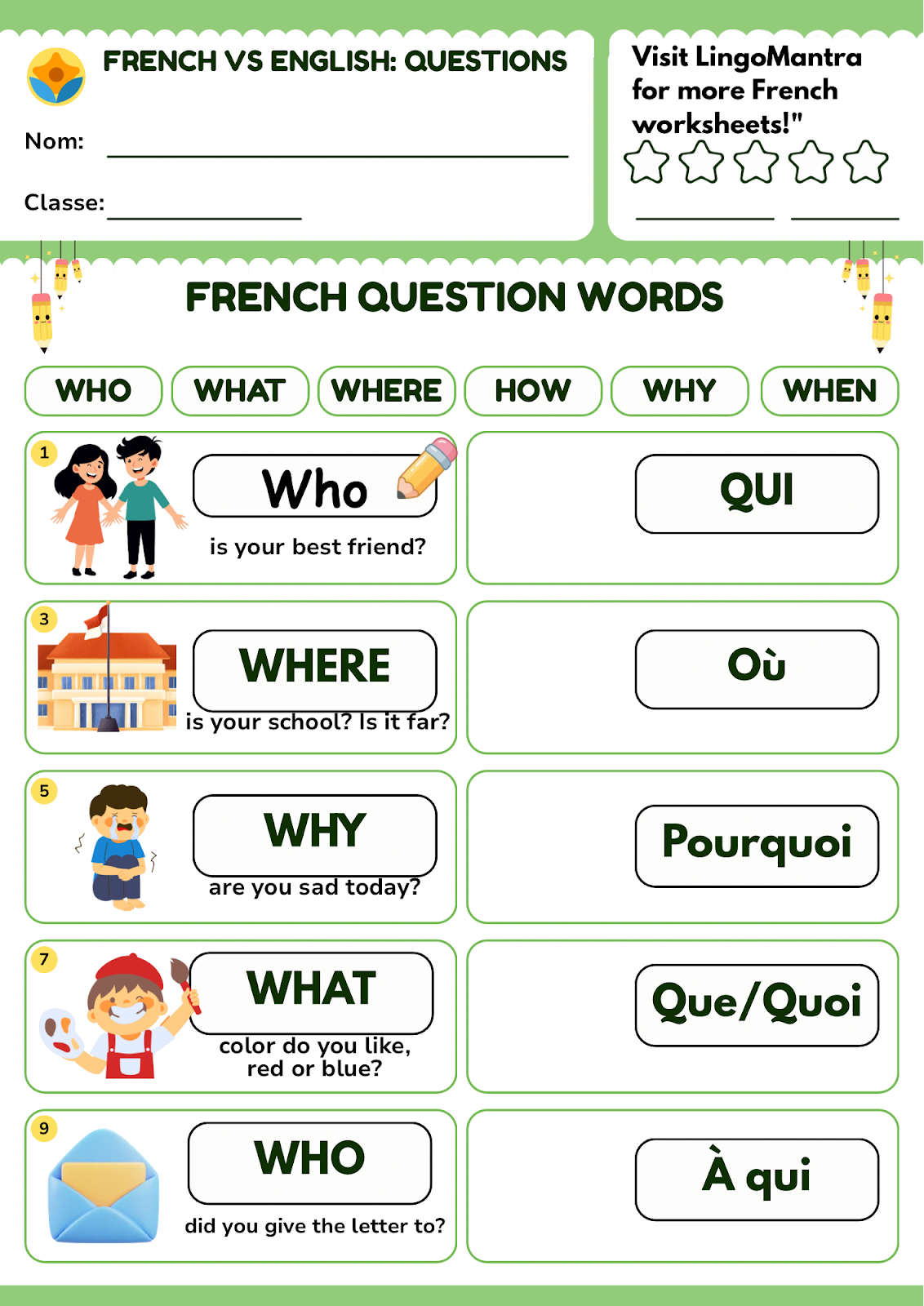
    👉 [“French Question Words”]

    Learn how to ask:

    Qui ? = Who?

    Que / Quoi ? = What?

    Où ? = Where?

    Comment ? = How?

    Pourquoi ? = Why?

    Quand ? = When?

    Keep practicing, keep building sentences, and keep learning French with LingoMantra! 🇫🇷

  • French Question Words: 7 Essential Words You Need to Know

    French Question Words: 7 Essential Words You Need to Know

    Welcome to LingoMantra! If you are aiming to speak French fluently, learning how to ask questions is one of your first important steps. Questions keep conversations going, help you navigate new places, and allow you to clarify things when you don’t understand.


    Imagine you are in France and want to ask:

    “Where is the train station?”

    “When does the train leave?”

    “Why is it closed?”

    You don’t need hundreds of French words to start asking useful questions. You first need a few powerful words:

    Qui · Que · Où · Comment · Pourquoi · Quand · Quel

    Master these question words, and you’ll be able to build dozens of everyday French questions.

    In this guide, you’ll learn their meanings, pronunciation, grammar, real-life examples, and how to build your own French questions.

    🎯 Quick Challenge: Can you guess what Où means before you continue?

    A. Who
    B. Where
    C. Why
    D. When

    Don’t worry if you don’t know yet. You’ll find the answer below.

    French Question Words: Quick Reference

    Let’s start with the basics. These are the most important French question words every beginner should know.

    English French

    Who

    Qui- kee


    What

    Que / Quoi- kuh/kwah


    Where

    Où- oo


    How

    Comment- Koh-mahn


    Why

    Pourquoi- poor-kwah


    When

    Quand- Kahn


    Which / What

    Quel / Quelle- kel


    🧠 Quick Memory Check

    Before moving on, try these:

    1. Which French word means “Where”?

    A. Qui
    B. Où
    C. Quand
    D. Pourquoi

    Answer: B — Où

    2. Which French word means “When”?

    A. Comment
    B. Qui
    C. Quand
    D. Quoi

    Answer: C — Quand

    If you got both right, you’re ready for the next level.


    1. Qui = Who?

    Imagine you meet someone new and want to ask:

    “Who is your teacher?”

    In French:

    Qui est ton professeur ?

    💡 Qui = Who

    Qui is used when asking about a person.

    Real-Life Examples

    Qui est ton meilleur ami ?
    = Who is your best friend?

    Qui est cette personne ?
    = Who is this person?

    Qui vient ce soir ?
    = Who is coming tonight?

    🧩 Try It Yourself

    How would you ask:

    “Who is your French teacher?”

    A. Qui est ton professeur de français ?
    B. Où est ton professeur de français ?
    C. Quand est ton professeur de français ?

    Take a guess before checking.

    ✅ Answer: A


    2. Que / Quoi = What?

    Now let’s talk about one of the most useful French question words: What.

    French has two common forms:

    Que
    Quoi

    They can both mean “what”, but their positions in a sentence are different.

    Que

    Que is commonly used at the beginning of a question.

    Example:

    Que fais-tu ?
    = What are you doing?

    Another example:

    Que veux-tu ?
    = What do you want?

    Quoi

    Quoi is often used at the end of an informal question or after a preposition.

    Example:

    Tu fais quoi ?
    = What are you doing?

    De quoi parles-tu ?
    = What are you talking about?

    🚨 Spot the Difference

    Which one sounds correct?

    _____ fais-tu ?

    A. Que
    B. Quoi

    Think first…

    ✅ Answer: Que

    Que fais-tu ?

    Now try this one:

    Tu fais _____ ?

    A. Que
    B. Quoi

    ✅ Answer: Quoi

    Tu fais quoi ?

    💡 Beginner Tip: Don’t worry about mastering every exception immediately. Start by remembering Que for questions like Que fais-tu ? and Quoi for common informal questions like Tu fais quoi ?


    3. Où = Where?

    Imagine you’re visiting Paris and you can’t find the train station.

    You want to ask:

    “Where is the train station?”

    In French:

    Où est la gare ?

    💡 Où = Where

    Real-Life Examples

    Où habites-tu ?
    = Where do you live?

    Où est l’hôtel ?
    = Where is the hotel?

    Où allez-vous ?
    = Where are you going?

    ⚠️ Important: Où vs Ou

    Be careful with the accent.

    Où = where
    Ou = or

    Compare:

    Où est ton école ?
    = Where is your school?

    Tu veux du thé ou du café ?
    = Do you want tea or coffee?

    That small accent changes the meaning completely.

    🧠 Quick Check

    Which sentence means “Where do you live?”

    A. Où habites-tu ?
    B. Ou habites-tu ?
    C. Quand habites-tu ?

    ✅ Answer: A — Où habites-tu ?


    4. Comment = How?

    Comment is used when asking how something happens or how someone does something.

    💡 Comment = How

    For example:

    Comment vas-tu ?
    = How are you?

    Comment tu t’appelles ?
    = What is your name?

    Comment fais-tu cela ?
    = How do you do that?

    🇫🇷 Real Conversation

    A: Comment vas-tu ?
    B: Je vais bien, merci !

    =
    A: How are you?
    B: I’m doing well, thank you!

    🎯 Your Turn

    How would you ask:

    “How do you learn French?”

    A. Pourquoi apprends-tu le français ?
    B. Comment apprends-tu le français ?
    C. Où apprends-tu le français ?

    ✅ Answer: B — Comment apprends-tu le français ?


    5. Pourquoi = Why?

    Sometimes you don’t just want information—you want a reason.

    That’s when you use:

    💡 Pourquoi = Why

    Example:

    Pourquoi apprends-tu le français ?
    = Why are you learning French?

    Pourquoi es-tu triste aujourd’hui ?
    = Why are you sad today?

    Pourquoi est-il fermé ?
    = Why is it closed?

    The Magic Answer: Parce que

    When answering a question that starts with Pourquoi, you will often use:

    Parce que = Because

    Example:

    Pourquoi apprends-tu le français ?

    Parce que j’aime la France.

    = Why are you learning French?

    = Because I love France.

    🧩 Complete the Answer

    Pourquoi étudies-tu le français ?

    Parce que ____________.

    Try creating your own answer.

    For example:

    Parce que j’aime le français.


    6. Quand = When?

    Quand is used when asking about time, dates, or when something will happen.

    💡 Quand = When

    Examples:

    Quand arrives-tu ?
    = When are you arriving?

    Quand commence le cours ?
    = When does the class start?

    Quand est ton anniversaire ?
    = When is your birthday?

    📅 Use Quand With Days

    This is where knowing the days of the week becomes especially useful.

    For example:

    Quand travailles-tu ?
    = When do you work?

    Je travaille lundi.
    = I work on Monday.

    Want to learn all seven days in French?

    👉 Continue with our guide to French Days of the Week.

    [LINK “French Days of the Week” TO YOUR DAYS ARTICLE HERE]

    🧠 Quick Challenge

    How would you ask:

    “When do you arrive?”

    A. Où arrives-tu ?
    B. Pourquoi arrives-tu ?
    C. Quand arrives-tu ?

    ✅ Answer: C


    7. Quel / Quelle = Which / What?

    Now let’s move to a slightly more advanced question word.

    Quel and Quelle are used when asking about a specific noun.

    They change according to the gender and number of the noun.

    For example:

    Quel livre lis-tu ?
    = Which book are you reading?

    Quelle couleur aimes-tu ?
    = Which color do you like?

    Notice that couleur is feminine, so we use:

    Quelle

    🧠 Remember

    Quel → masculine singular
    Quelle → feminine singular

    You will also see:

    Quels → masculine plural
    Quelles → feminine plural

    Don’t worry if this seems difficult at first. Focus on recognizing the pattern, and you’ll become more comfortable with practice.

    🎯 Quick Quiz

    Which sentence is correct?

    A. Quel couleur aimes-tu ?
    B. Quelle couleur aimes-tu ?

    ✅ Answer: B


    How to Form Questions in French

    Knowing the question word is only half the battle.

    You also need to know how to build the question.

    French commonly uses three structures.

    1. Formal: Inversion

    In formal French, the subject and verb can switch places.

    Où vas-tu ?
    = Where are you going?

    Quand arrives-tu ?
    = When are you arriving?

    This structure is common in formal writing and more formal speech.


    2. Standard: Est-ce que

    For beginners, Est-ce que is one of the easiest structures to learn.

    You place it after the question word.

    Où est-ce que tu vas ?
    = Where are you going?

    Quand est-ce que tu arrives ?
    = When are you arriving?

    Pourquoi est-ce que tu apprends le français ?
    = Why are you learning French?

    💡 Beginner Tip: If you’re unsure how to form a question, question word + est-ce que + subject + verb is a very useful pattern to remember.


    3. Informal: Intonation

    In everyday conversation, French speakers can also keep the normal sentence structure and use their voice to turn it into a question.

    Tu vas où ?
    = Where are you going?

    Tu fais quoi ?
    = What are you doing?

    Tu arrives quand ?
    = When are you arriving?

    This is common in casual spoken French.


    🧩 Build Your Own French Questions

    Now it’s your turn.

    Don’t look at the answer immediately.

    Challenge 1

    Arrange these words:

    Où + tu + habites

    Can you make a complete question?

    ↓

    Où est-ce que tu habites ?

    = Where do you live?


    Challenge 2

    Arrange these:

    Quand + tu + travailles

    ↓

    Quand est-ce que tu travailles ?

    = When do you work?


    Challenge 3

    Try this one yourself:

    Pourquoi + tu + apprends + le français

    Think for a few seconds.

    ↓

    Pourquoi est-ce que tu apprends le français ?

    = Why are you learning French?

    🎯 Can you create one French question of your own?

    Use any question word from this lesson.


    🚨 Can You Spot the Mistake?

    Let’s see if you really understand the difference.

    Question 1

    Which is correct?

    A. Ou est la gare ?
    B. Où est la gare ?

    ✅ Answer: B


    Question 2

    Which is correct?

    A. Que fais-tu ?
    B. Quoi fais-tu ?

    ✅ Answer: A


    Question 3

    Which sentence asks “Why are you learning French?”

    A. Quand apprends-tu le français ?
    B. Pourquoi apprends-tu le français ?
    C. Où apprends-tu le français ?

    ✅ Answer: B


    🇫🇷 French You Can Actually Use

    Here are some questions you can use in real-life situations.

    🚆 At a Train Station

    Où est la gare ?
    = Where is the train station?

    Quand part le train ?
    = When does the train leave?


    🍽️ At a Restaurant

    Qu’est-ce que vous recommandez ?
    = What do you recommend?

    Quel plat est populaire ?
    = Which dish is popular?


    🏨 At a Hotel

    Où est ma chambre ?
    = Where is my room?

    Quand est le petit-déjeuner ?
    = When is breakfast?


    👋 Meeting Someone

    Comment tu t’appelles ?
    = What is your name?

    D’où viens-tu ?
    = Where are you from?

    🗣️ Starting a Conversation

    Once you know these question words, you can use them to start simple conversations in French.

    For example, when meeting someone who is learning French, you can ask:

    Comment tu t’appelles ?
    = What is your name?

    D’où viens-tu ?
    = Where are you from?

    Pourquoi apprends-tu le français ?
    = Why are you learning French?

    Quand as-tu commencé à apprendre le français ?
    = When did you start learning French?

    You can also keep the conversation going by asking:

    Tu habites où ?
    = Where do you live?

    Tu fais quoi dans la vie ?
    = What do you do?

    Tu apprends le français depuis combien de temps ?
    = How long have you been learning French?

    💡 Tip: Don’t try to memorize all of these sentences at once. Choose two or three questions, practice saying them aloud, and then try using them in your own conversation.

    🎯 Mini Conversation Challenge

    Imagine you have just met a French speaker.

    Can you ask these three questions?

    1. What is your name?
    → Comment tu t’appelles ?

    2. Where are you from?
    → D’où viens-tu ?

    3. Why are you learning French?
    → Pourquoi apprends-tu le français ?

    Now try answering them yourself in French.

    For example:

    Je m’appelle Alex.
    Je viens d’Inde.
    J’apprends le français parce que j’aime la langue française.

    This is how individual question words become real French conversation.

    Free French Worksheet Preview
    👉 Continue learning with our guide to French Question Words
  • 5 Best French Books for Beginners in 2026 Guide: Learn French at Home

    Learning French from scratch can feel confusing at first.

    You learn a few words, then encounter unfamiliar grammar, confusing verb conjugations, and suddenly you don’t know what to study next.

    The good news? The right French book can give your learning journey some structure.

    If you’re a complete beginner and want to learn French through self-study, we’ve selected 5 highly recommended French books and learning resources that cover different needs — grammar, exercises, vocabulary, reading, and quick reference.

    But don’t worry — you don’t need to buy all five.

    By the end of this guide, you’ll know which one is best for your learning style.

    First: What Kind of French Learner Are You?

    Before choosing a book, ask yourself one simple question:

    What do I struggle with most?

    • 📚 Grammar confuses me → Start with Easy French Step-by-Step
    • ✍️ I learn by doing exercises → Try Practice Makes Perfect
    • 🧠 I need more vocabulary → Try the 201 French Words flashcards
    • 📖 I want to read French stories → Try Short Stories in French for Beginners
    • 🔎 I need a reliable reference → Get the Merriam-Webster French-English Dictionary

    Now let’s look at each option in detail.

    1. Best Overall Grammar Guide: “Easy French Step-by-Step”

    If you’re starting French from zero and want a clear, structured introduction to grammar, Easy French Step-by-Step by Myrna Bell Rochester is an excellent place to begin.

    Instead of throwing complicated French grammar at you all at once, the book gradually introduces concepts and builds on what you’ve already learned.

    What You’ll Learn

    The book focuses on:

    • Basic French grammar
    • High-frequency vocabulary
    • Sentence construction
    • Verb usage
    • Practice exercises
    • Building progressively more complex sentences

    👍 Why Beginners Like It

    One of its biggest advantages is its step-by-step approach.

    If you’ve ever opened a French grammar book and thought, “Where am I supposed to start?”, a structured book like this can make self-study much easier.

    👤 Best For:

    Absolute beginners who want to understand how French sentences work.

    ⚠️ One Thing to Keep in Mind

    This is primarily a grammar-focused resource. If your biggest goal is conversational practice or reading stories, you may want to combine it with another resource.


    2. Best for Practicing Exercises: “Practice Makes Perfect: Complete French All-in-One”

    Do you learn better when you practice instead of just reading explanations?

    Then Practice Makes Perfect: Complete French All-in-One by Annie Heminway may be a better fit.

    This comprehensive book brings together grammar, vocabulary, verbs, and exercises in one place.

    It’s easy to read a grammar explanation and think:

    “Yes, I understand that.”

    Then you try to create your own French sentence and suddenly forget everything.

    That’s why exercises matter.

    They force you to actively use what you’ve learned rather than simply recognizing it.

    👍 Why It’s Useful

    You get:

    • Grammar explanations
    • Vocabulary practice
    • Verb and tense exercises
    • Numerous practice activities
    • A comprehensive all-in-one format

    👤 Best For:

    Learners who enjoy worksheets, repetition, and hands-on practice.

    💡 Study Tip

    Don’t try to finish huge sections in one sitting.

    Instead, study one concept and then complete the exercises without looking back at the explanation.

    That small habit can make your study sessions much more effective.


    3. Best for Enhancing Vocabulary: “201 French Words You Need to Know Flashcards”

    Grammar is important, but you also need words if you want to understand and communicate in French.

    That’s where vocabulary flashcards can help.

    201 French Words You Need to Know Flashcards by Barron’s focuses on common French words, verbs, and expressions.

    Why Use Flashcards?

    Imagine learning 10 new words today.

    Tomorrow, you remember 7.

    A few days later, you remember 4.

    That’s completely normal.

    Flashcards give you an easy way to repeatedly review vocabulary until the words become easier to recall.

    👍 Why It’s Useful

    The cards are:

    • Portable
    • Organized by topic
    • Easy to review
    • Designed for quick study sessions
    • Useful for vocabulary building

    👤 Best For:

    Beginners who feel that they understand grammar but don’t know enough French words.

    ⏱️ Quick Study Challenge

    Try this:

    Learn 5 new French words per day.

    At the end of one month, that’s up to 150 words you’ve repeatedly encountered.

    Small daily progress can be easier to maintain than trying to memorize hundreds of words in one weekend.


    4. Best for Immersion & Reading: “Short Stories in French for Beginners”

    Here’s a common problem with language learning:

    You can study grammar rules for months…

    …but when you see an actual French paragraph, it still looks intimidating.

    Reading beginner-friendly stories can help bridge that gap.

    Short Stories in French for Beginners by Olly Richards uses short stories written for beginner-level learners, allowing you to encounter French vocabulary and sentence structures in context.

    Why Stories Can Make Learning More Interesting

    Compare these two approaches:

    Approach A:
    Memorize a random list of 20 French words.

    Approach B:
    Encounter those words while following a story.

    The second approach can make vocabulary easier to connect with meaning because you’re seeing words inside a context.

    👍 Why It’s Useful

    • Shorter reading passages
    • Beginner-friendly French
    • Vocabulary learned through context
    • Helpful glossary
    • More engaging than isolated grammar drills

    👤 Best For:

    Beginners who want to start reading French without immediately jumping into difficult novels.

    💡 Try This While Reading

    Don’t stop every few seconds to translate every single word.

    Instead:

    1. Read the paragraph once.
    2. Try to understand the general meaning.
    3. Identify unfamiliar words.
    4. Check their meanings.
    5. Read the paragraph again.

    This turns reading into an active learning exercise.


    5. Best for Quick Reference: “Merriam-Webster’s French-English Dictionary”

    Even with modern translation apps, having a reliable dictionary can still be useful when you’re studying seriously.

    Merriam-Webster’s French-English Dictionary provides a convenient way to look up French and English words while studying.

    What Can You Use It For?

    You can use a dictionary to:

    • Check word meanings
    • Verify spelling
    • Look up unfamiliar vocabulary
    • Check French-English equivalents
    • Quickly reference words while reading
    👤 Best For:

    Learners who read frequently and want a dependable reference resource.

    It’s also useful alongside your main French textbook rather than as your only learning resource.


    Which FRENCH Book should you buy?

    Still not sure?

    Here’s the quick version:

    Your Goal                 
    Learn French grammar  – Easy French Step-by-Step
    Practice what you learn  – Practice Makes Perfect
    Build vocabulary –   201 French Words
    Start reading French  – Short Stories in French for Beginners
    Look up words quickly   – Merriam-Webster Dictionary

    ⭐ Our Pick for Complete Beginners

    If you’re starting from scratch, we’d choose:

    Easy French Step-by-Step + Short Stories in French for Beginners

    Why?

    Because the two resources complement each other.

    One helps you understand how French works, while the other gives you an opportunity to encounter French in a more natural reading context.

    You don’t necessarily need five different books.

    Start with one main resource and build from there.


    🎯 Quick French Learning Challenge

    Want to make your study sessions more effective?

    Try this simple 20-minute French routine:

    ⏰ 5 Minutes — Vocabulary

    Learn or review 5–10 French words.

    📚 10 Minutes — Main Lesson

    Study one grammar concept or complete a few exercises.

    📖 5 Minutes — French Reading

    Read a short French paragraph or story.

    That’s it.

    You don’t need to spend three hours studying every day to make progress. Consistency matters more than having one giant study session once a week.

    Ready for Your Next French Lesson?

    10 Essential French Verbs for Beginners with Audio Pronunciation


    💬 One More Question Before You Go…

    What is your biggest problem with learning French right now?

    A. Grammar
    B. Vocabulary
    C. Pronunciation
    D. Understanding spoken French
    E. Speaking confidently

    Knowing your biggest difficulty can help you choose the right type of learning resource.


    Final Buying Tip

    Before purchasing any French learning book, use Amazon’s “Look Inside” feature whenever available.

    Look at a few sample pages and ask yourself:

    “Would I actually enjoy studying this book every week?”

    The best French textbook isn’t necessarily the one with the most pages.

    It’s the one you’ll actually open, study, and keep using.

    Amazon Affiliate Disclaimer: As an Amazon Associate, I earn from qualifying purchases at no extra cost to you. This helps support our site to keep creating free language learning guides.
  • Everyday Life French Quiz for Beginners (A1) – Answer Key & Explanations

     Are you learning French and want to test your daily conversation skills? If you came here from our Pinterest Quiz, you are in the right place!

    Below you will find the correct answers for all the everyday life quiz questions, along with helpful English translations and explanations to improve your French vocabulary.

    Ready?

    Let’s check your score! 🇫🇷


    🧠 Questions 1–5: How Did You Do?

    1. Feeling Unwell 🤒

    Question: If you’re feeling unwell, what might you say to a friend?

    ✅ Correct Answer: d) Je ne me sens pas bien.

    Meaning: “I am not feeling well.”

    This is a very useful everyday phrase when you’re feeling sick or simply don’t feel okay.

    ❌ Il fait beau = The weather is nice.

    ❌ Bonne journée = Have a good day.

    💡 Remember:

    Je ne me sens pas bien.
    = I don’t feel well.


    2. Looking for a Movie 🎬

    Question: What might you check when you want to watch a specific movie?

    ✅ Correct Answer: a) Regarder le programme de cinéma.

    Meaning: “Check the movie schedule/program.”

    The important vocabulary here is:

    programme de cinéma = movie schedule/program

    ❌ Vérifier les horaires de bus = Check the bus schedule.

    So unless you’re trying to catch a bus instead of a movie, that’s not the answer! 😄


    3. A Synonym for “Happy” 😊

    ✅ Correct Answer: c) Joyeux

    Meaning: “Joyful / Happy”

    This is a useful synonym to add to your French vocabulary.

    ❌ Triste = Sad

    ❌ Fatigué = Tired

    🧠 Quick memory check:

    joyeux → happy

    triste → sad


    4. Another Word for “Nice” 👍

    ✅ Correct Answer: c) Gentil

    Meaning: “Kind / Nice”

    You can use gentil when describing someone who is kind or nice.

    ❌ Méchant = Mean / Bad

    ❌ Impoli = Rude

    So if someone is kind to you:

    Il est gentil.
    “He is nice.”


    5. Asking to Borrow Something ✏️

    ✅ Correct Answer: b) Puis-je emprunter ton stylo ?

    Meaning: “May I borrow your pen?”

    This is a great everyday phrase.

    The key verb is:

    emprunter = to borrow

    ❌ Prends ton stylo = Take your pen.

    Notice the difference:

    emprunter → borrow

    prendre → take


    🔥 Questions 6–12: The Challenge Gets Harder

    Think you know beginner French?

    Let’s see how you do with the second half!


    6. You’re Hungry 🍞

    If you’re hungry and want to eat something, what might you say?

    ✅ Correct Answer: c) Je vais faire un sandwich.

    Meaning: “I am going to make a sandwich.”

    The other options mean:

    ❌ Je vais dormir. = I am going to sleep.

    ❌ Je vais lire un livre. = I am going to read a book.

    ❌ Je vais regarder la télé. = I am going to watch TV.

    💡 Useful pattern:

    Je vais + verb

    = “I am going to…”


    7. Synonym for “Big” 📏

    ✅ Correct Answer: b) Grand

    Meaning: “Big / Tall”

    Grand is one of those essential French words you’ll encounter constantly.

    ❌ Tout petit = Very small / Tiny

    ❌ Petit = Small / Short

    ❌ Minuscule = Tiny / Minuscule


    8. Neither Hot Nor Cold 🌡️

    Here’s a slightly trickier one.

    Which word describes something that is neither hot nor cold?

    ✅ Correct Answer: c) Tiède

    Meaning: “Lukewarm”

    Think about bath water or milk that’s warm but not actually hot.

    tiède = lukewarm

    Compare:

    🔥 chaud = hot

    ❄️ froid = cold

    🌡️ tiède = lukewarm


    9. A Synonym for “Cool / Fresh” 🍃

    ✅ Correct Answer: c) Frais

    Meaning: “Cool / Fresh”

    Frais can describe pleasantly cool temperatures or something fresh, depending on context.

    ❌ Chaud = Hot

    ❌ Doux = Mild / Gentle

    ❌ Chaleureux = Warm-hearted / Welcoming

    ⚠️ Don’t confuse chaleureux with a simple temperature word. It’s often used for people, personalities, or welcoming atmospheres.


    10. What Does “Fast” Mean? 🚀

    ✅ Correct Answer: a) Rapide

    Meaning: “Fast / Quick”

    Easy one!

    rapide = fast

    And here’s the opposite:

    lent = slow

    So:

    🏎️ rapide → fast

    🐢 lent → slow

    ❌ Paresseux = Lazy

    ❌ Calme = Calm / Quiet


    ⏰ 11. You’re Running Late!

    You’re late for an appointment.

    What could you tell someone who’s waiting?

    ✅ Correct Answer: b) Ne t’inquiète pas, je suis en chemin !

    Meaning: “Don’t worry, I am on my way!”

    This is an especially useful phrase for real conversations.

    🧠 Remember:

    Je suis en chemin.

    = I’m on my way.

    The other choices:

    ❌ Génial, on se voit là-bas ! = Great, see you there!

    ❌ Merci d’avoir attendu. = Thanks for waiting.

    ❌ Je pars à l’instant. = I’m leaving right now.


    🎬 12. Want to Go to the Movies?

    And now for the most conversational question of the quiz.

    You’re talking to a friend and want to suggest going to the movies tonight.

    What sounds natural?

    ✅ Correct Answer: b) Ça te dit de te faire un ciné ce soir ?

    Meaning: “Are you up for a movie tonight?”

    This is a casual, conversational way to make the suggestion.

    And un ciné is a shortened informal way of referring to going to the cinema.

    ❌ J’ai besoin de voir un film. = I need to see a movie.

    ❌ Tu peux me prêter de l’argent ? = Can you lend me some money?

    ❌ On va dîner ? = Shall we go to dinner?


    🏆 What’s Your Score?

    Now count how many you got right before checking the explanations.

    10–12 correct 🎉

    Excellent!

    Your everyday French vocabulary is looking strong.

    7–9 correct 🔥

    Great job!

    You already have a solid beginner foundation.

    4–6 correct 👏

    You’re making progress!

    Review the words you missed and try the quiz again later.

    0–3 correct 📚

    Don’t worry!

    That’s exactly what quizzes are for.

    Every mistake shows you what to learn next.


    🧠 3 Simple Ways to Remember These Words

    Don’t just read the answers and leave.

    Try this:

    1. Pick 3 new words.

    For example:

    joyeux — gentil — emprunter

    2. Create one short sentence with each.

    3. Say the sentences out loud.

    Even five minutes of active practice can be more useful than simply rereading a vocabulary list.


    🇫🇷 Ready for Another French Challenge?

    If you enjoyed this quiz, don’t stop here. Continue with the Link below

    👉 [Être vs Avoir in French: Complete Beginner Guide]

    That’s where the real learning happens. 😉

    And remember:

    Don’t just learn French words.

    Use them. Test yourself. Repeat them.

    Little by little, everyday French starts becoming much easier.

    Bonne chance et à bientôt! 🇫🇷✨

  • 5 Common Spanish False Friends You Must Avoid As A Beginner

     You walk into a Spanish-speaking country feeling confident.😎

    You know some English. You know some Spanish.

    Then you say one “easy” Spanish word…

    …and suddenly, you’ve told someone you’re pregnant instead of embarrassed. 🤰😳

    Yep. Spanish has words that look almost exactly like English words but mean something completely different.

    They’re called False Friends — and they’re one of the easiest ways for beginners to accidentally say something they really didn’t mean. 😂

    👀 How many can you get right?

    Embarazada
    Éxito
    Introduce
    Constipado
    Actual

    If you already know all five, you’re ahead of most beginners.

    If not, don’t worry.

    By the end of this guide, you’ll know exactly what these words mean — and, more importantly, what NOT to say. 👇


    Infographic chart explaining Spanish false friends with English meanings like Embarazada and Exito for beginners

    1️⃣ EMBARAZADA 🤰

    Let’s start with the most famous one.

    ❌ What English speakers think:

    Embarrassed

    ✅ What it actually means:

    Pregnant

    Yes. These two words look incredibly similar, but their meanings couldn’t be more different.

    Imagine someone asks you:

    🇪🇸 ¿Estás embarazada?

    They are asking:

    “Are you pregnant?”

    So if you accidentally say:

    🇪🇸 Estoy embarazada.

    You are saying:

    🤰 “I’m pregnant.”

    Not:

    “I’m embarrassed.”

    That’s a pretty important distinction! 😂

    😳 So how do you say “embarrassed”?

    There are several natural ways to express embarrassment in Spanish.

    For example:

    🇪🇸 Estoy avergonzado.
    “I’m embarrassed.”

    For a woman:

    🇪🇸 Estoy avergonzada.

    You can also hear:

    🇪🇸 Me da pena.

    Depending on the context, this can express embarrassment, awkwardness, or feeling shy/uncomfortable.

    🧠 Easy memory trick

    Think:

    EMBARAZADA = BABY 🤰

    Not:

    EMBARRASSED = EMBARAZADA ❌

    One extra “r” in English can save you from a very awkward conversation!


    2️⃣ ÉXITO 🏆

    Now imagine you’re visiting Spain or Latin America.

    You’re inside a shopping mall.

    You need to find the EXIT.

    Then you see this word:

    🇪🇸 ÉXITO

    Your brain immediately goes:

    EXIT! I found it! 🚪

    But…

    Nope. 😂

    ❌ What it looks like:

    Exit

    ✅ What it actually means:

    Success

    For example:

    🇪🇸 ¡Mucho éxito en tu examen!

    means:

    🏆 “Good luck on your exam!”

    You might also hear:

    🇪🇸 La película fue un éxito.

    That means:

    “The movie was a success.”

    So if you see ÉXITO, don’t start looking for a door.

    Start thinking:

    SUCCESS. 🏆

    🚪 So where is the actual exit?

    Look for:

    🇪🇸 SALIDA

    Salida = Exit

    This is the word you’ll want when you’re trying to leave a building.

    🧠 Remember it like this:

    ÉXITO → SUCCESS 🏆

    SALIDA → EXIT 🚪

    🎯 Mini Test

    You’re at a train station and see:

    SALIDA →

    Do you:

    A) Celebrate your success? 🏆
    B) Follow the sign to leave? 🚪

    Obviously:

    B! 😎


    3️⃣ INTRODUCE 📥

    This one is especially tricky because English speakers see the word introduce and immediately know what they think it means.

    But Spanish has a surprise waiting for you.

    ❌ What English speakers expect:

    Introduce someone

    ✅ What Spanish “introducir” can mean:

    To insert / put something in

    For example, imagine you’re using an ATM.

    The machine says:

    🇪🇸 Introduzca su tarjeta.

    or:

    🇪🇸 Introduce la tarjeta.

    You’re being told:

    💳 “Insert your card.”

    You’re definitely not being asked to introduce your bank card to the machine. 😂

    👋 So how do you introduce a person?

    The more useful word is:

    🇪🇸 PRESENTAR

    For example:

    🇪🇸 Te presento a Ana.

    This means:

    “Let me introduce you to Ana.”

    Another example:

    🇪🇸 Quiero presentarte a mi amigo.

    “I want to introduce you to my friend.”

    🧠 Remember:

    Introducir → Insert 📥

    Presentar → Introduce someone 👋

    This tiny difference becomes much easier once you connect each word with a real situation.


    4️⃣ CONSTIPADO 🤧

    Okay, this one deserves your attention.

    Especially if you’re traveling and need to explain how you’re feeling.

    ❌ What English speakers think:

    Constipated

    ✅ What “constipado/a” usually means:

    Having a cold / suffering from nasal congestion

    So if you tell someone:

    🇪🇸 Estoy constipado.

    You’re generally saying:

    🤧 “I have a cold.”

    You are NOT saying:

    🚽 “I’m constipated.”

    Imagine trying to explain a stomach problem to a doctor…

    …but accidentally telling them you have a cold. 😅

    That’s exactly why False Friends are worth learning.

    🚽 So how do you say “constipated”?

    The Spanish word is:

    🇪🇸 Estreñido/a

    For example:

    🇪🇸 Estoy estreñido.

    means:

    “I’m constipated.”

    🧠 Quick comparison

    Constipado/a → Cold 🤧

    Estreñido/a → Constipated 🚽

    ⚠️ One important note

    Vocabulary can vary between regions, and everyday medical language isn’t always identical across all Spanish-speaking countries.

    But as a beginner, remembering this basic distinction will help you avoid a very common misunderstanding.


    5️⃣ ACTUAL 📅

    This one is sneaky because the spelling is exactly the same as the English word:

    ACTUAL

    Surely it means the same thing, right?

    Wrong. 😅

    ❌ English meaning:

    Actual = Real / True / Existing in fact

    🇪🇸 Spanish meaning:

    Actual = Current / Present

    For example:

    🇪🇸 El presidente actual

    means:

    “The current president.”

    Not:

    “The real president.”

    Another example:

    🇪🇸 La situación actual

    means:

    “The current situation.”

    So whenever you see actual in Spanish, think:

    📅 CURRENT

    💡 What if you want to say “actual/real” in Spanish?

    Depending on the context, you can use:

    Real → Real

    or:

    Verdadero/a → True / Genuine

    For example:

    🇪🇸 Es una historia real.

    “It’s a real story.”

    And:

    🇪🇸 Es una historia verdadera.

    “It’s a true story.”

    🧠 Easy memory trick

    Actual → Current 📅

    Real → Real ✅


    🎯 Can You Remember All 5?

    Let’s make it harder.

    Don’t look back.

    What do these Spanish words mean?

    1. Embarazada

    A) Embarrassed
    B) Pregnant

    2. Éxito

    A) Exit
    B) Success

    3. Introducir

    A) Introduce someone
    B) Insert / put in

    4. Constipado

    A) Constipated
    B) Having a cold

    5. Actual

    A) Real
    B) Current

    👇 Answers

    1 → B 🤰

    2 → B 🏆

    3 → B 📥

    4 → B 🤧

    5 → B 📅

    Did you get all five?

    🔥 5/5: You’re ready for the next level.

    😎 3–4/5: Pretty good!

    📚 0–2/5: No problem — now you know exactly which words to watch out for.

    False Friends are just one of the little traps waiting for Spanish learners. 😅

    Another question beginners ask all the time is:

    “How do I know if a Spanish word is masculine or feminine?” 🤔

    Luckily, there’s a simple trick that can help you guess the gender of many Spanish words without memorizing every single one.

    👉 Learn the Easy Trick to Guess If a Spanish Word Is Masculine or Feminine →

    Click here to learn the trick before moving on to your next Spanish lesson. 


    🧠 Your Ultimate False Friends Cheat Sheet

    Save this list — you’ll probably come back to it later.

    🇪🇸 Spanish ❌ Looks Like ✅ Actually Means
    Embarazada Embarrassed 🤰 Pregnant
    Éxito Exit 🏆 Success
    Introducir Introduce 📥 Insert
    Constipado/a Constipated 🤧 Cold
    Actual Actual 📅 Current

    ⭐ The 5 words to remember:

    Embarazada = Pregnant

    Éxito = Success

    Introducir = Insert

    Constipado = Cold

    Actual = Current


    💬 Why Do These Words Cause So Many Mistakes?

    There’s a simple reason.

    When you’re learning a new language, your brain tries to save energy.

    If it sees:

    Actual

    your brain doesn’t want to learn a completely new meaning.

    It says:

    “I already know this word!”

    The same thing happens with:

    Éxito → Exit

    Embarazada → Embarrassed

    Constipado → Constipated

    Hasta Luego!

  • How to Speak Spanish Like a Native: 4 Textbook Phrases to Avoid

    You’ve studied Spanish.

    You know the basic grammar.
    You’ve memorized hundreds of words.
    You can even put together a decent sentence. 😎

    Then you finally talk to a native Spanish speaker…

    …and suddenly, you’re thinking:

    “Wait… why does their Spanish sound nothing like what I learned?” 😳

    If this has happened to you, you’re not doing anything wrong.

    There’s a big difference between learning Spanish from a textbook and hearing Spanish in a real conversation.

    Textbooks teach you what is correct.

    Real conversations teach you what sounds natural, casual, and alive.

    And sometimes, changing just one small phrase can make your Spanish sound much more conversational.

    So let’s upgrade your everyday Spanish.

    Here are 4 simple phrases you can start using today — plus a few important tips to help you understand why native Spanish can sound so different from the Spanish you learn in class.


    🗣️ 1. Instead of Always Saying “¿Cómo estás?” → Try “¿Qué tal?”

    Let’s start with something you probably learned on your first day of Spanish.

    🇪🇸 ¿Cómo estás?

    It means:

    “How are you?”

    And here’s the important part:

    ✅ “¿Cómo estás?” is NOT wrong.

    It’s completely correct Spanish.

    So don’t delete it from your vocabulary.

    But there’s another expression you’ll hear all the time in casual conversations:

    🇪🇸 ¿Qué tal?

    Depending on the context, it can mean:

    “How’s it going?”

    “How are things?”

    “What’s up?”

    It’s short, flexible, and very useful.


    💬 See the difference in a conversation

    Imagine you meet a friend on the street.

    You could say:

    🇪🇸 ¡Hola! ¿Cómo estás?

    That’s perfectly natural.

    Or you could say:

    🇪🇸 ¡Hola! ¿Qué tal?

    Also completely natural.

    The second one is simply a shorter, more casual option.

    And that’s the key idea of this article:

    You don’t have to replace correct Spanish.

    You want to add more natural options to your vocabulary.


    🎯 Why “¿Qué tal?” is worth learning

    One great thing about ¿Qué tal? is that you can use it in many situations.

    For example:

    🇪🇸 ¿Qué tal tu día?

    “How’s your day going?”

    Or:

    🇪🇸 ¿Qué tal el trabajo?

    “How’s work going?”

    Or simply:

    🇪🇸 ¿Qué tal?

    “How’s it going?”

    So instead of memorizing a completely new sentence every time, you get one short expression that can work in many everyday situations.

    🧠 Easy upgrade:

    ¿Cómo estás? → How are you?

    ¿Qué tal? → How’s it going?

    Both are useful.

    The trick is knowing when you want a casual alternative.


    👋 2. Instead of “Adiós” → Try “¡Nos vemos!”

    Here’s another phrase almost every beginner learns:

    🇪🇸 Adiós

    It means:

    “Goodbye.”

    Again, there’s nothing grammatically wrong with it.

    But imagine you’re leaving a friend’s house and you know you’ll probably see them again soon.

    You could say:

    🇪🇸 Adiós.

    Or:

    🇪🇸 ¡Nos vemos!

    The second expression literally relates to seeing each other, and naturally communicates:

    “See you!”

    “See you later!”


    💬 A tiny change that feels more conversational

    Imagine this:

    Friend:

    🇪🇸 Bueno, me voy.

    “Alright, I’m leaving.”

    You:

    🇪🇸 ¡Nos vemos!

    “See you!”

    That’s the kind of short exchange you’ll hear in everyday life.

    And because it’s so short, it’s easy to make it part of your active vocabulary.


    🤔 Does that mean “Adiós” sounds bad?

    No.

    This is important.

    Adiós is a normal Spanish word.

    You don’t need to avoid it.

    The problem with beginner Spanish isn’t usually that you’re using wrong words.

    It’s that you may only know one way to express an idea.

    Native speakers have many options.

    Learning those options gives your Spanish more flexibility.

    🧠 Easy upgrade:

    Adiós → Goodbye

    ¡Nos vemos! → See you!


    🙏 3. Instead of Always Saying “De nada” → Try “¡No hay de qué!”

    Someone helps you.

    What do you say?

    🇪🇸 Gracias.

    Of course.

    And the response you’ve probably memorized is:

    🇪🇸 De nada.

    Perfect.

    But here’s another useful expression:

    🇪🇸 ¡No hay de qué!

    Depending on the context, it can communicate:

    “You’re welcome.”

    “Don’t mention it.”

    It’s a nice phrase to recognize because native speakers don’t use only one expression for every situation.


    💬 Here’s how it can sound

    You:

    🇪🇸 Gracias por ayudarme.

    “Thanks for helping me.”

    Friend:

    🇪🇸 ¡No hay de qué!

    “You’re welcome!”

    Simple.

    Natural.

    And now you’ve added another real-world expression to your vocabulary.


    💡 Another phrase worth knowing

    You may also hear:

    🇪🇸 No te preocupes.

    This means:

    “Don’t worry about it.”

    Depending on the situation, it can also be used as a friendly response after someone thanks you.

    So now you have several options:

    De nada

    ¡No hay de qué!

    No te preocupes

    You don’t need to memorize all three today.

    Start with one.

    Then gradually add the others as you encounter them.


    🔥 4. Instead of Always Saying “Muy bien” → Try “¡De lujo!”

    Someone asks:

    🇪🇸 ¿Qué tal?

    You answer:

    🇪🇸 Muy bien.

    Nothing wrong with that.

    But here’s a fun problem:

    If you use Muy bien every single time someone asks how you are, your conversations can start sounding repetitive.

    That’s where expressive phrases can make your Spanish more interesting.

    One phrase you may encounter is:

    🇪🇸 ¡De lujo!

    Depending on context and region, this can communicate something like:

    “Fantastic!”

    “Excellent!”

    “Great!”


    💬 Try it in a conversation

    Friend:

    🇪🇸 ¿Qué tal?

    You:

    🇪🇸 ¡De lujo! ¿Y tú?

    That’s a little more expressive than simply repeating:

    Muy bien.

    And that’s what conversational Spanish is really about.

    Not using complicated words.

    Not showing off.

    Just having more natural choices available.


    ⚡ Your 1-Minute Spanish Upgrade

    Let’s put all four upgrades together.

    👋 When someone asks how you’re doing:

    Instead of always using:

    ¿Cómo estás?

    Try adding:

    ¿Qué tal?


    🚪 When you’re saying goodbye:

    Instead of always using:

    Adiós

    Try:

    ¡Nos vemos!


    🙏 When someone thanks you:

    Instead of always using:

    De nada

    Try:

    ¡No hay de qué!


    😎 When you’re doing great:

    Instead of always using:

    Muy bien

    Try:

    ¡De lujo!


    🧠 But Don’t Make This Beginner Mistake

    After reading this, you might think:

    “Okay! From now on, I’m never going to use ¿Cómo estás?, Adiós, De nada, or Muy bien again.”

    Don’t do that. 😂

    That’s not the goal.

    All four original expressions are useful.

    The real goal is to stop thinking that there is only one correct way to say something in Spanish.

    Think of your vocabulary like a toolbox. 🧰

    If you only have one tool, you can still get the job done.

    But if you have five different tools, you can choose the one that fits the situation.

    That’s what you’re doing here.

    You’re expanding your Spanish toolbox.


    👂 Why Does Real Spanish Sound So Different?

    This is one of the biggest frustrations for Spanish learners.

    You spend months learning Spanish from an app.

    The speaker talks slowly.

    Every word is pronounced clearly.

    The sentences are short.

    You understand almost everything.

    Then you hear two native speakers talking to each other.

    And suddenly:

    “¿Qué están saying?” 😭

    This happens because real conversations are messy.

    People don’t always speak like language-learning recordings.

    They speak quickly.

    They shorten expressions.

    They use fillers.

    They use local vocabulary.

    They interrupt each other.

    They change their tone.

    They don’t always pronounce every word as carefully as your textbook audio.

    And that’s completely normal.


    📚 Textbook Spanish vs Real-Life Spanish

    Think of it this way.

    📖 Textbook Spanish teaches you:

    What words mean

    How grammar works

    How sentences are constructed

    How to communicate clearly

    How to avoid basic mistakes

    These things are extremely important.

    Without them, you won’t have a strong foundation.

    🗣️ Real-life Spanish adds:

    Casual expressions

    Shorter phrases

    Natural reactions

    Regional vocabulary

    Different speaking speeds

    Cultural context

    You need both.

    It’s not:

    Textbook Spanish = Bad ❌

    and:

    Native Spanish = Good ✅

    It’s:

    Textbook Spanish gives you the foundation.

    Real-life Spanish teaches you how people actually use that foundation.


    🎯 You Don’t Need to Learn Slang to Sound Natural

    This is another common misconception.

    Some learners think:

    “If I want to sound fluent, I need to learn lots of slang.”

    Not necessarily.

    In fact, learning too much slang too early can sometimes make things more confusing.

    You don’t need 100 slang expressions.

    Start with simple, common phrases.

    For example:

    ¿Qué tal?

    ¡Nos vemos!

    ¡No hay de qué!

    These are much more useful for a beginner than memorizing obscure expressions that you may never need.

    💡 The goal isn’t to sound “cool.”

    The goal is to sound comfortable.

    There’s a big difference.


    🌎 Does Conversational Spanish Change by Country?

    Absolutely.

    This is one of the most interesting parts of learning Spanish.

    Spanish is spoken in many different countries, and people don’t use exactly the same vocabulary everywhere.

    You may notice differences between:

    🇪🇸 Spain

    🇲🇽 Mexico

    🇨🇴 Colombia

    🇦🇷 Argentina

    🇨🇱 Chile

    🇵🇪 Peru

    …and many other Spanish-speaking regions.

    The basic grammar is shared, but everyday expressions can vary.

    A phrase that’s extremely common in one country may sound less common somewhere else.

    Accents can also change.

    Pronunciation can change.

    Slang can change.

    Even familiar words can have different everyday uses depending on the country.


    ✈️ Traveling? Learn the Spanish You’ll Actually Hear

    If you’re planning a trip, here’s a useful strategy.

    Don’t try to learn every variety of Spanish.

    Instead, focus on the Spanish used in the place you’re visiting.

    For example, if you’re going to Mexico, spend some time listening to Mexican Spanish.

    If you’re visiting Spain, listen to Spanish from Spain.

    This gives your ears time to become familiar with:

    The accent

    The rhythm

    Common expressions

    Everyday vocabulary

    And most importantly:

    The way people actually talk.

    That can make a huge difference when you arrive.


    👀 Here’s Another Easy Spanish Trick You Should Know

    So far, you’ve learned how to make your everyday Spanish sound more natural.

    But there’s another beginner question that comes up constantly:

    “How do I know if a Spanish word is masculine or feminine?”

    At first, it can feel like you have to memorize the gender of every single noun.

    But what if there was a simple trick that lets you make a good guess for many Spanish words? 👀

    There is.

    And once you know the pattern, learning new vocabulary can become much easier.

    👉 [Learn the Easy Trick to Guess If a Spanish Word Is Masculine or Feminine → YOUR-EASY-GENDER-TRICK-URL]

    Click here to learn the easy trick before your next Spanish lesson. 🧠🇪🇸

    It’s a small grammar shortcut, but it can make a big difference when you’re building your vocabulary.


    🧠 How to Actually Make These Phrases Stick

    Reading a phrase once isn’t enough.

    Your brain needs to use it repeatedly before it becomes automatic.

    Here’s a simple method.

    Step 1: Pick ONE phrase

    Don’t try to memorize all four at once.

    Start with:

    ¿Qué tal?

    Use it whenever you want to ask someone how things are going.


    Step 2: Say it out loud

    Even if you’re studying alone.

    Your goal isn’t just to recognize the phrase.

    You want your mouth to become comfortable saying it.


    Step 3: Put it into a tiny conversation

    For example:

    ¿Qué tal?

    Muy bien, ¿y tú?

    That’s enough.

    You don’t need a complicated dialogue.


    Step 4: Add another phrase

    Once ¿Qué tal? feels automatic, move to:

    ¡Nos vemos!

    Then:

    ¡No hay de qué!

    Then:

    ¡De lujo!

    Four small upgrades can become part of your everyday Spanish surprisingly quickly.


    🎯 The “One Phrase a Day” Challenge

    Here’s a challenge you can try.

    For the next four days, learn one conversational phrase per day.

    Day 1️⃣

    ¿Qué tal?

    Use it instead of automatically reaching for “How are you?”

    Day 2️⃣

    ¡Nos vemos!

    Use it when saying goodbye to someone you expect to see again.

    Day 3️⃣

    ¡No hay de qué!

    Use it as another way to respond to “Gracias.”

    Day 4️⃣

    ¡De lujo!

    Use it when you want to say you’re doing great.

    By the end of four days, you haven’t memorized a huge vocabulary list.

    You’ve learned four expressions you can actually use.

    That’s much more valuable.


    ❓ Frequently Asked Questions

    Is “¿Cómo estás?” wrong?

    No.

    It’s completely correct and useful Spanish.

    The point is simply that ¿Qué tal? is another common, casual way to ask how things are going.

    Don’t replace one with the other completely.

    Learn both.


    Is “Adiós” too formal?

    Not necessarily.

    Adiós is a normal way to say goodbye.

    Depending on the situation, ¡Nos vemos! may feel more casual when you’re expecting to see the person again.

    Context matters.


    Is “De nada” still natural?

    Yes.

    De nada is a standard and widely understood way to say “you’re welcome.”

    Learning ¡No hay de qué! simply gives you another option.


    Should I stop saying “Muy bien”?

    Definitely not. 😄

    Muy bien is completely normal.

    The goal is simply to give yourself more ways to respond.

    Once you know phrases like ¡De lujo!, you can choose whichever expression fits the conversation.


    Do native Spanish speakers really use these expressions?

    Yes, these are real Spanish expressions, but frequency and preference can vary by country, region, age, and context.

    That’s an important part of learning conversational Spanish.

    There isn’t always one phrase that every Spanish speaker uses all the time.

    That’s why listening to Spanish from different regions is so valuable.


    Should beginners learn slang?

    Start with common conversational expressions before diving deeply into slang.

    Slang can be highly regional and can sometimes become outdated quickly.

    Focus first on phrases you’ll actually hear and use regularly.

    Then explore regional slang as your Spanish improves.


    🚀 The Biggest Upgrade Isn’t Vocabulary

    Here’s something many Spanish learners overlook.

    You don’t necessarily need to know 10,000 words to sound more comfortable.

    Sometimes, knowing the right 100 everyday expressions can make a bigger difference to your conversations.

    Why?

    Because conversations aren’t built from isolated vocabulary words.

    They’re built from patterns and ready-to-use expressions.

    Instead of mentally constructing every sentence from scratch, you start recognizing familiar patterns.

    That’s when speaking becomes faster.

    Listening becomes easier.

    And Spanish starts feeling less like a school subject…

    …and more like a real language you’re actually using.


    🇪🇸 Your Everyday Spanish Cheat Sheet

    Save these four phrases:

    👋 Ask how someone is doing

    ¿Qué tal?

    🚪 Say goodbye casually

    ¡Nos vemos!

    🙏 Respond to thanks

    ¡No hay de qué!

    🔥 Say you’re doing great

    ¡De lujo!

    You don’t have to use these every single time.

    Just start recognizing them.

    Then start using them.

    Eventually, they’ll stop feeling like phrases you studied…

    …and start feeling like phrases you own.


    🏁 Final Takeaway

    The fastest way to make your Spanish sound more natural isn’t always to learn complicated grammar or memorize huge vocabulary lists.

    Sometimes, it’s much simpler.

    Learn the little expressions people actually use.

    Replace:

    ¿Cómo estás?

    with:

    ¿Qué tal?

    when a casual alternative fits.

    Add:

    ¡Nos vemos!

    when you’re saying goodbye.

    Try:

    ¡No hay de qué!

    when someone thanks you.

    And when you’re having a great day:

    ¡De lujo! 😎

    These are tiny changes.

    But tiny changes repeated every day can completely change how comfortable your Spanish feels.

    And remember:

    Textbook Spanish isn’t your enemy.

    It’s your foundation.

    Now you’re simply building on that foundation with the Spanish you’ll hear in real conversations.


    💬 Your Turn!

    What’s one Spanish phrase you learned from a textbook that sounded completely different when you heard a native speaker use it?

    Or maybe there’s a Spanish expression you still don’t understand.

    Tell us in the comments below! 👇