Author: admin

  • Months of the Year in French: Learn All 12 Months + Pronunciation & Quiz

     🧠 Quick French Quiz — Don’t Scroll to the Answer Yet!

    How many French months can you recognize?

    Which month is “juillet”?

    A) June
    B) July
    C) January
    D) August

    👉 Choose your answer before continuing. We’ll reveal it a little later!

    Now try this one:

    “décembre” is which month?

    A) October
    B) November
    C) December
    D) February

    If you got these right, you already know more French than you might think. And if you guessed, that’s completely fine — by the end of this lesson, you’ll be able to recognize all 12 months in French and use them naturally in simple sentences.


    🎧 First, Listen to the French Months

    Before memorizing anything, hear the words.

    🎧 


    Listen once without trying to memorize. Then listen again and repeat each month aloud.

    Here are the 12 months in French:

    1. janvier — January
    2. février — February
    3. mars — March
    4. avril — April
    5. mai — May
    6. juin — June
    7. juillet — July
    8. août — August
    9. septembre — September
    10. octobre — October
    11. novembre — November
    12. décembre — December

    One useful thing to notice immediately: several French months look surprisingly familiar to English speakers.

    mars → March
    avril → April
    mai → May
    juin → June
    juillet → July
    août → August

    That means you don’t have to memorize everything from zero.


    📅 1. Janvier — January

    Janvier means January.

    January is the beginning of the calendar year, so this is a useful word to learn first.

    Example:

    Nous sommes en janvier.
    = We are in January.

    Notice the word en.

    When talking about being “in” a particular month, French commonly uses:

    en + month

    For example:

    en janvier = in January
    en avril = in April
    en septembre = in September

    This little pattern will become very useful as you continue.


    ❄️ 2. Février — February

    Février means February.

    Pay attention to the accent in février.

    The French spelling is:

    février ✅

    Not:

    fevrier ❌

    You may sometimes see accents removed in informal typing, but when you’re learning French, it’s better to learn the correct spelling from the beginning.

    Try saying:

    en février

    Now imagine someone asks:

    Ton anniversaire est en quel mois ?
    = What month is your birthday in?

    You could answer:

    Mon anniversaire est en février.
    = My birthday is in February.


    🌱 3. Mars — March

    Here comes an easy one.

    Mars means March.

    The spelling is almost identical to the English month.

    Mars is also the name of the planet Mars in French, so this word can be easy to remember.

    Example:

    Nous voyageons en mars.
    = We are traveling in March.

    One small detail: French months are normally written in lowercase.

    So French uses:

    mars ✅

    rather than:

    Mars ❌

    unless the word appears at the beginning of a sentence or in a title.


    🌷 4. Avril — April

    Avril means April.

    This is another month that English speakers can recognize quickly.

    April → avril

    Try connecting the two visually:

    April → avril

    Example:

    Il fait doux en avril.
    = The weather is mild in April.

    You don’t need to memorize complicated sentences yet. The important thing is to start seeing the month inside a real French sentence.


    ☀️ 5. Mai — May

    Mai means May.

    This is one of the shortest French month names.

    mai → May

    Example:

    Je commence un nouveau cours en mai.
    = I start a new course in May.

    Now stop for a second.

    Can you remember the first five without looking?

    janvier → février → mars → avril → mai

    If you can, you’re already halfway through the first part of the calendar.


    🌤️ 6. Juin — June

    Juin means June.

    This one can be slightly confusing for beginners because its spelling doesn’t look exactly like English.

    English:

    June

    French:

    juin

    Don’t worry about making it perfect immediately. 

    Example:

    Les vacances commencent en juin.
    = The vacation starts in June.


    🏖️ 7. Juillet — July

    Remember the quiz at the beginning?

    “juillet” = ?

    The answer is:

    🎉 B) July

    Juillet means July.

    This is one of the longer month names, so don’t try to pronounce it by looking at the English word “July.”

    Instead, listen to the French pronunciation and repeat it.

    Juillet → July

    Example:

    Nous partons en juillet.
    = We are leaving in July.

    And now you know why that first quiz question was worth remembering!


    🌞 8. Août — August

    Août means August.

    Be careful with the spelling:

    août ✅

    It contains a circumflex accent:

    û

    Example:

    Il fait chaud en août.
    = It is hot in August.

    This is another word where your own pronunciation audio can be especially helpful.

    Listen first. Then say it yourself without looking at the English translation.


    🍂 9. Septembre — September

    Septembre means September.

    This one is fairly recognizable:

    September → septembre

    Example:

    Les écoles ouvrent en septembre.
    = Schools open in September.

    September is also the beginning of autumn in France, so you can connect the word with cooler weather, changing leaves, and the return to school.

    That kind of mental association can make vocabulary easier to remember than simply repeating a word from a list.


    🎃 10. Octobre — October

    Octobre means October.

    Another familiar-looking month:

    October → octobre

    Example:

    Halloween est en octobre.
    = Halloween is in October.

    If you’re learning French through everyday topics, October is a great month to practice because you can combine it with seasonal vocabulary:

    octobre + automne + Halloween

    That gives your brain more than one connection to the same word.


    🍁 11. Novembre — November

    Novembre means November.

    The spelling is quite close to English:

    November → novembre

    Example:

    Il commence son travail en novembre.
    = He starts his job in November.

    Try saying the month without looking at the English translation:

    novembre

    Then ask yourself:

    “What comes immediately before novembre?”

    The answer is:

    octobre

    And what comes after it?

    décembre

    You’re now just one month away from completing the full calendar.


    🎄 12. Décembre — December

    And finally:

    Décembre means December.

    Don’t forget the accent:

    décembre ✅

    Example:

    Nous célébrons Noël en décembre.
    = We celebrate Christmas in December.

    And now you’ve reached the end:

    janvier → février → mars → avril → mai → juin → juillet → août → septembre → octobre → novembre → décembre

    🎉 You just learned all 12 months in French!


    🧩 A Simple Trick to Remember the French Months

    Instead of memorizing all 12 months as one giant list, divide them into four groups.

    ❄️ Winter

    décembre → janvier → février

    🌷 Spring

    mars → avril → mai

    ☀️ Summer

    juin → juillet → août

    🍂 Autumn

    septembre → octobre → novembre

    This makes the calendar much easier to recall.

    You can also notice that the final four months are especially friendly for English speakers:

    septembre → septembre
    octobre → October
    novembre → November
    décembre → December

    The biggest words to give extra pronunciation practice are often:

    février, juin, juillet, août

    So don’t just read them silently.

    🎧 Listen → Repeat → Say them without looking.


     One Important French Grammar Rule: Use “en”

    When you say “in January,” “in May,” or “in October,” French normally uses en before the month.

    Examples:

    en janvier = in January
    en février = in February
    en mai = in May
    en juillet = in July
    en octobre = in October

    Now look at these natural sentences:

    Mon anniversaire est en avril.
    My birthday is in April.

    Nous voyageons en juin.
    We are traveling in June.

    Elle arrive en septembre.
    She arrives in September.

    Ils partent en décembre.
    They leave in December.

    You don’t need to memorize every sentence. Focus on the pattern:

    en + month

    Once this becomes familiar, you’ll start using French months much more naturally.


    📆 How to Say a Date in French

    Months become even more useful when you start talking about dates.

    For example:

    le 5 mai
    = May 5

    le 14 juillet
    = July 14

    le 25 décembre
    = December 25

    Notice that French puts le before the number when giving a date.

    So instead of thinking only:

    mai = May

    start recognizing:

    le 5 mai

    as a complete real-life expression.

    This is the kind of vocabulary you can actually use when talking about birthdays, holidays, appointments, travel plans, and important events.


    🧠 Quick Challenge: Can You Fill in the Missing Months?

    Don’t look back!

    janvier → février → ______ → avril → mai

    What is missing?

    mars ✅

    Now try:

    juin → juillet → ______ → septembre

    Answer:

    août ✅

    One more:

    septembre → octobre → ______ → décembre

    Answer:

    novembre ✅

    If you got all three, your memory is starting to work without the list.


    🎧 Your Turn: Say All 12 Months Out Loud

    Now is the perfect time to use your pronunciation recordings.

    🎧 


    Listen once.

    Then try saying the months yourself:

    janvier
    février
    mars
    avril
    mai
    juin
    juillet
    août
    septembre
    octobre
    novembre
    décembre

    Don’t worry if one or two feel difficult.

    Language learning isn’t about getting every sound perfect on the first attempt. Repeated listening and speaking help unfamiliar words gradually become familiar.


    📝 Want Another French Challenge?

    Now that you know the months, why not test yourself with everyday French vocabulary too?

    👉 [INSERT INTERNAL LINK HERE: Everyday Life French Quiz for Beginners (A1) – Answer Key & Explanations]

    This is a useful next step because knowing individual words is only part of learning French. The real progress comes when you start recognizing those words in everyday situations.


    🏆 Final French Months Challenge

    Cover the English translations and see how many you can remember:

    janvier → ?
    février → ?
    mars → ?
    avril → ?
    mai → ?
    juin → ?
    juillet → ?
    août → ?
    septembre → ?
    octobre → ?
    novembre → ?
    décembre → ?

    Now try something harder.

    Can you write the months in order without looking at this article?

    Start with:

    janvier → février → mars…

    and see how far you can go.

    If you make a mistake, that’s not a problem. Go back, listen to the audio, and try again.

    🇫🇷 The Complete List One Last Time

    janvier — January
    février — February
    mars — March
    avril — April
    mai — May
    juin — June
    juillet — July
    août — August
    septembre — September
    octobre — October
    novembre — November
    décembre — December

    ⭐ Remember these three things:

    1. French months are normally lowercase.

    2. Use “en” when talking about being in a month:
    en janvier, en avril, en décembre

    3. For pronunciation, don’t rely only on spelling. Listen and repeat.

    🎧 Listen. Repeat. Say it again. Then try it without looking.


    That’s how janvier, février, mars… gradually stop looking like unfamiliar French words and start becoming part of your everyday vocabulary.

    À bientôt — and keep learning French! 🇫🇷
  • 🐈‍⬛ Black Cats in Spain: Good Luck or Bad Luck? Learn Spanish Through This Fun Culture Lesson

    🐈‍⬛ Black Cats in Spain: Good Luck or Bad Luck? Learn Spanish Through This Fun Culture Lesson

    🐈‍⬛ YOU SEE A BLACK CAT… BUT CAN YOU SAY IT IN SPANISH?


    Stop for 5 seconds. Don’t scroll yet! 👀

    Imagine you’re walking down the street when a black cat suddenly crosses in front of you.

    You want to tell your Spanish-speaking friend:

    “I saw a black cat.”


    Which sentence would you choose?
    🎯 Your 5-Second Spanish Challenge

    A. Vi un gato negro.

    B. Vi un gato blanco.

    C. Vi una gata roja.


    ⏱️ Pick your answer now.

    Don’t check the answer yet.

    There’s a small Spanish grammar trick hiding in this challenge—and if you notice it, you’ll understand why negro sometimes becomes negra.

    And the black cat itself has an interesting story.

    In parts of Spain and Europe, black cats have traditionally been connected with luck and superstition. But does un gato negro actually mean “bad luck” in Spanish?

    Not quite.

    Keep reading and you’ll discover the difference between the literal Spanish meaning and the cultural idea behind it.

    By the end, you’ll be able to:

    🐈 Say black cat naturally in Spanish
    🖤 Understand negro vs. negra
    🍀 Say good luck and bad luck
    🗣️ Build simple sentences about a cat
    🇪🇸 Understand the cultural connection between black cats and superstition
    🧠 Test yourself with quick Spanish challenges

    Ready? Let’s find out whether your answer was correct.

    🐈‍⬛ First Clue: What Does “Gato Negro” Mean?


    Let’s start with the phrase at the heart of today’s lesson:

    un gato negro


    It means:

    a black cat


    Here’s the simple breakdown:

    un = a
    gato = cat
    negro = black

    You can approximately pronounce it as:

    oon GAH-toh NEH-groh

    But there’s something interesting here.

    English puts the adjective before the noun:

    black cat


    Spanish commonly puts it after the noun:
    gato negro

    So you’re essentially learning:

    cat + black

    This is one of those small differences that becomes much easier once you see it in real Spanish.

    And now we’re ready to reveal your first answer.
    🎯 Correct answer: A. Vi un gato negro.

    vi = I saw
    un = a
    gato = cat
    negro = black

    So:
    Vi un gato negro.

    = I saw a black cat.

    But don’t stop here.

    Because that little word negro is about to change. 👀

    🧠 Negro or Negra? Here’s the Little Trick


    Imagine the cat is male.

    You can say:
    un gato negro

    But imagine you’re talking about a female cat.

    Now you would say:
    una gata negra

    Notice what changed?

    gato → gata

    and:

    negro → negra

    This happens because Spanish adjectives often agree with the noun they describe.

    So the pattern is:

    gato → negro

    gata → negra

    It’s a small change, but it’s extremely useful for beginners.

    Instead of memorizing:

    negro = black

    try learning:
    gato negro

    and:
    gata negra

    Now you’re learning vocabulary and grammar together.

    🔎 Can You Spot the Correct Spanish?


    Let’s see if you’ve understood the pattern.

    Which phrase means:
    “a black shirt”

    A. una camisa negro

    B. una camisa negra

    C. un camisa negra

    Think carefully.

    👇
    ✅ Answer: B. una camisa negra

    Why?

    camisa is feminine, so the adjective becomes:

    negra

    You can see the same idea in:

    un coche negro
    = a black car

    una casa negra
    = a black house

    You don’t need to memorize dozens of grammar rules right now.

    Just watch how the adjective matches the noun.

    🍀 Now Let’s Talk About Luck

    Here’s where our black cat becomes more interesting.

    The Spanish word for luck is:

    suerte


    And there are two expressions you’ll definitely want to remember.

    🍀 Buena suerte


    Good luck

    And:

    😬 Mala suerte


    Bad luck

    It’s simple:

    buena = good

    mala = bad

    suerte = luck

    So if your friend has an important exam, you can say:

    ¡Buena suerte en tu examen!


    Good luck on your exam!

    And if something unfortunate happens, you might hear:

    ¡Qué mala suerte!


    What bad luck!

    Now you’ve got some Spanish you can actually use outside this lesson.

    🐈‍⬛ So… Why Are Black Cats Connected With Bad Luck?


    Now let’s return to our black cat.

    Black cats have traditionally been associated with bad luck and superstition in Spain and other parts of Europe.

    But there’s an important detail here.

    This is a cultural superstition, not a scientific fact.

    And saying:

    “Black cats are bad luck in Spain.”

    can make the idea sound much more universal than it really is.

    People don’t all think the same way.

    Some people may know the traditional superstition but not believe it.

    Others may simply see a black cat and think:
    ¡Qué bonito!

    How cute!

    That’s why it’s useful to separate:

    the Spanish word

    from:

    the cultural belief connected to it.
    un gato negro

    literally means:

    a black cat

    It does not literally mean:

    bad luck

    The superstition is an additional cultural association.

    🌍 One Word, One Culture… But Not One Meaning


    This is one of the most useful things to understand when learning a language.

    Words don’t exist in isolation.

    Culture affects how people understand symbols, expressions and situations.

    A black cat might appear in a Halloween decoration.

    It might appear in a superstition.

    Or it might simply be someone’s pet.

    So if you hear:

    Vi un gato negro.


    the speaker is simply saying:

    I saw a black cat.


    You shouldn’t automatically assume they mean:

    I had bad luck.


    Context tells you much more.

    This is also why learning a language can be more interesting than simply memorizing vocabulary lists.

    You aren’t just learning words.

    You’re learning how those words fit into real life.

    🗣️ Let’s Build a Tiny Spanish Conversation


    Imagine you’re walking down a street with a Spanish-speaking friend.

    Suddenly, a black cat appears.

    You point at it and say:

    ¡Mira! Un gato negro.


    Look! A black cat.

    Your friend smiles:

    ¡Qué bonito!


    How cute!

    Then you ask:

    ¿Trae mala suerte?


    Does it bring bad luck?

    Your friend might answer:

    No lo sé.


    I don’t know.

    Or:

    No creo.


    I don’t think so.

    Look how much Spanish you’ve learned from one tiny situation.

    mira = look

    qué bonito = how cute

    trae = brings

    mala suerte = bad luck

    no lo sé = I don’t know

    no creo = I don’t think so

    That’s much more useful than learning ten unrelated words.

    🎯 Quick Challenge: What Does “Trae” Mean?


    You just saw:

    ¿Trae mala suerte?


    What does trae mean?

    A. sees

    B. brings

    C. crosses

    Take a moment.

    👇
    ✅ Answer: B. brings

    The infinitive is:
    traer

    = to bring

    And:
    trae

    = brings

    So:

    ¿Trae mala suerte?


    means:

    Does it bring bad luck?

    You’ve just picked up a new Spanish verb from context.

    🚶 The Cat Keeps Walking…


    The cat doesn’t care about the superstition.

    It simply continues across the street. 😄

    You can describe what happens:

    El gato cruzó la calle.


    The cat crossed the street.

    The verb is:

    cruzar


    = to cross

    And:

    la calle


    = the street

    Now you can combine your Spanish naturally:

    ¡Mira! Un gato negro.


    Look! A black cat.

    El gato cruzó la calle.


    The cat crossed the street.

    ¿Trae mala suerte?


    Does it bring bad luck?

    That’s already a tiny Spanish story.

    🧩 A Useful Grammar Pattern to Remember


    Let’s take one final look at the adjective pattern—but from a different angle.

    Masculine


    un gato negro

    un coche negro

    un sombrero negro

    Feminine


    una gata negra

    una camisa negra

    una casa negra

    The important thing isn’t just memorizing negro = black.

    It’s noticing the pattern:
    -o → -a

    when the adjective changes from masculine to feminine.

    This same kind of agreement appears with many common Spanish adjectives.

    Once you start noticing it, Spanish sentences become easier to decode.

    🧠 Final Spanish Challenge


    Let’s see what you remember.

    Challenge 1


    How do you say:

    “Good luck!”

    A. Mala suerte

    B. Buena suerte

    C. Gato suerte

    Challenge 2


    Which one is correct?

    A. una gata negro

    B. un gato negra

    C. una gata negra

    Challenge 3


    What does this sentence mean?

    El gato cruzó la calle.


    A. The cat crossed the street.

    B. The cat brought bad luck.

    C. The cat saw the street.

    Take a few seconds before checking.

    👇

    👇

    👇
    ✅ Answers

    1. B — Buena suerte
    Good luck!

    2. C — una gata negra
    A female cat + feminine adjective.

    3. A — The cat crossed the street.

    How many did you get right?

    One More Spanish Word That Can Surprise Travelers


    Here’s another reason Spanish learners need to think beyond simple translations.

    Some Spanish words can be completely normal in one Spanish-speaking country but have a very different—and sometimes vulgar—meaning somewhere else.

    One famous example is:

    coger


    In Spain, coger is a normal everyday verb meaning to take, catch, or grab, depending on context.

    However, in several Latin American varieties of Spanish, it can have a vulgar sexual meaning.

    That makes it an important word to understand before using it casually while traveling.

    👉 [Spanish Warning: Be Careful With “Coger” in Latin America!]

    It’s a perfect reminder that learning Spanish isn’t only about asking:

    “What does this word mean?”

    A better question is:

    “Where and how is this word used?”


    🐈‍⬛ What Did You Learn Today?


    You came here because of a black cat.

    But you learned much more than one vocabulary phrase.

    Spanish words to remember:


    🐈 gato = cat

    🐈 gata = female cat

    🖤 negro / negra = black

    🍀 suerte = luck

    😊 buena suerte = good luck

    😬 mala suerte = bad luck

    🚶 cruzar = to cross

    👜 traer = to bring

    And these useful sentences:

    ¡Mira! Un gato negro.


    Look! A black cat.

    ¿Trae mala suerte?


    Does it bring bad luck?

    El gato cruzó la calle.


    The cat crossed the street.

    ¡Buena suerte!


    Good luck!

    Most importantly, remember the little grammar trick:
    gato negro
    gata negra

    That tiny change from -o to -a helps you understand how Spanish adjectives agree with nouns.

    And what about the original mystery?
    🐈‍⬛ Vi un gato negro.

    Yes—that means:

    I saw a black cat.

    As for whether that means good luck or bad luck?

    That’s where language ends and culture begins.

    So the next time you see a black cat, you can simply say:
    ¡Mira! Un gato negro! 🐈‍⬛🇪🇸

    And if you’re ready for another Spanish word with a surprising cultural difference, check out the “coger” lesson above.

    ¡Buena suerte con tu español! 🍀

  • What Time Is It in Spanish?

    What Time Is It in Spanish?

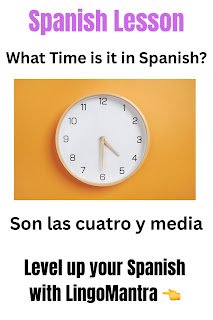
     Look at the clock in the image: it shows 4:30. Which Spanish sentence correctly tells the time?


    A Son las cuatro y media.

    B Son las cinco y media.
    C Son las cuatro y cuarto.
    D Es las cuatro y media.

    Can you tell the time in Spanish without translating every word in your head?

    If you saw the clock above showing 4:30, would you immediately know what to say?

    Son las cuatro y media.

    If you got it right, great! But if you hesitated, don’t worry. Telling time in Spanish becomes much easier once you understand a few simple patterns.

    The good news? You do not need to memorize dozens of sentences.

    You mainly need to understand how Spanish talks about:


    • the hour

    • minutes

    • half past

    • quarter past

    • quarter to

    • and a few useful everyday expressions

    Let’s make it simple.


    🕐 First: How Do You Ask “What Time Is It?” in Spanish?

    The most common question is:

    ¿Qué hora es?

    It literally asks:

    “What hour is it?”

    You can use it when asking someone for the current time.

    For example:

    ¿Qué hora es?
    What time is it?

    A natural answer might be:

    Son las cuatro.
    It is four o’clock.

    Or:

    Son las cuatro y media.
    It is 4:30.

    A tiny detail to remember

    You may notice something interesting:

    ¿Qué hora es?

    uses es, but the answer often uses:

    Son las…

    That’s because Spanish treats the time expression differently depending on the hour.

    There is one important exception that beginners should remember.


    🌅 Morning, Afternoon, or Night? Spanish Can Tell You

    Spanish doesn’t always need to say whether a time is AM or PM.

    Often, the situation makes it obvious.

    But when you want to be specific, you can add:

    de la mañana

    = in the morning

    de la tarde

    = in the afternoon / evening

    de la noche

    = at night

    So the same clock time can be described differently depending on the part of the day.

    4:30 AM

    Son las cuatro y media de la mañana.

    That’s 4:30 in the morning.

    4:30 PM

    Son las cuatro y media de la tarde.

    That’s 4:30 in the afternoon.

    This is especially useful when the listener might otherwise be unsure which 4:30 you mean.


    ⏰ What Does “Son las cuatro y media” Mean?

    Let’s look at the exact sentence from your pin:

    Son las cuatro y media.

    Break it into two useful parts:

    las cuatro = four o’clock

    y media = and a half / half past

    Together:

    Son las cuatro y media.

    = It is 4:30.

    If you want to specify the time of day:

    Son las cuatro y media de la mañana.

    = 4:30 AM

    Son las cuatro y media de la tarde.

    = 4:30 PM

    So don’t worry if you initially wondered, “How do I know whether it’s AM or PM?”

    You often don’t know from the clock expression alone. Context tells you, or Spanish adds de la mañana, de la tarde, or de la noche.


    ⭐ The Special Case: One O’Clock

    For 1:00, Spanish uses the singular:

    Es la una.

    Not:

    Son las una.

    So:

    Es la una.
    It is one o’clock.

    But:

    Son las dos.
    It is two o’clock.

    Son las tres.
    It is three o’clock.

    Son las cuatro.
    It is four o’clock.

    A simple way to remember it:

    1:00 → Es la una
    2:00–12:00 → Son las…

    That’s one of those small patterns that becomes automatic with practice.

    Now let’s come back to the clock from the pin.

    The clock shows:

    4:30

    In Spanish:

    Son las cuatro y media.

    Here is the useful part:

    y media = half past

    So:

    Son las cuatro y media.
    = It is half past four.
    = It is 4:30.

    You don’t need to think:

    “Four… thirty… Spanish… how do I translate this?”

    Instead, recognize the pattern:

    hour + y media

    And you’re done.

    Try a few more:

    2:30 → Son las dos y media.

    6:30 → Son las seis y media.

    9:30 → Son las nueve y media.

    See the pattern?

    Only the hour changes.


    🕒 What About :15?

    Now imagine the clock shows 3:15.

    Spanish commonly uses:

    Son las tres y cuarto.

    The expression:

    y cuarto

    means:

    quarter past

    So:

    3:15 → Son las tres y cuarto.

    Here are some examples:

    1:15 → Es la una y cuarto.

    5:15 → Son las cinco y cuarto.

    8:15 → Son las ocho y cuarto.

    This is useful because cuarto literally relates to a quarter.

    Think of an hour as four equal parts:

    15 minutes = one quarter
    30 minutes = half
    45 minutes = three quarters

    That makes the expressions easier to remember.


    🕘 What About :45?

    Now things get a little more interesting.

    For 9:45, Spanish can say:

    Son las diez menos cuarto.

    This literally means:

    It is a quarter before ten.

    Instead of focusing on the hour that has already passed, Spanish counts backward from the next hour.

    So:

    9:45 → Son las diez menos cuarto.

    This pattern is:

    next hour + menos cuarto

    where:

    menos cuarto = quarter to

    A few examples:

    2:45 → Son las tres menos cuarto.

    6:45 → Son las siete menos cuarto.

    10:45 → Son las once menos cuarto.

    At first, this can feel strange if you’re used to simply saying “ten forty-five.”

    But after hearing it a few times, your brain starts recognizing the pattern naturally.


    🧩 A Simple Spanish Time Formula

    You can think of telling time as a little building game.

    Start with:

    1. The hour

    Son las cuatro…

    Then add:

    2. The minutes

    For example:

    Son las cuatro y diez.

    = 4:10

    Or:

    Son las cuatro y veinte.

    = 4:20

    Or use a special expression:

    Son las cuatro y cuarto.

    = 4:15

    Son las cuatro y media.

    = 4:30

    And when you’re at :45:

    Son las cinco menos cuarto.

    = 4:45

    That’s the basic system.


    🎯 Quick Practice: Can You Read These?

    Don’t look for a translation word by word.

    Try to recognize the pattern.

    1. 5:10

    Son las cinco y diez.

    2. 7:20

    Son las siete y veinte.

    3. 8:30

    Son las ocho y media.

    4. 11:15

    Son las once y cuarto.

    5. 12:45

    Es la una menos cuarto.

    Notice the last one carefully.

    The clock says 12:45, but Spanish can describe it as a quarter before one.

    That’s why the next hour appears.


    💡 A Trick That Makes Spanish Time Easier

    Instead of memorizing complete sentences, memorize these four building blocks:

    y diez → :10

    y cuarto → :15

    y media → :30

    menos cuarto → :45

    Now imagine you see a clock.

    You identify the hour.

    Then identify which pattern you need.

    For example:

    6:30

    You see:

    6 + half

    So:

    Son las seis y media.

    That’s much easier than memorizing the entire sentence as one giant piece of information.


    🗣️ Time Expressions You’ll Actually Use

    Knowing how to tell the time is useful, but you’ll often hear time inside everyday conversations.

    Imagine a friend asks:

    ¿Qué hora es?

    You answer:

    Son las cuatro y media.

    Your friend says:

    ¡Gracias!

    You might also hear:

    A las cuatro.

    This means:

    At four o’clock.

    This is important because the time something happens is expressed differently from simply saying what time it is.

    For example:

    La clase es a las cinco.

    The class is at five.

    Trabajo a las ocho.

    I work at eight.

    Cenamos a las nueve.

    We have dinner at nine.

    So remember this useful difference:

    ¿Qué hora es?
    What time is it?

    Son las cinco.
    It is five.

    ¿A qué hora…?
    At what time…?

    A las cinco.
    At five.

    Once you learn this difference, conversations about schedules become much easier.


    🎮 Turn It Into a 30-Second Game

    Here’s a simple way to practice Spanish time without sitting down for a long study session.

    Look at any clock around you.

    Don’t translate.

    Just say the time in Spanish.

    If it’s:

    2:00

    say:

    Son las dos.

    If it’s:

    3:30

    say:

    Son las tres y media.

    If it’s:

    7:15

    say:

    Son las siete y cuarto.

    If it’s:

    8:45

    say:

    Son las nueve menos cuarto.

    Do this whenever you naturally look at a clock.

    You’re turning something you already do every day into a tiny Spanish lesson.


    🔥 One More Challenge

    Imagine you’re meeting a Spanish-speaking friend.

    You want to say:

    “Let’s meet at 4:30.”

    You already know that 4:30 is:

    Son las cuatro y media.

    But when talking about the time of an event, you use a las:

    Nos vemos a las cuatro y media.

    That means:

    See you at 4:30.

    Now you’ve moved from simply recognizing the time to actually using it in a conversation.

    That’s the real goal of learning vocabulary.


    🧠 Remember These 5 Spanish Time Patterns

    Before you leave, keep these patterns in your memory:

    1:00
    Es la una.

    4:00
    Son las cuatro.

    4:15
    Son las cuatro y cuarto.

    4:30
    Son las cuatro y media.

    4:45
    Son las cinco menos cuarto.

    You don’t need to memorize a huge list.

    Learn the pattern, change the hour, and practice.


    🌟 Can You Now Tell the Time in Spanish?

    If the clock shows 04:30, your answer is:

    Son las cuatro y media. ⏰🇪🇸

    And now you know why.

    You can ask:

    ¿Qué hora es?

    You can tell someone the time:

    Son las cuatro y media.

    You can talk about a schedule:

    A las cuatro y media.

    And you can describe common times using:

    y cuarto, y media, and menos cuarto.

    The next time you look at a clock, give yourself a tiny Spanish challenge.

    Don’t just see the time—say it in Spanish.

    That’s how a simple everyday moment can become a language-learning habit.

    Level up your Spanish with LingoMantra. 


    🧠 Don’t Learn Spanish Words in Isolation

    Here’s another important lesson that goes beyond telling time.

    Sometimes a Spanish phrase looks like the English structure in your head—but Spanish uses a completely different pattern.

    For example, an English speaker might think:

    “I am hungry.”

    and try to translate it word by word as:

    Estoy hambre. ❌

    But Spanish says:

    Tengo hambre. ✅

    Literally, it uses tener (“to have”) rather than estar (“to be”).

    If you’ve ever caught yourself thinking “Did I just say ‘Estoy hambre’ instead of ‘Tengo hambre’?”, check out our guide:

    Did I just say “Estoy hambre” instead of “Tengo hambre”?

    That kind of mistake is completely normal when learning Spanish. The trick is not to memorize isolated English-to-Spanish translations. Learn the Spanish pattern as a whole.

    The same idea applies to telling time.

    Don’t memorize:

    “4:30 = this giant sentence.”

    Instead, recognize:

    four + half past → four y media

    That’s much easier to reuse.

  • The Secret 6-Year-Olds Know About Learning French (That You Don’t)

     What if learning French has less to do with memorizing hundreds of words—and more to do with how you use the words you already know?

    Think about a six-year-old learning French.

    They aren’t sitting at a desk worrying about whether they have memorized enough vocabulary. They aren’t waiting until they understand every grammar rule. And they certainly aren’t thinking, “I must speak perfect French before I say anything.”

    They listen.

    They copy.

    They make mistakes.

    They try again.

    And somehow, little by little, French starts making sense.

    That simple process contains a surprisingly useful lesson for adult French learners.

    But before we get into it, let’s see if you can spot a few French-learning traps.

    🧠 Quick French Quiz: Can You Get All 3 Right?

    Don’t check the answers yet!

    Try these first.

    1. Which sentence is correct?

    A. Je sais Paris.
    B. Je connais Paris.

    2. You forget one French word while speaking. What should you do?

    A. Stop completely until you remember it.
    B. Try to explain the idea using simpler French.

    3. Which is generally more useful for a beginner?

    A. Memorizing isolated vocabulary.
    B. Learning useful words inside short sentences.

    Keep your answers in your head.

    We’ll come back to them later.

    And here’s the interesting part: all three questions are connected to the same idea.

    The Secret Isn’t Really a Secret

    Six-year-olds don’t have a magical shortcut to French.

    Their advantage is often much simpler:

    They use the language before they expect themselves to be perfect.

    A child may hear the same French expression many times before understanding every part of it.

    They may pronounce something incorrectly.

    They may use a word in the wrong situation.

    Then they hear it again.

    Eventually, their brain begins connecting the sound, meaning, situation, and usage.

    Adults often approach language differently.

    We learn a new word.

    Then a grammar rule.

    Then another tense.

    Then another list of vocabulary.

    And suddenly French starts feeling like a giant puzzle.

    You might even think:

    “I’ll start speaking properly when I know enough.”

    But there’s a problem.

    You don’t become comfortable with French first and then start using it.

    Very often, using French is part of how you become comfortable with it.

    Secret #1: Learn French in Useful Chunks

    Imagine you learn the French word:

    faim

    It means “hunger.”

    That’s useful—but knowing a single word doesn’t necessarily mean you’ll remember how to use it naturally.

    Now learn:

    J’ai faim.

    I’m hungry.

    Suddenly, the word has a situation.

    You can imagine saying it at lunchtime.

    You can recognize it when somebody says it.

    And you can use the same structure later.

    Try:

    J’ai soif.
    I’m thirsty.

    J’ai peur.
    I’m afraid.

    J’ai froid.
    I’m cold.

    Instead of collecting French words like items in a dictionary, start collecting small pieces of French you can actually use.

    That’s one reason everyday phrases can be so powerful for beginners.

    For example:

    Bonjour ! — Hello!

    Ça va ? — How are you?

    Je ne sais pas. — I don’t know.

    Je ne comprends pas. — I don’t understand.

    À bientôt ! — See you soon!

    You don’t need to build these sentences from scratch every time.

    Your brain gradually becomes familiar with the patterns.

    Secret #2: Don’t Wait for Perfect French

    Here’s a funny thing about language learning:

    Sometimes trying desperately to avoid mistakes makes you speak less, not better.

    Imagine someone asks:

    Tu veux un café ?

    You understand the question.

    But then your brain starts working overtime.

    “Which answer should I use?”

    “Is my pronunciation correct?”

    “Should I use a complete sentence?”

    “What if I make a grammar mistake?”

    By the time you’ve finished thinking, the conversation has already moved on.

    A beginner-friendly answer could simply be:

    Oui, merci !

    That’s French.

    It’s short.

    It’s useful.

    And it communicates.

    Children naturally do something adults sometimes forget:

    A simple sentence that gets the message across is more useful than a perfect sentence that never gets spoken.

    Secret #3: Make French Part of Your Day

    You don’t necessarily need a two-hour French study session every day.

    Instead, create tiny French moments.

    When you wake up:

    Bonjour !

    When you’re hungry:

    J’ai faim.

    When you drink water:

    Je bois de l’eau.

    When you’re leaving:

    À bientôt !

    When you don’t understand:

    Je ne comprends pas.

    These moments may look incredibly simple.

    That’s exactly why they work well as a beginner habit.

    You’re connecting French with something that is actually happening.

    You’re not just memorizing:

    “boire = to drink.”

    You’re thinking:

    Je bois de l’eau.

    You’re not just memorizing:

    “manger = to eat.”

    You’re thinking:

    Je vais manger.

    The language starts becoming connected to your life.

    Secret #4: Let Context Help You Remember

    Have you ever learned a French word on Monday and completely forgotten it by Friday?

    You’re definitely not the only learner who experiences this.

    One reason is that isolated vocabulary can be difficult to remember.

    Compare:

    manger = to eat

    with:

    Je vais manger.
    I’m going to eat.

    The second example gives the word a context.

    Now imagine changing the verb:

    Je vais travailler.
    I’m going to work.

    Je vais dormir.
    I’m going to sleep.

    Je vais étudier.
    I’m going to study.

    You’ve learned several useful sentences while becoming familiar with the same basic structure.

    That’s much more practical than simply staring at a vocabulary list.

    Secret #5: Don’t Memorize Confusing Words in Isolation

    French has plenty of words that look simple until you try to use them.

    A classic example is:

    savoir vs connaître

    Both can be connected to the English verb “to know,” but they aren’t interchangeable.

    For example:

    Je sais.
    I know.

    Je sais parler français.
    I know how to speak French.

    But when you’re talking about being familiar with a person, place, or thing, connaître is often the verb you need.

    For example:

    Je connais Paris.
    I know Paris / I’m familiar with Paris.

    That’s why:

    Je sais Paris ❌

    doesn’t work when you want to say that you’re familiar with Paris.

    If this difference still feels confusing, read our detailed guide:

    Connaitre vs Savoir: Why “Je sais Paris” Is Wrong

    The bigger lesson here is important:

    Don’t learn confusing French words only through English translations. Learn them through real examples.

    A sentence can show you how a word actually behaves.

    Secret #6: Repeat Without Making It Boring

    Yes, repetition matters.

    But repeating the exact same word twenty times isn’t necessarily the most interesting way to learn.

    Instead, change the situation.

    Start with:

    J’ai faim.

    Then ask:

    Tu as faim ?

    Now change the idea:

    J’ai soif.

    Then try:

    Tu as soif ?

    The structure feels familiar, but something has changed.

    That’s useful repetition.

    Your brain has to notice the difference instead of simply copying the same line again and again.

    You can do this with almost any beginner sentence.

    Secret #7: Turn French Into a Game

    Here’s another thing children naturally do well:

    They make learning interactive.

    They use pictures.

    Objects.

    Questions.

    Stories.

    Songs.

    Games.

    You can borrow the same approach as an adult.

    Look around your room.

    Can you name five things in French?

    Maybe:

    la table — the table

    la chaise — the chair

    la porte — the door

    le livre — the book

    la fenêtre — the window

    Now make it harder.

    Choose one object and create a sentence.

    For example:

    Le livre est sur la table.

    Now you’re doing more than memorizing vocabulary.

    You’re connecting vocabulary with grammar and meaning.

    And suddenly your room becomes a tiny French classroom.

    So… What Were the Quiz Answers?

    Ready?

    For Question 1, the correct sentence is:

    Je connais Paris.

    Paris is a place you can be familiar with, so connaître is used here.

    For Question 2, if you forget one word, it is usually more useful to keep communicating with simpler French rather than completely freezing.

    For example, if you forget a specific word, you can sometimes describe it using words you already know.

    That’s an important communication skill.

    And Question 3?

    Learning vocabulary inside meaningful sentences can give you more useful context than simply memorizing isolated words.

    But if you missed one—or even all three—don’t worry.

    The quiz wasn’t designed to catch you out.

    It was designed to show you something important:

    French becomes easier when you interact with it instead of treating every mistake as a failure.

    Try This 5-Minute French Routine Today

    You don’t need to completely reorganize your life to try this approach.

    Give yourself five minutes.

    Minute 1: Choose one useful French phrase.

    For example:

    Je ne comprends pas.

    Minute 2: Say it aloud several times.

    Don’t worry about sounding perfect.

    Minute 3: Change one part.

    Try:

    Je comprends.

    Then:

    Je ne comprends pas.

    Minute 4: Imagine a real situation where you might use the phrase.

    Maybe you’re talking to someone in a French-speaking country.

    Maybe you’re watching a French video.

    Maybe you’re in a classroom.

    Minute 5: Look away from the sentence and try to say it from memory.

    That’s your five-minute practice.

    Simple?

    Yes.

    But simple doesn’t mean useless.

    The goal is to create a habit you can actually repeat tomorrow.

    The Real Secret to Learning French

    So, what do six-year-olds know about learning French that adults sometimes forget?

    Maybe the answer isn’t one magical technique.

    It’s a mindset.

    They don’t need to know everything before they begin.

    They don’t treat every mistake as a disaster.

    They hear language repeatedly.

    They copy useful expressions.

    They connect words with real situations.

    And they keep going.

    You can do the same thing.

    Instead of asking:

    “How can I learn all of French?”

    ask yourself:

    “What is one small piece of French I can actually use today?”

    Maybe it’s:

    Bonjour.

    Maybe it’s:

    J’ai faim.

    Maybe it’s:

    Je ne comprends pas.

    Or maybe today you finally remember why it’s:

    Je connais Paris.

    —not:

    Je sais Paris.

    Those little pieces add up.

    And eventually, French stops looking like one enormous mountain of vocabulary and grammar.

    It starts becoming a collection of familiar expressions, patterns, sounds, and situations.

    That may be the real secret:

    You don’t have to wait until you know enough French to start using French.

    Use the French you know—and let using it help you learn more.

  • Connaître vs Savoir: Why “Je sais Paris” Is Wrong

    Can you spot the mistake before reading the rule?

    ❌ Je sais Paris.
    ✅ Je connais Paris.

    If you chose Je connais Paris, you’re already on the right track.

    But why is savoir wrong here?

    This is one of the most common problems for French learners because English uses just one verb — “to know.”

    In French, however, you normally need to choose between two different verbs:

    connaître and savoir.

    🧠 Quick Quiz: Connaître or Savoir?

    Before reading the explanation, test yourself.

    Don’t worry if you’re not sure. Just choose the answer that feels correct.

    1. “I know Marie.”

    A. Je sais Marie.
    B. Je connais Marie.

    2. “I know the answer.”

    A. Je sais la réponse.
    B. Je connais la réponse.

    3. “I know Paris.”

    A. Je sais Paris.
    B. Je connais Paris.

    4. “I know how to swim.”

    A. Je connais nager.
    B. Je sais nager.

    5. “I know this restaurant.”

    A. Je connais ce restaurant.
    B. Je sais ce restaurant.

    Take a few seconds and make your choices.

    Ready?

    Answers

    1 → B: Je connais Marie.

    2 → A: Je sais la réponse.

    3 → B: Je connais Paris.

    4 → B: Je sais nager.

    5 → A: Je connais ce restaurant.

    If you got a few wrong, that’s completely normal. The English word “know” makes this distinction especially confusing.

    Let’s make it simple.


    The Simple Difference Between Connaître and Savoir

    Here’s the basic idea you should remember:

    CONNAÎTRE = to know / be familiar with a person, place, or thing

    Use connaître when you are talking about familiarity.

    Think:

    People → Places → Things you are familiar with

    For example:

    Je connais Marie.
    I know Marie.

    Je connais Paris.
    I know Paris.

    Je connais ce restaurant.
    I know this restaurant.


    SAVOIR = to know information, a fact, or how to do something

    Use savoir when you are talking about information, facts, answers, or knowing how to perform an action.

    Think:

    Facts → Information → Answers → Know how to

    For example:

    Je sais la réponse.
    I know the answer.

    Je sais la vérité.
    I know the truth.

    Je sais que tu es ici.
    I know that you are here.

    Je sais nager.
    I know how to swim.

    That’s the basic distinction.

    Now let’s look at each one more carefully.


    1. When Do You Use “Connaître”?

    Use connaître when you are familiar with a person, place, or thing.

    A useful way to think about it is:

    “I know it because I am familiar with it.”

    👤 Knowing a Person

    When you know a person, use connaître.

    Je connais Marie.
    I know Marie.

    Tu connais Paul ?
    Do you know Paul?

    Nous connaissons cette personne.
    We know this person.

    Notice something important.

    You are not talking about information about Marie.

    You are saying that you know Marie as a person.

    So:

    ❌ Je sais Marie.

    ✅ Je connais Marie.


    2. Use Connaître for Places

    This is where many learners make the famous mistake:

    ❌ Je sais Paris.

    The correct sentence is:

    ✅ Je connais Paris.

    Why?

    Because here you’re talking about being familiar with the city.

    For example:

    Je connais Paris.
    I know Paris. / I am familiar with Paris.

    Elle connaît Londres.
    She knows London. / She is familiar with London.

    Nous connaissons cette ville.
    We know this city.

    You can use connaître with cities, countries, neighborhoods, and other places when the meaning is familiarity.


    Why “Je sais Paris” Doesn’t Work

    Let’s slow down and look at the original example.

    ❌ Je sais Paris.

    An English speaker may think:

    “I know Paris → I know = savoir → Je sais Paris.”

    It seems logical if you translate word-for-word.

    But French doesn’t work that way.

    In Je connais Paris, you’re saying:

    “I am familiar with Paris.”

    Maybe you’ve visited Paris.

    Maybe you’ve lived there.

    Maybe you know the city well.

    The important idea is familiarity.

    Now compare it with:

    Je sais que Paris est en France.

    This means:

    “I know that Paris is in France.”

    Here you’re talking about information or a fact, so savoir is used.

    This is the key distinction.


    3. When Do You Use “Savoir”?

    Use savoir when you’re talking about information, knowledge of a fact, an answer, or knowing how to do something.

    For example:

    Je sais la réponse.
    I know the answer.

    Je sais son nom.
    I know his/her name.

    Je sais la vérité.
    I know the truth.

    Nous savons l’heure.
    We know the time.

    In each case, you’re talking about information.

    You aren’t saying that you’re familiar with a person or place.


    💡 A Simple Question to Ask Yourself

    When you’re unsure whether to use connaître or savoir, ask yourself:

    “Am I talking about familiarity or information?”

    If it’s familiarity, think:

    👉 CONNAÎTRE

    If it’s information, a fact, an answer, or knowing how to do something, think:

    👉 SAVOIR

    This little question can save you from a lot of mistakes.


    4. Savoir + Infinitive = “Know How To…”

    There is another extremely important use of savoir.

    When you want to say that someone knows how to do something, use:

    savoir + infinitive

    For example:

    Je sais nager.
    I know how to swim.

    Elle sait cuisiner.
    She knows how to cook.

    Il sait conduire.
    He knows how to drive.

    Nous savons danser.
    We know how to dance.

    Tu sais parler français.
    You know how to speak French.

    This is a very useful pattern to remember.

    So don’t say:

    ❌ Je connais nager.

    Say:

    ✅ Je sais nager.


    5. Savoir + “Que”

    You will also frequently see savoir followed by que.

    Use this structure when someone knows that something is true.

    savoir + que + sentence

    For example:

    Je sais que tu es français.
    I know that you are French.

    Elle sait que nous sommes ici.
    She knows that we are here.

    Nous savons qu’il est à Paris.
    We know that he is in Paris.

    Ils savent que le restaurant est fermé.
    They know that the restaurant is closed.

    Here, you’re dealing with information or a fact, so savoir is the natural choice.


    ⭐ One Example That Explains Everything

    Here’s one sentence worth remembering:

    Je connais Paris, mais je sais que Paris est en France.

    Let’s break it down.

    Je connais Paris.

    → I am familiar with Paris.

    Je sais que Paris est en France.

    → I know the fact that Paris is in France.

    Same subject.

    Same English word “know.”

    But two different French verbs.

    That’s the difference between connaître and savoir.


    ⚠️ Common Mistakes to Avoid

    Because English uses “know” for many different situations, beginners often use savoir too much.

    Here are some common mistakes.

    ❌ Je sais Marie.

    ✅ Je connais Marie.

    You know a person → connaître


    ❌ Je sais Paris.

    ✅ Je connais Paris.

    You are familiar with a place → connaître


    ❌ Je connais la réponse.

    ✅ Je sais la réponse.

    You know information/an answer → savoir


    ❌ Je connais nager.

    ✅ Je sais nager.

    You know how to do something → savoir


    🧠 The Easiest Memory Trick

    If you don’t want to memorize a complicated grammar explanation, remember these two groups.

    CONNAÎTRE

    Think:

    👤 People

    📍 Places

    📖 Things you’re familiar with

    Examples:

    Je connais Marie.

    Je connais Paris.

    Je connais ce livre.

    Je connais ce restaurant.


    SAVOIR

    Think:

    💡 Facts

    ❓ Answers

    📚 Information

    🛠️ Knowing how to do something

    Examples:

    Je sais la réponse.

    Je sais la vérité.

    Je sais que tu es ici.

    Je sais nager.


    🎯 Test Yourself Again

    Now that you’ve seen the rule, try these without looking back.

    Complete each sentence with the correct form of connaître or savoir.

    1. Je ______ cette femme.

    2. Je ______ la réponse.

    3. Nous ______ Paris.

    4. Elle ______ jouer du piano.

    5. Tu ______ mon frère ?

    6. Ils ______ que nous sommes ici.

    7. Vous ______ ce restaurant ?

    8. Je ______ parler espagnol.

    Pause here.

    Try to answer all eight before checking below.


    Answers

    1. Je connais cette femme.

    You’re talking about a person → connaître

    2. Je sais la réponse.

    You’re talking about information → savoir

    3. Nous connaissons Paris.

    You’re familiar with a place → connaître

    4. Elle sait jouer du piano.

    She knows how to do something → savoir

    5. Tu connais mon frère ?

    You’re talking about a person → connaître

    6. Ils savent que nous sommes ici.

    They’re aware of a fact → savoir

    7. Vous connaissez ce restaurant ?

    You’re familiar with the restaurant → connaître

    8. Je sais parler espagnol.

    You know how to speak Spanish → savoir


    What About Books, Restaurants, Songs, and Other Things?

    You can also use connaître for things you’re familiar with.

    For example:

    Je connais ce livre.
    I know this book. / I’m familiar with this book.

    Elle connaît cette chanson.
    She knows this song.

    Nous connaissons ce restaurant.
    We know this restaurant.

    The idea is still the same:

    You’re talking about familiarity, not simply knowing a piece of information.

    Compare:

    Je connais ce restaurant.

    → I’m familiar with this restaurant.

    But:

    Je sais que ce restaurant est fermé.

    → I know that this restaurant is closed.

    Again, the distinction is familiarity versus information.


    🔥 A Quick “Don’t Translate Word-for-Word” Rule

    One of the biggest lessons here is this:

    Don’t automatically translate every English “know” as “savoir.”

    English:

    I know Marie.

    French:

    Je connais Marie.

    English:

    I know Paris.

    French:

    Je connais Paris.

    English:

    I know the answer.

    French:

    Je sais la réponse.

    English:

    I know how to swim.

    French:

    Je sais nager.

    The English verb stays the same.

    The French verb changes depending on the meaning.


    📝 Mini Challenge

    Let’s finish with three sentences.

    Don’t look at the answers immediately.

    A.

    “I know your sister.”

    Je ______ ta sœur.

    B.

    “I know his name.”

    Je ______ son nom.

    C.

    “I know how to swim.”

    Je ______ nager.

    Think carefully.

    The answers are:

    A. Je connais ta sœur.

    Person → connaître

    B. Je sais son nom.

    Information → savoir

    C. Je sais nager.

    Knowing how to do something → savoir

    If you got all three, you’ve understood the main rule.


     Want to Ask Better Questions in French?

    Now that you know the difference between connaître and savoir, there’s another group of French words you’ll use constantly in real conversations: question words.

    Words such as:

    qui — who
    que / quoi — what
    où — where
    quand — when
    pourquoi — why
    comment — how
    combien — how much / how many

    If you’re building your French vocabulary step by step, continue here:

    👉 French Question Words: 7 Essential Words You Need to Know

    Read the full guide → French Question Words: 7 Essential Words You Need to Know

    This is a natural next step because knowing the right question words makes it much easier to turn your vocabulary into actual French questions.


    🎯 Final Challenge

    Before you leave, try translating this sentence without looking back:

    “I know Sarah, I know Paris, and I know how to speak French.”

    Think about each part separately.

    Sarah → person

    Paris → place

    speak French → knowing how to do something

    Answer:

    Je connais Sarah, je connais Paris et je sais parler français.

    Notice how both verbs appear in the same sentence.

    Je connais Sarah → person

    Je connais Paris → place

    Je sais parler français → know how to do something

    That’s the pattern you want to remember.


    Quick Recap

    If you remember only one thing from this article, remember this:

    CONNAÎTRE = familiarity

    Use it for people, places, and things you’re familiar with.

    Je connais Marie.

    Je connais Paris.

    Je connais ce restaurant.


    SAVOIR = information / facts / knowing how

    Use it for facts, information, answers, and knowing how to do something.

    Je sais la réponse.

    Je sais que tu es ici.

    Je sais nager.


    And that is why:

    ❌ Je sais Paris.

    is not the sentence you normally want.

    Instead:

    ✅ Je connais Paris.

    Because you are talking about being familiar with the city.

    The next time you see connaître and savoir, don’t ask yourself:

    “Which French word means know?”

    Ask:

    “Am I talking about familiarity or information?”

    That small change in thinking will make choosing the correct verb much easier.


     One Last Test Before You Go

    “I know this city, but I know that it is expensive.”

    Can you choose the correct verbs?

    Je ______ cette ville, mais je ______ qu’elle est chère.

    Answer:

    Je connais cette ville, mais je sais qu’elle est chère.

    Connaître → familiarity.

    Savoir → information.

  • Weekly review and Quiz 1

     The first review day is here! 🎉

    You’ve spent the first part of the challenge learning basic Spanish phrases, numbers, months, days of the week, jobs, and simple ways to practice.

    Today, we’re not adding a big new lesson.

    Instead, it’s time to look back, test your memory, and see what you’ve actually learned.

    Think of this as your Week 1 Spanish check-in.

    👉 Follow the full 30-Day Spanish Basics Challenge here: 

    No notes.

    No scrolling back.

    Just you and Quiz 1. 🧠🇪🇸

    Ready?


    🔄 Quick Week 1 Recap

    Before the quiz, here’s a super-fast review of what you’ve covered.

    👋 Introductions

    You learned how to introduce yourself:

    Me llamo… → My name is…

    Yo tengo … años. → I am … years old.

    Soy de… → I am from…

    Me gusta… → I like…

    You also learned some everyday expressions:

    Hola → Hello

    ¿Cómo estás? → How are you?

    Gracias → Thank you

    Por favor → Please

    Adiós → Goodbye

    Don’t overthink these.

    The goal is to be able to recognize them and start using them naturally.


    🔢 Numbers 1–50

    You worked through Spanish numbers from 1 to 50.

    A few useful ones to remember:

    uno → 1
    cinco → 5
    diez → 10
    quince → 15
    veinte → 20
    treinta → 30
    cuarenta → 40
    cincuenta → 50

    And you learned an important study habit:

    Listen → Repeat → Recall → Repeat again


    📅 Months

    You learned all 12 months:

    enero, febrero, marzo, abril, mayo, junio, julio, agosto, septiembre, octubre, noviembre, diciembre.

    Remember:

    Mi cumpleaños es en mayo.

    “My birthday is in May.”

    And one small but important writing rule:

    Spanish months are normally written in lowercase.

    So:

    ✅ enero
    ❌ Enero


    🗓️ Days of the Week

    You also learned:

    lunes → Monday
    martes → Tuesday
    miércoles → Wednesday
    jueves → Thursday
    viernes → Friday
    sábado → Saturday
    domingo → Sunday

    Two days have accent marks:

    miércoles
    sábado

    And remember:

    el lunes → on Monday / a particular Monday

    los lunes → on Mondays / every Monday


    💼 Jobs & Professions

    You also practiced vocabulary for different professions.

    Some of the words you encountered were:

    enfermero / enfermera → nurse

    maestro / maestra → teacher

    abogado / abogada → lawyer

    bombero / bombera → firefighter

    mecánico / mecánica → mechanic

    programador / programadora → programmer

    contador / contadora → accountant

    dentista → dentist

    electricista → electrician

    periodista → journalist

    veterinario / veterinaria → veterinarian

    You also noticed something important:

    Not every profession follows exactly the same masculine/feminine pattern.

    For example:

    mecánico → mecánica

    but:

    dentista → dentista


    🧠 QUIZ 1: How Much Spanish Do You Remember?

    Now it’s your turn.

    Don’t look back at the review.

    Write down your answers as you go.

    Let’s see how much you remember from Week 1. 👇


    1️⃣ What does “Me llamo…” mean?

    A. I like…
    B. My name is…
    C. I am from…
    D. Goodbye


    2️⃣ How do you say “Thank you” in Spanish?

    A. Hola
    B. Por favor
    C. Gracias
    D. Adiós


    3️⃣ Complete the sentence:

    Me gusta ______.

    A. the phrase “my name”
    B. something you like
    C. your age
    D. your country


    4️⃣ What does quince mean?

    A. 12
    B. 13
    C. 15
    D. 20


    5️⃣ Which Spanish number means 50?

    A. cuarenta
    B. cincuenta
    C. treinta
    D. quince


    6️⃣ What comes after marzo?

    A. mayo
    B. abril
    C. junio
    D. febrero


    7️⃣ Which one means July?

    A. junio
    B. julio
    C. agosto
    D. septiembre


    8️⃣ Which Spanish month has the meaning “December”?

    A. noviembre
    B. octubre
    C. diciembre
    D. septiembre


    9️⃣ Which sentence is written correctly?

    A. El Lunes trabajo.
    B. El lunes trabajo.
    C. El lunes Trabajo.
    D. El Lunes Trabajo.


    🔟 Which Spanish day means Wednesday?

    A. viernes
    B. martes
    C. miércoles
    D. jueves


    1️⃣1️⃣ Which two Spanish days have accent marks?

    A. lunes and martes
    B. martes and jueves
    C. miércoles and sábado
    D. viernes and domingo


    1️⃣2️⃣ Which spelling is correct?

    A. marrtes
    B. martes
    C. martés
    D. martes


    1️⃣3️⃣ What does los lunes generally refer to?

    A. A particular Monday
    B. Mondays / something that happens on Mondays
    C. Last Monday
    D. Next Monday


    1️⃣4️⃣ Who is an abogado / abogada?

    A. A teacher
    B. A lawyer
    C. A mechanic
    D. A nurse


    1️⃣5️⃣ What does mecánico / mecánica mean?

    A. Mechanic
    B. Accountant
    C. Programmer
    D. Carpenter


    1️⃣6️⃣ What does dentista mean?

    A. Dentist
    B. Doctor
    C. Electrician
    D. Pharmacist


    1️⃣7️⃣ Which word means firefighter?

    A. Bombero
    B. Panadero
    C. Contador
    D. Periodista


    1️⃣8️⃣ Which profession is connected with software and applications?

    A. Jardinero
    B. Programador
    C. Fotógrafo
    D. Cocinero


    1️⃣9️⃣ Spot the mistake:

    Mi cumpleaños es en Mayo.

    What’s wrong?

    A. cumpleaños
    B. es
    C. en
    D. Mayo should normally be lowercase


    2️⃣0️⃣ Which is the best way to practice new Spanish vocabulary?

    A. Read the same list once and never review it
    B. Memorize everything in one sitting
    C. Learn, recall, speak, and review regularly
    D. Wait until your Spanish is perfect before speaking


    🎯 BONUS ROUND

    Let’s make it a little harder.

    Don’t choose from multiple choices this time.

    21️⃣ Complete the introduction:

    Me llamo ______.

    Write your own name.


    22️⃣ Complete:

    Yo tengo ______ años.

    Write your age in Spanish.


    23️⃣ Complete:

    Soy de ______.

    Where are you from?


    24️⃣ Complete:

    Me gusta ______.

    What do you like?


    25️⃣ One final challenge:

    Write the seven Spanish days of the week in order without looking.

    Ready?

    Go! 👀


    ✅ QUIZ 1 ANSWERS

    Don’t check until you’ve finished!

    1. B — My name is

    2. C — Gracias

    3. B — Something you like

    4. C — 15

    5. B — cincuenta

    6. B — abril

    7. B — julio

    8. C — diciembre

    9. B — El lunes trabajo.

    10. C — miércoles

    11. C — miércoles and sábado

    12. B — martes

    13. B — Mondays / something that happens on Mondays

    14. B — Lawyer

    15. A — Mechanic

    16. A — Dentist

    17. A — Bombero

    18. B — Programador

    19. D — Mayo should normally be lowercase

    20. C — Learn, recall, speak, and review regularly


    📊 How Did You Do?

    🏆 18–20 correct

    Excellent! You’ve got a strong Week 1 foundation.

    🌟 14–17 correct

    Great progress! Review the questions you missed and try the quiz again later.

    💪 10–13 correct

    You’re building your Spanish foundation. A little more review will help these words stick.

    🌱 Under 10

    No problem at all.

    This is exactly what a review day is for.

    Go back through the earlier lessons, practice the words out loud, and try Quiz 1 again.

    The goal isn’t to be perfect.

    The goal is to remember a little more each time.


    🗣️ Your 2-Minute Speaking Challenge

    Before you finish Day 7, try saying this without looking:

    Hola.

    Me llamo ______.

    Yo tengo ______ años.

    Soy de ______.

    Me gusta ______.

    Then add:

    ¡Gracias!

    ¡Adiós!

    If you can say those sentences from memory, you’ve already started turning your Week 1 vocabulary into real Spanish. 🇪🇸


    ❤️ What You Learned This Week

    This week wasn’t about memorizing hundreds of words.

    You learned how to:

    👋 Introduce yourself
    🔢 Count from 1–50
    📅 Name the months
    🗓️ Talk about days of the week
    💼 Recognize common jobs and professions
    🗣️ Build simple Spanish sentences
    🧠 Practice recall instead of relying only on recognition

    And perhaps most importantly, you practiced using Spanish instead of just reading about Spanish.

    That’s the habit we want to keep.


    🚀 Ready for the Next Part?

    Week 1 is done.

    Take a moment to celebrate the progress — then keep going


  • The SER vs. ESTAR Trap That Confuses English Speakers

    If you’re learning Spanish, you’ve probably noticed something confusing:

    SER and ESTAR both mean “to be.”

    So how do you know which one to use?

    Before practicing SER and Estar; let’s quickly see their present-tense forms.

    SER- To Be

    Yo soy — I am
    Tú eres — You are
    Él / Ella es — He / She is
    Nosotros somos — We are
    Vosotros sois — You are
    Ellos / Ellas son — They are

    For example:

    Yo soy de Texas.
    I am from Texas.

    Ella es doctora.
    She is a doctor.

    Ellos son estudiantes.
    They are students.


    ESTAR — To Be

    Yo estoy — I am
    Tú estás — You are
    Él / Ella está — He / She is
    Nosotros estamos — We are
    Vosotros estáis — You are
    Ellos / Ellas están — They are

    For example:

    Yo estoy en casa.
    I am at home.

    Ella está cansada.
    She is tired.

    Ellos están en el restaurante.
    They are at the restaurant.

    At first, many beginners learn this:

    SER = permanent

    ESTAR = temporary

    It sounds simple.

    But then Spanish gives you sentences like these:

    El baño está en el segundo piso.

    The bathroom is on the second floor.

    And:

    La fiesta es en mi casa.

    The party is at my house.

    Wait.

    Both sentences talk about location.

    So why do we use estar in one sentence and ser in the other?

    The answer is easier than it looks.


    The Simple SER vs ESTAR Rule

    For location, start with this idea:

    Person or physical thing → ESTAR

    Event → SER

    For example:

    El baño está en el segundo piso.

    The bathroom is on the second floor.

    The bathroom is a physical place, so we use estar.

    Now look at:

    La fiesta es en mi casa.

    The party is at my house.

    A party is an event.

    So Spanish uses ser.

    That’s the key difference.


    Why English Speakers Get Confused

    English uses the verb “to be” in both sentences.

    We say:

    The bathroom is upstairs.

    And:

    The party is at my house.

    The English verb doesn’t change.

    Spanish works differently.

    You have to decide whether the subject is a physical person or thing, or an event.

    That’s why translating every English “is” as es can lead to mistakes.

    Instead, ask yourself:

    What am I talking about?

    That question is much more useful.


    When to Use ESTAR for Location

    Use estar when you’re talking about the location of a person, object, or physical place.

    Here are some everyday examples.

    El baño está en el segundo piso.

    The bathroom is on the second floor.

    Mi teléfono está en la mesa.

    My phone is on the table.

    El restaurante está cerca.

    The restaurant is nearby.

    Mi hotel está en el centro.

    My hotel is downtown.

    María está en casa.

    María is at home.

    Los libros están en la mochila.

    The books are in the backpack.

    In all these examples, you’re answering a location question.

    That’s why estar is used.


    When to Use SER for Events

    Now let’s talk about events.

    Spanish normally uses ser when describing where an event takes place.

    For example:

    La fiesta es en mi casa.

    The party is at my house.

    El concierto es en el parque.

    The concert is in the park.

    La boda es en una iglesia.

    The wedding is in a church.

    La reunión es en la oficina.

    The meeting is in the office.

    El partido es en Nueva York.

    The game is in New York.

    La clase es en el salón 204.

    The class is in room 204.

    Look at the subjects:

    Fiesta.

    Concierto.

    Boda.

    Reunión.

    Partido.

    Clase.

    They’re all events.

    That’s why Spanish uses ser.


    Same Place, Different Verb

    Here’s one of the easiest ways to understand this rule.

    Imagine your house is in Texas.

    You can say:

    Mi casa está en Texas.

    My house is in Texas.

    Why?

    Because mi casa is a physical place.

    So we use estar.

    Now imagine you’re having a party there.

    You say:

    La fiesta es en mi casa.

    The party is at my house.

    The location hasn’t changed.

    The house is still in Texas.

    But the subject has changed.

    Mi casa → physical place → ESTAR

    La fiesta → event → SER

    That’s the important part.


    Don’t Memorize Only “Permanent vs Temporary”

    You may have heard this rule:

    SER = permanent

    ESTAR = temporary

    It’s useful for beginners, but it isn’t a complete explanation.

    For example:

    Nueva York está en Estados Unidos.

    New York is in the United States.

    Its geographical location isn’t temporary.

    But Spanish still uses estar for location.

    Now look at:

    La fiesta es en mi casa.

    The party isn’t permanent.

    But Spanish uses ser because we’re talking about where an event takes place.

    So don’t rely only on:

    Permanent = SER

    and:

    Temporary = ESTAR

    Instead, learn the common patterns.


    SER Is Commonly Used For

    Identity

    Soy Ana.

    I am Ana.

    Origin

    Soy de California.

    I’m from California.

    Profession

    Ella es doctora.

    She is a doctor.

    Characteristics

    El coche es rojo.

    The car is red.

    Time

    Son las tres.

    It’s three o’clock.

    Events

    La fiesta es en mi casa.

    The party is at my house.

    These are some of the most useful situations to recognize.


    ESTAR Is Commonly Used For

    Location

    Estoy en casa.

    I’m at home.

    El libro está en la mesa.

    The book is on the table.

    Current condition

    Estoy cansado.

    I’m tired.

    Current state

    Estamos ocupados.

    We’re busy.

    Temporary situation

    El restaurante está cerrado.

    The restaurant is closed.

    You don’t need to memorize every possible use today.

    Start by recognizing the patterns.


    Two Spanish Questions You Should Know

    Now let’s connect this grammar rule to everyday conversation.

    Compare these two questions:

    ¿Dónde estás?

    Where are you?

    And:

    ¿Dónde es la fiesta?

    Where is the party?

    They look very similar.

    But they use different verbs.


    ¿Dónde estás?

    This means:

    Where are you?

    You’re asking about the location of a person.

    So we use estar.

    For example:

    ¿Dónde estás?

    Estoy en casa.

    I’m at home.

    Or:

    Estoy en el trabajo.

    I’m at work.


    ¿Dónde es la fiesta?

    This means:

    Where is the party?

    You’re asking about the location of an event.

    So we use ser.

    For example:

    ¿Dónde es la fiesta?

    La fiesta es en mi casa.

    The party is at my house.

    This difference is extremely useful for beginners.


    Want to Learn More Basic Spanish Questions?

    If you’re still building your beginner Spanish conversation skills, check out our separate guide:

    Basic Questions in Spanish for Beginners

    You’ll find useful questions for everyday conversations, travel, restaurants, introductions, and other common situations.

    Learning those questions together with ser and estar can make Spanish grammar much easier to use in real conversations.


    More Real-Life Examples

    Let’s imagine you’re traveling.

    You want to find the airport.

    You ask:

    ¿Dónde está el aeropuerto?

    Where is the airport?

    Because the airport is a physical place, we use estar.

    Now you’re asking about a concert.

    You ask:

    ¿Dónde es el concierto?

    Where is the concert?

    Because the concert is an event, we use ser.

    Here’s another example.

    ¿Dónde está el restaurante?

    Where is the restaurant?

    But:

    ¿Dónde es la reunión?

    Where is the meeting?

    The pattern stays the same.

    Physical place?

    ESTAR

    Event?

    SER


    A Quick Memory Trick

    When you see “is” or “are” in English, don’t immediately choose es or está.

    Take one second.

    Ask:

    Am I locating a person or physical thing?

    If yes, think:

    ESTAR

    Example:

    ¿Dónde está el hotel?

    Where is the hotel?

    Now ask:

    Am I talking about where an event takes place?

    If yes, think:

    SER

    Example:

    ¿Dónde es el concierto?

    Where is the concert?

    This small mental pause can prevent many beginner mistakes.


    Quick SER vs ESTAR Practice

    Try these before checking the answers.

    1.

    El supermercado ___ cerca de mi casa.

    2.

    La boda ___ en un hotel.

    3.

    Mis amigos ___ en el restaurante.

    4.

    El concierto ___ en Chicago.

    5.

    Mi mochila ___ debajo de la mesa.

    6.

    ¿De dónde ___ tú?

    7.

    ¿Dónde ___ tus padres?

    8.

    ¿Dónde ___ la reunión?

    Take a moment.

    Then check your answers below.


    Answers

    1. Está

    El supermercado está cerca de mi casa.

    The supermarket is a physical place, so we use estar.

    2. Es

    La boda es en un hotel.

    A wedding is an event, so we use ser.

    3. Están

    Mis amigos están en el restaurante.

    We’re talking about the location of people, so we use estar.

    4. Es

    El concierto es en Chicago.

    A concert is an event, so we use ser.

    5. Está

    Mi mochila está debajo de la mesa.

    A backpack is a physical object, so its location uses estar.

    6. Eres

    ¿De dónde eres tú?

    This asks about someone’s origin, so we use ser.

    7. Están

    ¿Dónde están tus padres?

    We’re asking where people are located, so we use estar.

    8. Es

    ¿Dónde es la reunión?

    A meeting is an event, so we use ser.


    Can You Spot the Pattern?

    Look at these pairs:

    ¿Dónde está el hotel?

    Physical place → ESTAR

    ¿Dónde es la conferencia?

    Event → SER


    ¿Dónde está María?

    Person → ESTAR

    ¿Dónde es la boda?

    Event → SER


    ¿Dónde está mi teléfono?

    Object → ESTAR

    ¿Dónde es el partido?

    Event → SER

    Once you see these examples together, the difference becomes much easier to recognize.


    One More Important Example

    Consider this pair:

    Mi casa está en Miami.

    My house is in Miami.

    La fiesta es en Miami.

    The party is in Miami.

    Both sentences mention the same city.

    But the subjects are different.

    Casa is a physical place.

    Fiesta is an event.

    Therefore:

    Casa → está

    Fiesta → es

    This is why the subject matters so much when choosing between ser and estar.


    Your 10-Second SER vs ESTAR Test

    Before choosing the verb, ask yourself three questions.

    Is it a person or physical thing?

    Use ESTAR for its location.

    El coche está aquí.

    Is it an event?

    Use SER for where it takes place.

    El concierto es aquí.

    Am I talking about identity, origin, profession, or a characteristic?

    These commonly use SER.

    Soy de Texas.

    Ella es profesora.

    Am I talking about a current condition or location?

    These commonly use ESTAR.

    Estoy cansado.

    Estoy en casa.


    Final Takeaway

    The biggest thing to remember is this:

    Don’t automatically translate English “is” as es.

    Instead, think about the meaning.

    Person or physical thing + location → ESTAR

    Event + location → SER

    So:

    El baño está en el segundo piso.

    But:

    La fiesta es en mi casa.

    That’s the difference.

    The more examples you see, the more natural this distinction will become.

    And if you’re ready to practice everyday Spanish conversation, continue with our guide:

    Basic Questions in Spanish for Beginners

    You’ll learn practical questions that you can actually use when speaking Spanish.

    Now try this one yourself:

    ¿Dónde estás ahora?

    Answer in Spanish:

    Estoy en ______.

  • Did I Just Say “Estoy Hambre” Instead of “Tengo Hambre”? 😅

    If you’re learning Spanish, you’ve probably discovered that Spanish doesn’t always follow English sentence patterns.

    And that can lead to some very understandable mistakes.

    For example, an English speaker thinks:

    “I am hungry.”

    Then they learn that hambre is related to “hunger” and try to build the sentence themselves:

    ❌ Estoy hambre.

    It looks logical.

    But Spanish doesn’t say it that way.

    The natural expression is:

    ✅ Tengo hambre.
    I’m hungry.

    And this little mistake opens the door to something much more useful: 10 everyday Spanish phrases that beginners should actually know.

    These aren’t random textbook sentences. They’re expressions you can use in real conversations, while traveling, ordering food, meeting people, asking for help, or simply trying to sound less like you’re translating English in your head.

    So let’s get into them.


    First, Why Is It “Tengo Hambre”?

    The key word is tengo.

    It comes from the Spanish verb tener, meaning “to have.”

    And hambre is a noun meaning “hunger.”

    So, literally:

    Tengo hambre.
    “I have hunger.”

    English normally expresses the idea as:

    “I’m hungry.”

    Spanish uses a different structure.

    That’s completely normal. Languages don’t always organize the same idea in the same way.

    So instead of memorizing:

    hambre = hunger

    and then trying to construct a sentence every time, learn the complete expression:

    Tengo hambre.

    That way, when you’re hungry, you don’t have to stop and translate.

    You simply say it.


    The 10 Native Spanish Phrases You Actually Need

    Now let’s go beyond tengo hambre.

    These 10 phrases are useful because they help you handle everyday conversations—not because they sound impressive in a textbook.


    1. Tengo hambre. 🍕

    Meaning: I’m hungry.

    This is the phrase that started it all.

    Imagine you’re sightseeing, you’ve been walking for hours, and your stomach is officially done with you.

    You can simply say:

    Tengo hambre.

    Want to make it stronger?

    Tengo mucha hambre.
    I’m very hungry.

    Or:

    Tengo un poco de hambre.
    I’m a little hungry.

    Quick memory trick:

    Don’t think:

    “I am hungry = estoy + hambre.”

    Think:

    “Hunger = tener.”

    So:

    Tengo hambre. ✅


    2. Tengo sed. 🥤

    Meaning: I’m thirsty.

    Here’s another useful tener expression.

    English:

    “I’m thirsty.”

    Spanish:

    Tengo sed.

    Literally, it is closer to:

    “I have thirst.”

    Again, don’t worry about making the literal translation sound natural in English.

    You’re learning how Spanish expresses the idea.

    For example:

    Tengo mucha sed.
    I’m very thirsty.

    If you’re traveling somewhere hot, this phrase could become one of your favorites very quickly.


    3. Tengo sueño. 😴

    Meaning: I’m sleepy.

    This one is especially useful after a long flight or a late night.

    Tengo sueño.

    means:

    “I’m sleepy.”

    For example:

    Tengo mucho sueño.
    I’m very sleepy.

    Notice something?

    You’ve now learned three expressions with the same structure:

    Tengo hambre.
    Tengo sed.
    Tengo sueño.

    That’s not a coincidence.

    Recognizing patterns is one of the easiest ways to expand your Spanish vocabulary without memorizing hundreds of unrelated sentences.


    4. Tengo frío. 🥶

    Meaning: I’m cold.

    If you walk outside and immediately regret not bringing a jacket, you can say:

    Tengo frío.

    For example:

    Tengo mucho frío.
    I’m very cold.

    This is another case where English and Spanish use different structures.

    English uses:

    “I am cold.”

    Spanish commonly uses:

    Tengo frío.

    Once again, tener comes to the rescue.


    5. Tengo calor. ☀️

    Meaning: I’m hot.

    Now we get the opposite situation.

    You’re outside. The sun is brutal. You’re sweating. You want air conditioning immediately.

    You can say:

    Tengo calor.

    Meaning:

    “I’m hot.”

    You might also hear:

    Tengo mucho calor.
    I’m very hot.

    One useful warning:

    Don’t assume you can simply replace tener with estar because English uses “I am.”

    These expressions are a perfect example of why translating word-for-word can lead you astray.


    6. Tengo miedo. 😨

    Meaning: I’m scared. / I’m afraid.

    Imagine you’re watching a horror movie and suddenly hear something move behind you.

    You could say:

    Tengo miedo.

    Literally:

    “I have fear.”

    Natural English:

    “I’m scared.”

    You can also say:

    Tengo mucho miedo.
    I’m very scared.

    At this point, you may have noticed the bigger lesson:

    tener + noun can be incredibly useful in everyday Spanish.

    And that’s much more valuable than memorizing one isolated grammar rule.


    Okay, Enough “Tengo” Phrases 😄

    If we gave you ten different tener expressions, this article would start feeling like a Spanish grammar worksheet.

    So let’s switch gears.

    The next four phrases are different—but they’re just as useful in real conversations.


    7. ¿Qué tal? 👋

    Meaning: How’s it going? / How are things?

    This is one of those short expressions that can make your Spanish feel much more conversational.

    Instead of always relying on:

    ¿Cómo estás?

    you’ll also hear:

    ¿Qué tal?

    It’s short, casual, and useful in everyday interactions.

    For example:

    ¡Hola! ¿Qué tal?

    “Hi! How’s it going?”

    You don’t necessarily need a complicated answer.

    You could say:

    Bien, ¿y tú?

    “Good, and you?”

    That’s a complete mini-conversation.

    And that’s exactly what beginners should be practicing: small, reusable chunks of real conversation.


    8. No pasa nada. 👍

    Meaning: No worries. / It’s okay. / Nothing’s wrong.

    This is an extremely useful expression because little things go wrong all the time.

    Someone apologizes because they’re a few minutes late.

    You could respond:

    No pasa nada.

    Someone makes a small mistake.

    Again:

    No pasa nada.

    The exact English translation can change depending on the situation, but the overall idea is reassurance:

    It’s okay. Don’t worry about it.

    It’s a great phrase to recognize when listening to native speakers, too.


    9. Ya voy. 🏃

    Meaning: I’m coming. / I’m on my way. / I’ll be right there.

    Someone calls you from another room:

    ¡Ven!

    You can answer:

    ¡Ya voy!

    It literally relates to “I’m going already,” but in everyday context it can naturally mean:

    “I’m coming!”

    This is a great example of why learning Spanish through complete expressions is so effective.

    If you tried to translate every word separately, you might miss the way the phrase actually functions in conversation.

    Learn it as a chunk:

    Ya voy.

    Short.

    Useful.

    Easy to remember.


    10. ¿Me echas una mano? 🤝

    Meaning: Can you give me a hand?

    This is a very useful conversational expression for asking someone for help.

    For example, you’re trying to carry something heavy:

    ¿Me echas una mano?

    You’re essentially asking:

    “Can you give me a hand?”

    The verb echar has many uses in Spanish, which is one reason phrases like this are worth learning as complete expressions.

    Don’t worry about mastering every possible meaning of echar before you can use this phrase.

    Just remember:

    ¿Me echas una mano?

    = Can you help me? / Can you give me a hand?


    Your 10-Phrase Spanish Cheat Sheet

    Here’s the complete list in one place:

    # Spanish
    1 Tengo hambre- I’m hungry.
    2 Tengo sed- I’m thirsty.
    3 Tengo sueño- I’m sleepy.
    4 Tengo frío- I’m cold.
    5 Tengo calor- I’m hot.
    6 Tengo miedo- I’m scared.
    7 ¿Qué tal?- How’s it going?
    8 No pasa nada- No worries. / It’s okay.
    9 Ya voy- I’m coming. / I’m on my way.
    10 ¿Me echas una mano?- Can you give me a hand?

    Don’t try to memorize all ten in one sitting.

    Pick three today.

    Use them repeatedly.

    Then add three more.

    That’s much more effective than cramming a giant vocabulary list and forgetting most of it tomorrow.


    🧠 Quick Quiz: How Many Can You Remember?

    Let’s see whether these phrases are actually sticking.

    Question 1

    You haven’t eaten since breakfast. What do you say?

    A. Estoy hambre.
    B. Tengo hambre.
    C. Soy hambre.

    Answer: B — Tengo hambre.


    Question 2

    Someone asks how you’re doing casually. Which phrase can mean “How’s it going?”

    A. ¿Qué tal?
    B. Ya voy.
    C. No pasa nada.

    Answer: A — ¿Qué tal?


    Question 3

    Your friend apologizes for making a small mistake. What could you say?

    A. Tengo miedo.
    B. No pasa nada.
    C. Tengo sed.

    Answer: B — No pasa nada.


    Question 4

    Someone calls you from another room and you want to say “I’m coming!”

    A. Ya voy.
    B. Tengo sueño.
    C. ¿Qué tal?

    Answer: A — Ya voy.


    Question 5

    You need help carrying a suitcase. What could you ask?

    A. ¿Me echas una mano?
    B. Tengo calor.
    C. No pasa nada.

    Answer: A — ¿Me echas una mano?


    🌎 One More Spanish Warning: “Coger”

    There’s one more thing every Spanish learner should understand:

    Spanish changes from country to country.

    A word that sounds completely ordinary in Spain may have a very different association in parts of Latin America.

    A classic example is:

    coger

    In Spain, coger can be a normal everyday verb meaning things such as “to take,” “to catch,” or “to pick up,” depending on context.

    However, in many parts of Latin America, the word can have a vulgar sexual meaning.

    So if you’re learning Spanish from Spanish TV, YouTube, TikTok, or travel content, don’t automatically assume that every word works the same way everywhere.

    Regional vocabulary matters.

    And if you’re planning to travel to Latin America, this is definitely one word worth understanding before you casually start using it.

    👉 Read the full guide: Spanish Warning: Be Careful With “Coger” in Latin America!

    Why Native Phrases Beat Word-for-Word Translation

    There’s a bigger lesson hiding behind “Estoy hambre.”

    When you’re a beginner, translating feels natural.

    You see:

    “I’m hungry.”

    Your brain searches for:

    I = yo
    am = estoy
    hungry = hambre?

    And suddenly:

    Yo estoy hambre.

    It seems logical.

    But natural Spanish doesn’t work by simply replacing English words with Spanish words.

    Instead, native speakers rely on expressions they’ve heard countless times.

    That’s why tengo hambre is more useful to memorize as a complete phrase than to analyze every time you want to use it.

    The same idea applies to:

    ¿Qué tal?

    No pasa nada.

    Ya voy.

    ¿Me echas una mano?

    You don’t need to mentally rebuild these expressions every time you speak.

    You want them to become automatic.

    That’s when Spanish starts feeling less like a translation exercise and more like an actual language you can use.


    Final Takeaway

    So, did you just say:

    ❌ Estoy hambre?

    Don’t worry.

    Almost every Spanish learner runs into these kinds of mistakes.

    Just remember:

    🇪🇸 Tengo hambre.
    🇺🇸 I’m hungry.

    And while you’re at it, save these ten phrases:

    Tengo hambre.
    Tengo sed.
    Tengo sueño.
    Tengo frío.
    Tengo calor.
    Tengo miedo.
    ¿Qué tal?
    No pasa nada.
    Ya voy.
    ¿Me echas una mano?

    These are the kinds of expressions that can actually come in handy when you’re having a real conversation.

    And remember: don’t just learn Spanish words—learn how Spanish speakers put those words together.

    That’s the difference between knowing vocabulary and actually sounding natural.


    🇪🇸 Ready for another Spanish word trap?

    Spanish Warning: Be Careful With “Coger” in Latin America!

    Learn the regional meaning, why the word can cause confusion, and what Spanish learners should know before using it in Latin America.

  • Mon Amie or Ma Amie? The French Grammar Rule Beginners Often Get Wrong

     If you are learning French, you may have come across these two expressions:

    Mon amie
    Ma amie

    At first glance, ma amie seems like the obvious choice.

    After all, amie is a feminine noun, and French beginners learn that ma means “my” before a feminine singular noun.

    So why do French speakers say:

    Mon amie ✅

    instead of:

    Ma amie ❌

    The answer is a simple but important French pronunciation rule. Once you understand it, expressions such as mon amie, ton amie, and son amie become much easier to remember.

    Let’s break it down step by step.


    First: Ami and Amie Are Not the Same

    Before looking at the possessive adjective, make sure you know the difference between ami and amie.

    • un ami = a male friend

    • une amie = a female friend

    For example:

    Paul est mon ami.
    Paul is my friend.

    Marie est mon amie.
    Marie is my friend.

    The spelling changes because the gender of the noun changes.

    The important thing to notice is that both expressions can use mon:

    mon ami
    mon amie

    This can look strange when you are just starting French.

    But there is a very good reason for it.


    Why Is It “Mon Amie” Instead of “Ma Amie”?

    Normally, a feminine singular noun takes ma when you want to say “my.”

    For example:

    • ma sœur = my sister

    • ma mère = my mother

    • ma voiture = my car

    • ma maison = my house

    • ma classe = my class

    So you might expect:

    ma amie

    But French avoids this combination because it creates an awkward vowel-to-vowel sequence.

    The noun amie begins with a vowel sound.

    Instead of using ma, French uses mon before a feminine singular noun beginning with a vowel sound.

    Therefore:

    ma amie ❌
    mon amie ✅

    The purpose here is mainly pronunciation and smooth speech.


    The Easy Rule to Remember

    For beginners, this is the simplest way to remember the pattern:

    Before a feminine singular noun beginning with a vowel sound, use mon, ton, or son instead of ma, ta, or sa.

    So you get:

    mon amie = my female friend

    ton amie = your female friend

    son amie = his/her female friend

    The noun itself remains feminine.

    That last point is extremely important.


    “Mon” Does Not Make “Amie” Masculine

    One of the biggest beginner mistakes is thinking:

    “If French uses mon, then amie must be masculine.”

    No.

    Amie is still feminine.

    The possessive adjective changes because of the pronunciation rule.

    You can see this clearly when another adjective is added.

    Mon ami est français.

    My male friend is French.

    Mon amie est française.

    My female friend is French.

    Look at the final adjective:

    français → masculine
    française → feminine

    The word amie is feminine, and française agrees with it.

    So even though we say mon amie, the noun has not suddenly become masculine.


    Compare These Examples

    Here are some examples that make the pattern easier to see:

    French
    mon ami- my male friend
    mon amie- my female friend
    ma sœur- my sister
    ma voiture- my car
    mon école- my school
    mon idée- my idea

    Notice the difference.

    With sœur and voiture, we use ma.

    With amie, école, and idée, we use mon because these feminine nouns begin with a vowel sound.


    More Examples With “Mon”

    Once you understand mon amie, you will start noticing the same pattern in other expressions.

    Mon école

    école is feminine:

    une école = a school

    But we say:

    mon école = my school

    Not:

    ma école ❌


    Mon idée

    une idée = an idea

    Therefore:

    mon idée = my idea

    Not:

    ma idée ❌


    Mon histoire

    une histoire = a story

    Therefore:

    mon histoire = my story

    Not:

    ma histoire ❌


    Mon adresse

    une adresse = an address

    Therefore:

    mon adresse = my address

    Again, the noun is feminine, but mon is used because the noun begins with a vowel sound.


    What Happens With “Ton” and “Son”?

    The same pattern applies to other possessive adjectives.

    Normally:

    ta sœur = your sister

    But:

    ton amie = your female friend

    Similarly:

    sa sœur = his/her sister

    But:

    son amie = his/her female friend

    So you can remember this little pattern:

    Examples:

    ma sœur → mon amie

    ta sœur → ton amie

    sa sœur → son amie

    This is a pronunciation-friendly change, not a change in the gender of the noun.


    Mon Amie vs. Mon Ami

    These two expressions are especially useful to compare.

    Mon ami

    Mon ami est français.

    = My male friend is French.

    Mon amie

    Mon amie est française.

    = My female friend is French.

    The pronunciation of ami and amie is essentially the same in standard French, so the spelling and surrounding context become important.

    If you are writing French, remember the final -e in:

    amie

    That -e tells you that you are talking about a female friend.


    What About “Une Amie”?

    Here is another point that sometimes confuses beginners.

    You may think:

    If “ma” changes to “mon,” does “une” also change?

    No.

    We say:

    Une amie

    = a female friend

    Not un amie.

    For example:

    J’ai une amie française.

    = I have a French female friend.

    Here, une remains feminine.

    The special change happens with possessive adjectives such as ma, ta, sa.

    So keep these expressions separate:

    une amie = a female friend
    mon amie = my female friend
    ton amie = your female friend
    son amie = his/her female friend


    What About “L’Amie”?

    There is another useful French contraction you will see frequently.

    You do not say:

    la amie ❌

    Instead, French uses:

    L’amie

    = the female friend

    This happens because amie begins with a vowel sound.

    You will see the same type of contraction in many common French expressions:

    l’école = the school

    l’histoire = the story

    l’idée = the idea

    l’amie = the female friend

    This is another example of French making pronunciation smoother.


    Common Mistake: Translating Word by Word

    English speakers sometimes approach French like this:

    “My” = ma for feminine nouns.

    So they create:

    ma amie

    But French cannot always be learned by translating each word independently.

    You need to learn the pattern as a complete French structure:

    Mon amie

    Think of mon amie as one useful expression.

    Once you have seen it repeatedly in real sentences, it becomes much more natural.

    For example:

    Mon amie habite à Paris.
    My female friend lives in Paris.

    Mon amie aime le français.
    My female friend likes French.

    Je parle avec mon amie.
    I am talking with my female friend.

    Mon amie est très gentille.
    My female friend is very kind.

    After seeing these sentences several times, mon amie starts to feel natural instead of strange.


    A Simple Memory Trick

    If you are a beginner, don’t try to memorize a complicated grammar explanation.

    Use this three-step thought process:

    Step 1: Is the noun feminine singular?

    If yes, you would normally think of:

    ma / ta / sa

    Step 2: Does it begin with a vowel sound?

    If yes, the possessive adjective changes for smoother pronunciation.

    Step 3: Use:

    mon / ton / son

    So:

    amie → feminine + vowel sound

    Therefore:

    mon amie

    The same logic gives:

    ton amie

    and

    son amie


    Quick Practice Quiz

    Let’s see if you can apply the rule.

    1. Choose the correct sentence:

    A. Ma amie est française.
    B. Mon amie est française.

    Answer: B — Mon amie est française.


    2. Which means “my sister”?

    A. Mon sœur
    B. Ma sœur

    Answer: B — Ma sœur.

    The noun sœur does not begin with a vowel sound, so the normal feminine possessive form is used.


    3. Complete the sentence:

    _____ amie habite à Lyon.

    A. Ma
    B. Mon

    Answer: B — Mon amie habite à Lyon.


    4. Which sentence is correct?

    A. Ton amie est gentille.
    B. Ta amie est gentille.

    Answer: A — Ton amie est gentille.


    5. Which sentence correctly refers to a female friend?

    A. Mon amie est française.
    B. Mon ami est française.

    Answer: A — Mon amie est française.

    In the second sentence, ami is masculine while française is feminine, so the forms do not agree.


    A Mini Challenge

    Now try these without looking at the answers.

    Fill in the missing word:

    1. ___ amie est très sympathique.

    2. ___ sœur est médecin.

    3. ___ école est grande.

    4. ___ voiture est rouge.

    5. ___ amie habite à Marseille.

    Choose from:

    ma / mon

    Answers

    1. Mon amie

    2. Ma sœur

    3. Mon école

    4. Ma voiture

    5. Mon amie

    The trick is not simply to ask whether the noun is feminine.

    You also need to notice how the noun begins.


    One Small Detail About Vowel Sounds

    For beginners, you will often see this rule described as “before a vowel.”

    That is a useful shortcut, but technically the important point is sound, not simply the written letter.

    French pronunciation can sometimes be more complicated than spelling suggests.

    So as you progress, pay attention to how words are actually pronounced rather than relying only on the first written letter.

    For your beginner French studies, however, remembering mon amie and the general vowel-sound pattern will take you a long way.


    Mon Amie: The Rule in One Table

    Save this quick reference:

    Expression
    mon ami- my male friend
    mon amie- my famale friend
    ma sœur- my sister
    mon école- my school
    ton ami- your male friend
    ton amie- your female friend
    son ami- his/her male friend
    son amie- his/her female friend
    une amie- a female friend
    l’amie- the female friend

    The key expression to remember is:

    Mon amie = my female friend


    Want to Build More French Sentences?

    Understanding small grammar patterns like mon amie is one step toward becoming comfortable with French sentences.

    The next useful area for beginners is French verb conjugation.

    If you are ready to learn how common -ER verbs work, continue with our beginner-friendly guide:

    French 1st Group Verbs: Easy -ER Verb Rules for Beginners

    In that lesson, you can learn the basic pattern behind regular first-group -ER verbs and start building simple French sentences with much more confidence.


    Final Takeaway

    So, mon amie or ma amie?

    The correct expression is:

    Mon amie ✅

    Even though amie is a feminine noun, French uses mon before it because it begins with a vowel sound.

    Remember these three examples:

    mon amie = my female friend
    ton amie = your female friend
    son amie = his/her female friend

    And remember one more thing:

    Mon does not make amie masculine.

    Amie remains feminine.

    That is why you can correctly say:

    Mon amie est française.

    The more French examples you read and hear, the more natural this pattern will become. Instead of translating every word separately, try learning useful combinations such as mon amie, ton amie, and son amie as complete expressions.

    French may seem full of small exceptions when you first begin, but many of these patterns become much easier once you understand the reason behind them.

    Now you know why French says “mon amie” — even though “amie” is feminine.

  • What happens if you gift “un couteau” (a knife) to a friend in France?

    Imagine this.

    You’ve found a beautiful French kitchen knife and decided to give it to a close friend as a thoughtful gift. Maybe they love cooking, or perhaps you’re bringing back a souvenir from France.

    You hand over the beautifully wrapped couteau.

    Your friend smiles.

    But then… instead of simply saying “thank you,” they give you a tiny coin. 🪙

    Why?

    Is it about money?

    Is there a hidden French tradition behind it?

    Or is your friendship somehow involved?

    Let’s find out—but don’t jump to the answer yet!

    First, take the quiz.


    🧠 French Culture Quiz

    What does gifting “un couteau” (a knife) to a friend in France supposedly risk?

    A. La santé — Health

    B. L’argent — Money

    C. L’amitié — Friendship

    D. La chance — Luck

    Your answer: ______

    Take a moment before continuing.

    If you already have an answer in mind, keep it there.

    We’ll come back to it after exploring the French superstition behind this unusual gift.


    🔪 Why Would a Knife Be a Problem?

    A knife is a perfectly normal object.

    You can use it to chop vegetables, slice bread, prepare a meal, or simply keep it in your kitchen.

    So why would giving one as a gift have a negative meaning?

    The answer comes from an old superstition found in various cultures, including a French tradition associated with gifting sharp objects.

    The idea is surprisingly simple:

    A knife can “cut” something.

    And symbolically, that “something” can be a relationship.

    In this superstition, giving a knife to someone you care about can represent cutting the bond between you.

    That is why a knife isn’t always considered an ideal gift when it is given directly to a friend.

    But there is a clever little way to avoid the superstition.

    And that’s where the coin comes in.


    🪙 The Little Coin Trick

    According to the tradition, the person receiving the knife can give the giver a small coin.

    Why?

    Because the coin changes the symbolic meaning of the exchange.

    Instead of the recipient simply receiving the knife as a gift, they symbolically “buy” it from the giver.

    That means the knife is no longer purely a gift.

    And if the knife wasn’t technically given as a gift, the superstition about “cutting” the relationship can supposedly be avoided.

    It’s a small gesture, but it makes for a memorable piece of French cultural trivia.

    So if someone gives you a knife and asks for a tiny coin in return, don’t be surprised.

    They may simply be trying to keep the superstition happy. 😊


    🇫🇷 A Quick French Vocabulary Lesson

    This superstition is also a fun way to learn several useful French words.

    Un couteau

    Un couteau means a knife.

    Example:

    J’ai un couteau.

    I have a knife.

    The pronunciation can be a little surprising for English speakers because the final -eau doesn’t sound like the English word “eau.”

    You’ll encounter similar spelling patterns in French vocabulary, so learning words in context is useful.


    La santé

    La santé means health.

    Example:

    La santé est importante.

    Health is important.

    Notice the accent:

    santé ✅

    not:

    sante ❌

    The accent on é is an important part of the correct spelling.


    L’argent

    L’argent means money.

    Example:

    Je n’ai pas d’argent.

    I don’t have any money.

    Here, le becomes l’ because the noun begins with a vowel sound:

    l’argent


    L’amitié

    L’amitié means friendship.

    Example:

    Notre amitié est importante.

    Our friendship is important.

    And yes, the accent matters here too:

    l’amitié ✅

    The word comes from ami (friend), and the feminine noun amitié means friendship.


    La chance

    La chance means luck.

    Example:

    Bonne chance !

    Good luck!

    This is one of the most useful French expressions you can learn.


    🧩 Can You Match the Words?

    Before we reveal the quiz answer, let’s make things a little more interesting.

    Match each French word with its English meaning.

    1. Un couteau

    2. La santé

    3. L’argent

    4. L’amitié

    5. La chance

    A. Luck

    B. Money

    C. Friendship

    D. A knife

    E. Health

    Try to answer without looking below.


    Answers

    1 → D

    2 → E

    3 → B

    4 → C

    5 → A

    If you got all five, excellent!

    Now you already know enough vocabulary to understand the main idea of the superstition.

    But we’re still not revealing the original quiz answer just yet.

    Let’s look at why sharp objects have such interesting symbolism.


    🔪 Why Are Sharp Objects Sometimes Considered Unlucky Gifts?

    The idea isn’t unique to France.

    Knives, scissors, and other sharp objects have acquired symbolic meanings in different cultures.

    Their most obvious function is that they cut.

    That’s useful in everyday life, but symbolically, cutting can be associated with separation.

    A knife can cut a piece of food.

    It can also, in the language of symbolism, represent cutting a connection.

    That’s where the superstition comes from.

    This doesn’t mean that every French person believes giving a knife will cause something bad to happen.

    Superstitions are cultural traditions, and people’s beliefs vary.

    Some people may follow the custom carefully, while others may simply know it as an old tradition.

    So don’t interpret this as a universal French rule.

    It’s better understood as an interesting piece of French cultural folklore.


    🇫🇷 What Would You Do?

    Imagine your French friend gives you a beautiful knife as a present.

    They smile and say:

    “Un petit sou, s’il te plaît.”

    A little coin, please.

    What would you do?

    A. Give them a coin 🪙

    B. Give the knife back 🔪

    C. Ask why they want a coin 🤔

    D. Ignore the superstition completely

    There’s no single “correct” response here.

    It depends on the person and how seriously they take the tradition.

    But knowing the cultural background means you won’t be completely confused if someone mentions the coin.


    💬 A Mini French Conversation

    Here’s how this could look in a playful conversation:

    Marie: Regarde ! J’ai un cadeau pour toi.

    Look! I have a gift for you.

    Lucas: Pour moi ? Merci !

    For me? Thank you!

    Marie: Oui. Un couteau.

    Yes. A knife.

    Lucas: Un couteau ? Très joli !

    A knife? Very nice!

    Marie: Oui… mais donne-moi une petite pièce.

    Yes… but give me a small coin.

    Lucas: Pourquoi ?

    Why?

    And that’s the moment when Lucas learns about the superstition.

    A tiny exchange can turn into a conversation about French culture—and that’s exactly why cultural vocabulary is so useful when learning a language.


    🎯 One More Challenge

    Let’s see if you can understand these French sentences.

    Question 1

    J’ai un couteau.

    What does it mean?

    A. I have a friend.

    B. I have a knife.

    C. I want money.

    D. I have luck.


    Question 2

    Bonne chance !

    What does it mean?

    A. Good health!

    B. Good friendship!

    C. Good luck!

    D. Good money!


    Question 3

    Notre amitié est importante.

    What does it mean?

    A. Our friendship is important.

    B. Our health is important.

    C. Our money is important.

    D. Our knife is important.


    Question 4

    Which French word means money?

    A. La santé

    B. La chance

    C. L’argent

    D. L’amitié


    Answers

    1. B — I have a knife.

    2. C — Good luck!

    3. A — Our friendship is important.

    4. C — L’argent

    Great job if you got them right!

    Now you have enough vocabulary to understand the original question.


    🔐 Ready for the Answer?

    Let’s go back to the quiz from the beginning.

    What does gifting “un couteau” to a friend in France supposedly risk?

    A. La santé — Health

    B. L’argent — Money

    C. L’amitié — Friendship

    D. La chance — Luck

    Have you chosen your answer?

    If yes, here’s the reveal.

    🎉 The Answer Is…

    C. L’amitié — Friendship

    According to the superstition, giving a knife directly to a friend can symbolically “cut” the friendship.

    That’s why the small-coin tradition exists.

    The recipient gives the giver a coin, turning the exchange into a symbolic purchase rather than simply accepting the knife as a gift.

    So the knife itself isn’t necessarily considered a bad object.

    It’s the symbolic meaning of giving a sharp object as a gift that creates the superstition.


    🇫🇷 Does Everyone in France Believe This?

    Not necessarily.

    This is important when learning about cultural traditions.

    A superstition should not be presented as something that every person in a country follows.

    Modern French people have different beliefs and customs, just like people everywhere else.

    Some may know the knife-and-coin tradition well.

    Others may have heard of it but never follow it.

    And some may not care about it at all.

    So if you give a French friend a knife and they don’t ask for a coin, there’s no reason to panic!

    Think of it as an interesting cultural tradition rather than a universal rule.


    🧠 What Can You Learn From This?

    A small superstition can actually teach you several things at once.

    You learned:

    un couteau = a knife

    la santé = health

    l’argent = money

    l’amitié = friendship

    la chance = luck

    You also encountered:

    Bonne chance ! = Good luck!

    And you learned about a cultural tradition involving a small coin.

    This is one of the benefits of learning vocabulary through stories and culture.

    Instead of memorizing five disconnected words, you can connect them to a memorable situation.


    🇫🇷 Want to Learn More French Family Vocabulary?

    If you’re building your French vocabulary step by step, don’t stop with these five words.

    Family vocabulary is another useful area because you’ll use it when talking about yourself, introducing people, describing relationships, and having everyday conversations.

    Continue your French learning with our post:

    20+ Family Members in French: Learn French Family Vocabulary Easily

    You’ll learn common French words for family members in an easy-to-follow format.


    🏆 Final Challenge

    Before you leave, see if you can answer these without looking back.

    What is “un couteau”?

    What does “l’amitié” mean?

    What does “Bonne chance !” mean?

    Why might someone give a coin when receiving a knife?

    If you can answer all four, you’ve understood both the vocabulary and the cultural idea behind today’s quiz.


    ✨ Final Takeaway

    The next time you see a beautiful couteau being given as a present in France, you might remember this little superstition.

    The traditional idea is that a knife can symbolically cut a friendship, which is why a small coin may be exchanged to avoid that meaning.

    Whether someone actually follows the tradition or simply enjoys the story behind it, it’s a fascinating example of how language and culture are connected.

    And that’s what makes learning French more interesting than simply memorizing vocabulary lists.

    Sometimes, one little word like couteau can lead you to an entire cultural story.

    So, would you give a knife as a gift to a French friend—or would you make sure to keep a tiny coin nearby? 🪙🇫🇷