Want to express how you feel in French? Imagine meeting a French-speaking friend who asks, “Comment ça va ?” (How are you?)
You might feel happy, tired, nervous, or excited. Instead of always saying Ça va bien, learn how to describe your emotions naturally!
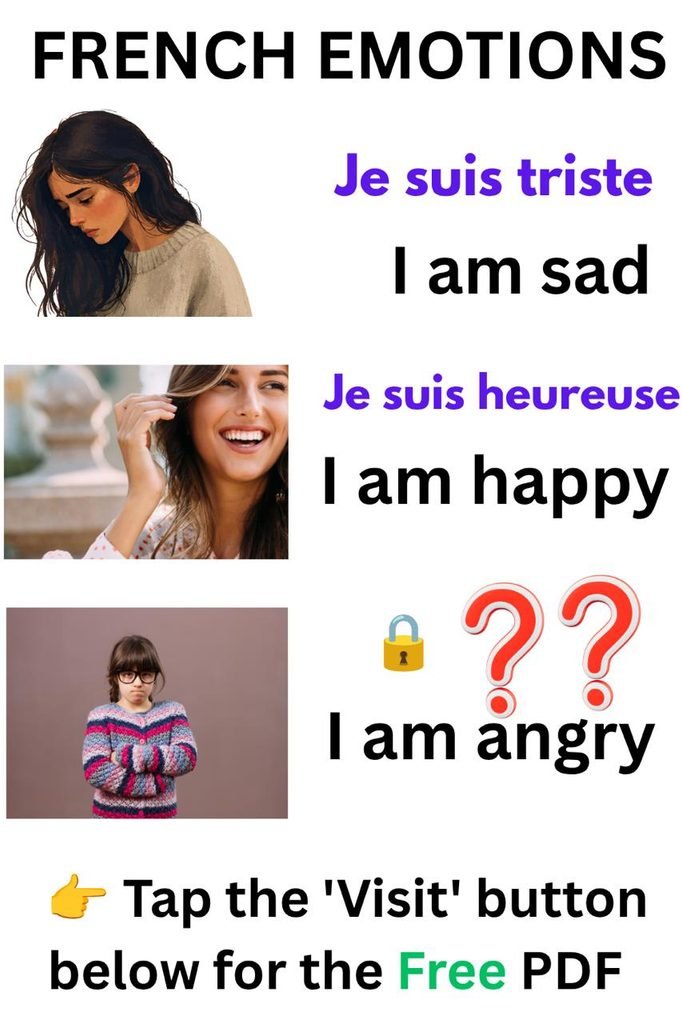
Save the image above to your Pinterest board so you can revise these French emotion words whenever you need them. (Hover on the image to see the save button).
👇Click the button below to instantly download your Free 3-Page French Emotions PDF!
Ready to test your French? Play the quiz first, discover your score, and then learn 20 useful emotions with examples you can use in everyday conversations.
Why? Heureux means happy when describing a masculine person, while heureuse is the feminine form. A birthday surprise is a perfect reason to feel happy! Why? Triste means sad. The spelling stays the same for masculine and feminine subjects. Why? Fatigué means tired for a masculine person, and fatiguée is used for a feminine person. Why? The natural French expression for “I am angry” is Je suis en colère. It works regardless of the speaker’s gender. Why? Surpris is masculine, while surprise is feminine. You might feel this way when someone plans an unexpected party! Why? Inquiet means worried for a masculine person, and inquiète is the feminine form. Why? Fier means proud for a masculine person, while fière is the feminine form Why? Elle refers to a feminine subject, so the adjective must be nerveuse. The masculine form is nerveux. Why? Triste has the same spelling for masculine and feminine subjects. You don’t need to change it. Why? Déçue means disappointed and is the feminine form. A masculine speaker would say déçu.Results


#1. You just received a wonderful birthday gift. How do you feel?
#2. Your friend looks upset and wants to be alone. Which word means “sad”?
#3. You stayed awake all night studying. How might you feel?
#4. Someone takes your seat on the train, and you feel angry. Which expression should you use?
#5. Which French word means “surprised”?
#6. You have an important exam tomorrow and cannot stop worrying. How do you feel?
#7. Your team wins a difficult competition. You feel proud. Which word fits?
#8. Complete the sentence: “Elle est très ______.” (She is very nervous.)
#9. True or false: “Je suis triste” can be said by both a man and a woman.
#10. Your friend says, “Je suis déçue.” What does this mean?
Quiz challenge complete! Count how many you answered correctly, then continue below to learn more emotions and make your French sound more natural.
Learn 20 French Emotions and Feelings
Here are 20 useful French emotion words and expressions to add to your everyday vocabulary. Read each word aloud and try making your own sentence.
| French emotion | English meaning | Masculine / Feminine |
|---|---|---|
| Heureux / Heureuse | Happy | Heureux / Heureuse |
| Triste | Sad | Triste / Triste |
| Content / Contente | Pleased, happy | Content / Contente |
| Fatigué / Fatiguée | Tired | Fatigué / Fatiguée |
| Fâché / Fâchée | Upset, angry | Fâché / Fâchée |
| En colère | Angry | Same expression |
| Calme | Calm | Calme / Calme |
| Surpris / Surprise | Surprised | Surpris / Surprise |
| Inquiet / Inquiète | Worried | Inquiet / Inquiète |
| Nerveux / Nerveuse | Nervous | Nerveux / Nerveuse |
| Fier / Fière | Proud | Fier / Fière |
| Honteux / Honteuse | Ashamed | Honteux / Honteuse |
| Jaloux / Jalouse | Jealous | Jaloux / Jalouse |
| Amoureux / Amoureuse | In love | Amoureux / Amoureuse |
| Déçu / Déçue | Disappointed | Déçu / Déçue |
| Ennuyé / Ennuyée | Bored | Ennuyé / Ennuyée |
| Frustré / Frustrée | Frustrated | Frustré / Frustrée |
| Effrayé / Effrayée | Frightened | Effrayé / Effrayée |
| Confus / Confuse | Confused | Confus / Confuse |
| Stressé / Stressée | Stressed | Stressé / Stressée |
Quick tip: In this table, the masculine and feminine forms are listed separately wherever the spelling changes. Some adjectives, such as triste and calme, stay the same.
💬 Use These Emotions in Real French Sentences
Knowing a word is useful, but using it in a sentence helps you remember it.
1. Je suis heureuse aujourd’hui.
I am happy today.
A female speaker uses heureuse. A male speaker would say heureux.
2. Il est fatigué après le travail.
He is tired after work.
Il means “he,” so we use the masculine form fatigué.
3. Elle est inquiète pour son examen.
She is worried about her exam.
Inquiète agrees with the feminine subject elle.
4. Nous sommes contents.
We are happy or pleased.
For a group of men or a mixed-gender group, use contents. For a group consisting entirely of women, use contentes.
5. Je suis en colère contre lui.
I am angry with him.
The expression en colère does not change according to the speaker’s gender.
6. Elle est fière de son travail.
She is proud of her work.
The feminine form of fier is fière.
Notice the pattern? French adjectives often change to agree with the person or people being described. Let’s make that rule easy to remember.
🧠 French Grammar Made Easy: Masculine vs Feminine Emotions
In French, many emotion words are adjectives. When you use them with être (to be), they usually agree with the subject’s gender and number.
For example:
- Il est heureux. — He is happy.
- Elle est heureuse. — She is happy.
- Ils sont heureux. — They are happy (a masculine or mixed group).
- Elles sont heureuses. — They are happy (an all-female group).
You do not need to memorize every rule at once. Start with the patterns below.
Rule 1: Add -e to many masculine adjectives
Many adjectives form the feminine by adding -e.
| Masculine | Feminine | Meaning |
|---|---|---|
| Fatigué | Fatiguée | Tired |
| Stressé | Stressée | Stressed |
| Déçu | Déçue | Disappointed |
| Frustré | Frustrée | Frustrated |
Remember: If the masculine form already ends in -e, the spelling may stay the same, as in triste and calme.
Rule 2: Some adjectives change more than one letter
Not every feminine form simply adds an -e. Some words have a different spelling.
| Masculine | Feminine | Meaning |
|---|---|---|
| Heureux | Heureuse | Happy |
| Nerveux | Nerveuse | Nervous |
| Inquiet | Inquiète | Worried |
| Fier | Fière | Proud |
| Jaloux | Jalouse | Jealous |
| Amoureux | Amoureuse | In love |
Learn these pairs together so you can recognize them quickly when reading or speaking French.
Rule 3: The subject determines the adjective
Look at who you are describing, not who you are speaking to.
- Je suis heureux. — I am happy. (A male speaker)
- Je suis heureuse. — I am happy. (A female speaker)
- Marie est stressée. — Marie is stressed.
- Paul est stressé. — Paul is stressed.
With je, the adjective agrees with the speaker. With il and elle, it agrees with the person being described.
Rule 4: Some expressions do not change
A useful example is:
Je suis en colère. — I am angry.
You can use this expression whether the speaker is male or female. It is often more natural than trying to translate “angry” word for word.
Also remember that French uses different expressions depending on the meaning. For example, ennuyé(e) can describe being bored, while je m’ennuie means “I am bored” or “I’m getting bored.”
Rule 5: Watch out for plural forms
When describing more than one person, adjectives often change again.
- Ils sont fatigués. — They are tired. (Men or a mixed group)
- Elles sont fatiguées. — They are tired. (All women)
The extra letters are often silent in everyday speech, so listening and reading together can help you recognize the difference.
📥 Download Your Free French Emotions PDF
Want to revise these words without opening the website every time?
Download your Free French Emotions PDF and keep the vocabulary handy for your next French practice session. Use it to revise the words, review masculine and feminine forms, and create your own sentences.
| French Word | English Meaning | Easy Pronunciation |
|---|---|---|
| Heureux / Heureuse | Happy | uh-ruh / uh-ruhz |
| Triste | Sad | treest |
| Content / Contente | Pleased, happy | kon-tahn / kon-tahnt |
| Fatigué / Fatiguée | Tired | fa-tee-gay |
| Fâché / Fâchée | Angry, upset | fah-shay |
| En colère | Angry | ahn koh-lair |
| Calme | Calm | kah-lm |
| Surpris / Surprise | Surprised | sühr-pree / sühr-preez |
| Inquiet / Inquiète | Worried | an-kyay / an-kyet |
| Nerveux / Nerveuse | Nervous | nair-vuh / nair-vuhz |
| Fier / Fière | Proud | fyair |
| Honteux / Honteuse | Ashamed | on-tuh / on-tuhz |
| Jaloux / Jalouse | Jealous | zhah-loo / zhah-looz |
| Amoureux / Amoureuse | In love | ah-muh-ruh / ah-muh-ruhz |
| Déçu / Déçue | Disappointed | day-sü |
| Ennuyé / Ennuyée | Bored | ahn-nwee-yay |
| Frustré / Frustrée | Frustrated | früs-tray |
| Effrayé / Effrayée | Frightened | ay-fray-yay |
| Confus / Confuse | Confused | kon-fü / kon-füz |
| Stressé / Stressée | Stressed | strays-say |
A Quick Pronunciation Tip
French contains some sounds that do not exist in English. In words such as déçu and surpris, the French u sound is different from the English “oo” sound. Listen to native French speakers and repeat the words slowly to improve your pronunciation.
Practice challenge: Choose three emotions from the table and say them aloud. Then use each one in a short sentence beginning with Je suis (I am).
Ready for Your Next French Lesson?
Now that you can express your feelings in French, why not learn some useful time-related vocabulary too?
👉 Continue learning: [Months of the Year in French]
Learn the French names of the months and build your everyday vocabulary one fun lesson at a time!