You might know how to say Estoy bien (I am fine), but what if you want to express a more specific emotion?
Learning Spanish feelings helps you describe your mood, understand other people, and make everyday conversations more natural. In this beginner-friendly lesson, you will discover 20 useful Spanish emotions, practise them through a fun quiz, and learn simple grammar rules with real-life examples.
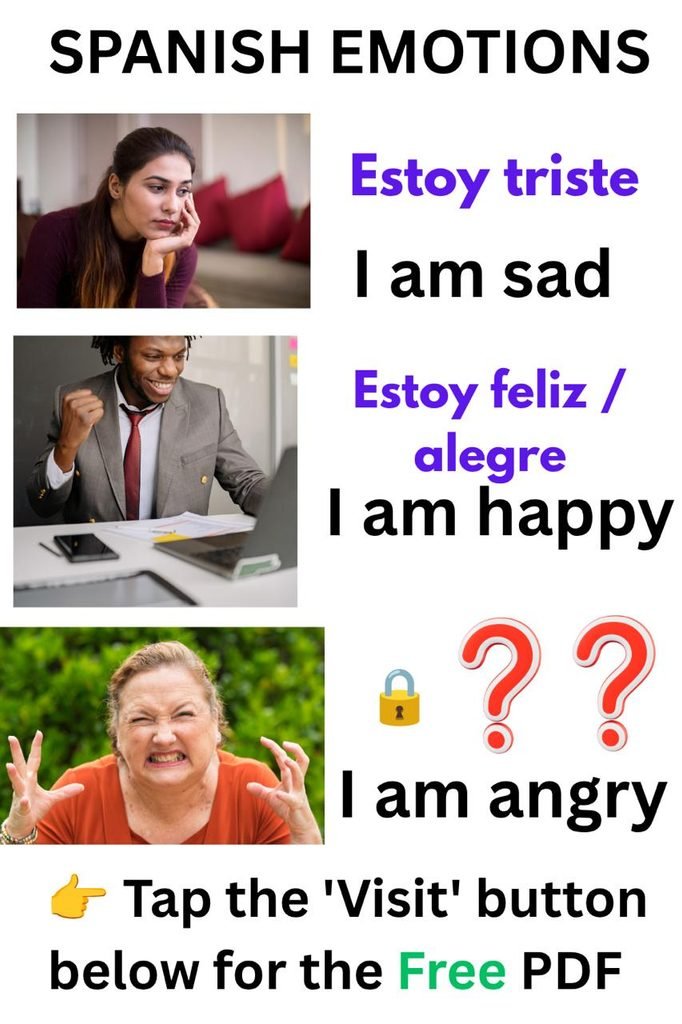
Save the image above to your Pinterest board so you can revise these Spanish emotion words whenever you need them. (Hover on the image to see the save button).
👇Click the button below to instantly download your Free 3-Page Spanish Emotional PDF!
Ready to test yourself? Play the quiz first, check your answers, and then explore the vocabulary and grammar below!
Feliz means happy in English. feliz stays the same for masculine and feminine singular subjects. You can use it for both a man and a woman. Triste means sad. The word estoy means “I am” in this sentence. When you want to say that you are sad, simply use Estoy triste. Cansada means tired and is the feminine form. The masculine form is cansado. Estoy cansado. — I am tired. (Masculine) Estoy cansada. — I am tired. (Feminine) Aburrido means bored. For a female student, it changes to “Estoy aburrida”. Unlike other emotions that use ‘Estoy’ (I am), fear uses ‘Tengo’ (I have), which literally means ‘I have fear’. Since the speaker is female, the adjective ending changes from ‘-o’ to ‘-a’, making it ‘sorprendida’. “Cansado” (male) or “cansada” (female) is the standard way to say tired in Spanish. “Orgulloso” means proud. A mother speaking would say “Estoy orgullosa”. “Emocionado” translates to being excited, thrilled, or enthusiastic about something. “Confundido” is a cognate, meaning it looks and sounds very similar to its English translation, “confused”.Results


#1. You just received a wonderful birthday gift. How do you feel?
#2. How do you say “I am sad” in Spanish?
#3. What does “Cansada” mean?
#4. If a student is yawning in class, they might say: “Estoy _______” (I am bored).
#5. What emotion does “Tengo miedo” represent?
#6. How would a female express “I am surprised” in Spanish?
#7. Choose the correct translation for “I am tired”.
#8. What does “Estoy orgulloso” mean when a parent says it to their child?
#9. If you win a competition, you will shout: “Estoy _____ !” (I am excited).
#10. “Estoy confundido” means:
Quiz challenge complete! Count your correct answers and see how many Spanish emotions you already know. Now let’s build your vocabulary and learn how to use these words naturally.
Learn 20 Spanish Emotions and Feelings
Here are 20 useful Spanish emotion words for beginners. Notice the masculine and feminine forms, and try saying each word aloud.
| Spanish emotion | English meaning |
|---|---|
| Feliz | Happy |
| Triste | Sad |
| Contento/a | Pleased, happy |
| Cansado/a | Tired |
| Enfadado/a | Angry, annoyed |
| Enojado/a | Angry, upset |
| Tranquilo/a | Calm |
| Sorprendido/a | Surprised |
| Preocupado/a | Worried |
| Nervioso/a | Nervous |
| Orgulloso/a | Proud |
| Avergonzado/a | Embarrassed, ashamed |
| Celoso/a | Jealous |
| Enamorado/a | In love |
| Decepcionado/a | Disappointed |
| Aburrido/a | Bored |
| Frustrado/a | Frustrated |
| Asustado/a | Frightened, scared |
| Confundido/a | Confused |
| Estresado/a | Stressed |
Quick tip: In the table, -o/a represents two forms. For example, cansado is masculine and cansada is feminine. Words such as feliz and triste do not change their spelling according to gender.
Also, enfadado/a and enojado/a both mean angry. Enfadado/a is especially common in Spain, while enojado/a is widely used in Latin America. Usage varies by region.
💬 Use Spanish Emotions in Real-Life Sentences
Memorising a vocabulary list is a good start, but using emotions in sentences helps you remember them in context.
1. Estoy feliz hoy.
I am happy today.
Feliz works for both masculine and feminine speakers.
2. Mi hermano está cansado después del trabajo.
My brother is tired after work.
Use cansado because mi hermano is masculine.
3. Ella está preocupada por su examen.
She is worried about her exam.
Preocupada agrees with the feminine subject ella.
4. Estamos contentos con los resultados.
We are pleased with the results.
Contentos is used for a group of men or a mixed-gender group. For an all-female group, use contentas.
5. Estoy enfadado con mi amigo.
I am angry with my friend.
A masculine speaker uses enfadado. A feminine speaker would say enfadada.
6. Mi hermana está orgullosa de su trabajo.
My sister is proud of her work.
The feminine form of orgulloso is orgullosa.
7. Estoy nervioso antes de la entrevista.
I am nervous before the interview.
A feminine speaker would say nerviosa.
Notice the pattern? Many Spanish adjectives change their endings depending on the person or people being described. Let’s make this rule easy to understand.
🧠 Spanish Grammar Made Easy: Masculine vs. Feminine Emotions
Many Spanish emotion words are adjectives. When you use them with estar (to be), they usually agree with the gender and number of the subject.
For example:
- Él está cansado. — He is tired.
- Ella está cansada. — She is tired.
- Ellos están cansados. — They are tired (a masculine or mixed-gender group).
- Ellas están cansadas. — They are tired (an all-female group).
You do not need to memorise every pattern at once. Start with these simple rules.
Rule 1: Change -o to -a
Many Spanish adjectives form the feminine by changing the final -o to -a.
| Masculine | Feminine | Meaning |
|---|---|---|
| Cansado | Cansada | Tired |
| Nervioso | Nerviosa | Nervous |
| Preocupado | Preocupada | Worried |
| Estresado | Estresada | Stressed |
| Orgulloso | Orgullosa | Proud |
Remember: The ending depends on the person being described, not simply on whether you are speaking to a man or a woman.
Rule 2: Some adjectives do not change
Some emotion adjectives have the same spelling for masculine and feminine subjects.
| Masculine | Feminine | Meaning |
|---|---|---|
| Feliz | Feliz | Happy |
| Triste | Triste | Sad |
For example:
- Carlos está feliz. — Carlos is happy.
- María está feliz. — María is happy.
- Carlos está triste. — Carlos is sad.
- María está triste. — María is sad.
The spelling remains the same in all four sentences.
Rule 3: Remember the plural forms
When describing several people, many adjectives also change to show whether the group is masculine, mixed, or entirely feminine.
- Ellos están cansados. — They are tired (men or a mixed group).
- Ellas están cansadas. — They are tired (all women).
- Ellos están nerviosos. — They are nervous (men or a mixed group).
- Ellas están nerviosas. — They are nervous (all women).
For adjectives such as feliz, the plural is felices:
- Ellos están felices. — They are happy.
- Ellas están felices. — They are happy.
Rule 4: When should you use ser or estar?
For describing how someone feels at a particular moment, Spanish normally uses estar.
- Estoy triste. — I am sad.
- Estoy cansada. — I am tired. (Feminine speaker)
- Estamos emocionados. — We are excited. (Masculine or mixed group)
Compare these with ser, which is commonly used to describe more lasting characteristics or personality traits.
For example:
Soy una persona tranquila. — I am a calm person.
Estoy tranquilo/a. — I am calm.
As a beginner, remember this practical pattern: estar + emotion adjective is useful for describing how you feel.
Rule 5: Do not confuse aburrido with aburrirse
Spanish has two useful ways to talk about boredom.
- Estoy aburrido/a. — I am bored.
- Me aburro en clase. — I get bored in class.
The first describes how you feel. The second uses the reflexive verb aburrirse, meaning “to get bored” or “to become bored.”
Learning both expressions will help you sound more natural in everyday Spanish.
📥 Download Your Free Spanish Emotions PDF
Want to practise these words without opening the website every time?
Download your Free Spanish Emotions PDF and keep the vocabulary handy for your next Spanish practice session. Use it to revise the 20 emotions, review masculine and feminine forms, and create your own sentences.
Spanish Emotions: Pronunciation Guide
| Spanish Word | Pronunciation | English Meaning |
|---|---|---|
| Feliz | feh-LEES | Happy |
| Triste | TREES-teh | Sad |
| Contento/a | kohn-tehn-toh / kohn-tehn-tah | Pleased, happy |
| Cansado/a | kahn-SAH-doh / kahn-SAH-dah | Tired |
| Enfadado/a | ehn-fah-DAH-doh / ehn-fah-DAH-dah | Angry, annoyed |
| Enojado/a | eh-noh-HAH-doh / eh-noh-HAH-dah | Angry, upset |
| Tranquilo/a | trahn-KEE-loh / trahn-KEE-lah | Calm |
| Sorprendido/a | sohr-prehn-DEE-doh / sohr-prehn-DEE-dah | Surprised |
| Preocupado/a | preh-oh-koo-PAH-doh / preh-oh-koo-PAH-dah | Worried |
| Nervioso/a | nehr-BYOH-soh / nehr-BYOH-sah | Nervous |
| Orgulloso/a | ohr-goo-YOH-soh / ohr-goo-YOH-sah | Proud |
| Avergonzado/a | ah-behr-gohn-SAH-doh / ah-behr-gohn-SAH-dah | Embarrassed, ashamed |
| Celoso/a | seh-LOH-soh / seh-LOH-sah | Jealous |
| Enamorado/a | eh-nah-moh-RAH-doh / eh-nah-moh-RAH-dah | In love |
| Decepcionado/a | deh-sehp-syoh-NAH-doh / deh-sehp-syoh-NAH-dah | Disappointed |
| Aburrido/a | ah-boo-RREE-doh / ah-boo-RREE-dah | Bored |
| Frustrado/a | froos-TRAH-doh / froos-TRAH-dah | Frustrated |
| Asustado/a | ah-soos-TAH-doh / ah-soos-TAH-dah | Frightened |
| Confundido/a | kohn-foon-DEE-doh / kohn-foon-DEE-dah | Confused |
| Estresado/a | ehs-treh-SAH-doh / ehs-treh-SAH-dah | Stressed |
Note: These are approximate pronunciation guides, not exact phonetic transcriptions. Spanish pronunciation varies by region. In this guide, “h” represents an English-style breath sound where needed, and “rr” represents the strong Spanish rolled-r sound.
📚 Keep Learning Spanish!
[Learn Spanish Alphabets Easily: Free Printable PDF chart Inside]