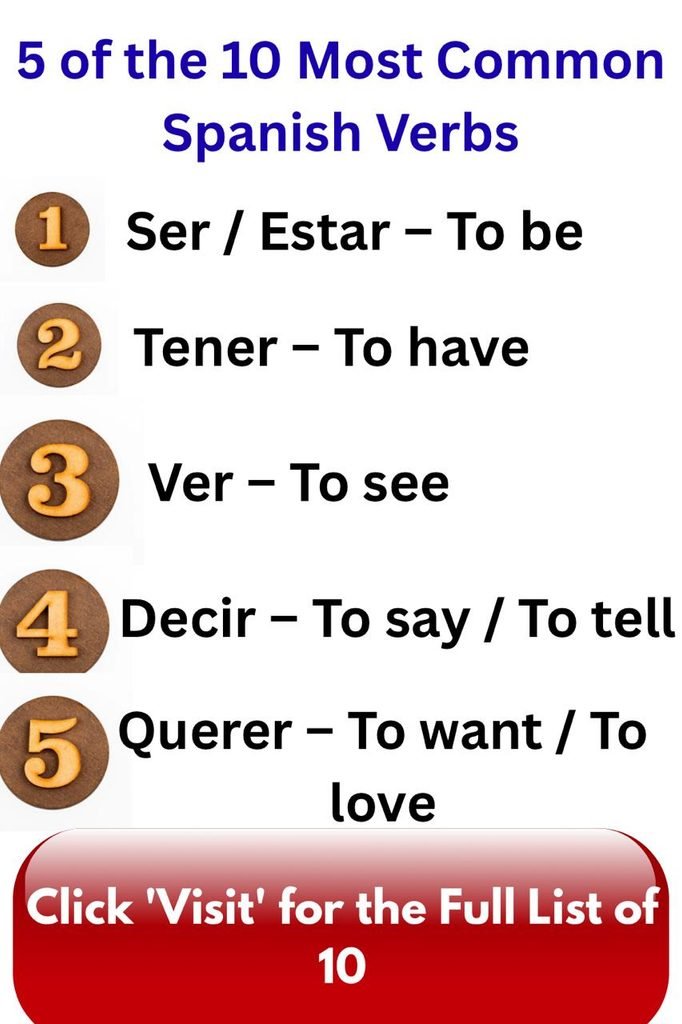
Download your free Spanish verbs PDF to revise the meanings, useful sentence patterns, and essential conjugations whenever you need a quick refresher.
Save This Spanish Verbs Cheat Sheet on Pinterest
Spanish Verb Challenge: 10 Questions to Test Yourself
Tener means “to have.” You could say Tengo un teléfono nuevo, meaning “I have a new phone.” Use estar to express location. Estoy is its first-person singular form, used with yo (I). Soy de India means “I am from India.” The verb ser is commonly used to express origin. Querer expresses wanting. Quiero café is a simple, useful sentence when ordering a drink. Vemos is the present-tense form of ver used with nosotros (we). The sentence means “We watch a movie” or “We are watching a movie.” Dice is the correct form of decir for ella. Remember that digo means “I say,” while dice means “he or she says.” Spanish uses tener hambre, literally “to have hunger,” to express being hungry. This is a useful example of why direct word-for-word translation does not always work. Spanish expresses age using tener. The phrase literally resembles “I have eighteen years,” but the natural English translation is “I am eighteen years old.” Quiero means “I want,” and aprender means “to learn.” The pattern querer + infinitive helps you express things you want to do. Estoy feliz describes how you feel, while quiero aprender español means “I want to learn Spanish.” This question combines two different verb patterns in one sentence.Results


#1. You want to tell someone that you have a new phone. Which verb do you need?
#2. Your friend asks where you are. Which sentence means “I am at home”?
#3. Complete the sentence: Yo _____ de India.
#4. The waiter asks whether you want coffee. You want to say, “I want coffee.”
#5. Complete the sentence: Nosotros _____ una película.
#6. Which sentence correctly means “She tells the truth”?
#7. Someone asks why you are looking for food. You want to say, “I am hungry.” Which expression is natural Spanish?
#8. What does Tengo dieciocho años mean?
#9. Lucía says: Quiero aprender español. What does she mean?
#10. You meet a new person and want to say, “I am happy, and I want to learn Spanish.” Which sentence works?
Your challenge score
- 9–10 correct: You’re off to a strong start. Try creating your own sentences next.
- 7–8 correct: Great work! Review the forms that confused you.
- 4–6 correct: You know some useful vocabulary. Practise using it in context.
- 0–3 correct: No problem. The lesson below will help you build your foundation.
The aim is not just to memorize answers. Try to understand why a particular verb fits each situation.
4. Learn These Spanish Verbs Through Real Conversations
Spanish becomes much more useful when you can do something with it. You might introduce yourself, tell a friend how you feel, order a drink, or explain what you want to do next.
The verbs in this guide help you handle exactly these kinds of situations. Let’s explore them through practical examples rather than memorizing a list of English translations.
Ser and estar: Two ways to say “to be”
Imagine someone asks you two different questions:
- ¿De dónde eres? — Where are you from?
- ¿Cómo estás? — How are you?
Although both questions use forms of “to be” in English, Spanish uses different verbs.
You would answer the first question with Soy de India (I am from India) and the second with Estoy bien (I am well).
The distinction is important because ser and estar communicate different kinds of information.
Use ser for identity, origin, professions, and characteristics:
| Spanish | English |
|---|---|
| Yo soy | I am |
| Tú eres | You are |
| Él / Ella es | He / She is |
| Nosotros somos | We are |
| Ellos / Ellas son | They are |
For example, Ella es profesora means “She is a teacher,” and Somos amigos means “We are friends.”
Use estar for location, feelings, and conditions:
| Spanish | English |
|---|---|
| Yo estoy | I am |
| Tú estás | You are |
| Él / Ella está | He / She is |
| Nosotros estamos | We are |
| Ellos / Ellas están | They are |
For example, Estoy cansado means “I am tired,” and El libro está aquí means “The book is here.”
One useful warning: the difference is not simply that ser describes permanent things and estar describes temporary things. Spanish has more nuanced rules, and some adjectives change meaning depending on the verb.
Try this: If you are describing your nationality, which verb would you normally choose? If you are telling someone where your keys are, which verb fits? Thinking about the meaning of the whole sentence is more reliable than translating individual words.
Tener: The verb behind hunger, age, and possessions
Suppose a friend asks whether you have a notebook. You can reply, Sí, tengo un cuaderno (Yes, I have a notebook).
The same verb helps you talk about your age and physical needs.
| Spanish form | Meaning |
|---|---|
| Tengo | I have |
| Tienes | You have |
| Tiene | He / She has |
| Tenemos | We have |
| Tienen | They have |
Notice that the stem changes in tienes and tiene, but not in tenemos. This is a useful pattern to recognize when learning Spanish conjugations.
Now consider these expressions:
- Tengo hambre. — I am hungry.
- Tengo sed. — I am thirsty.
- Tengo sueño. — I am sleepy.
- Tengo frío. — I am cold.
These phrases are worth learning as complete units. If you memorize only the individual word hambre, you might still produce the unnatural sentence Soy hambre. Learning the whole expression helps you avoid that mistake.
A small conversation:
— ¿Tienes hambre? — Are you hungry?
— Sí, tengo hambre. — Yes, I am hungry.
Once you know this pattern, you can recognize and use it in many everyday conversations.
Ver: From seeing things to watching movies
You do not need advanced vocabulary to start using ver. Look around your room, and you can immediately make sentences about what you see.
Veo una ventana means “I see a window.” If you are watching a film with friends, Vemos una película means “We are watching a movie.”
Here are the essential present-tense forms:
- Yo veo — I see
- Tú ves — You see
- Él / Ella ve — He / She sees
- Nosotros vemos — We see
- Ellos / Ellas ven — They see
Unlike many Spanish verbs, ver does not follow the most common regular pattern completely. Its first-person form is veo, not vo.
The verb also appears in everyday expressions such as Nos vemos, meaning “See you” or “We’ll see each other,” depending on context.
Make it practical: Write down three things you can see right now. Turn each into a sentence beginning with Veo…. This small exercise connects vocabulary with your surroundings.
Decir: Sharing information and asking questions
Imagine your friend tells you a story, but you did not hear the last sentence. You could ask ¿Qué dices? (What are you saying?) or, depending on the situation, ¿Qué dijiste? (What did you say?).
The first uses the present tense, while the second uses the past tense. For now, focus on the present-tense forms:
- Yo digo — I say / tell
- Tú dices — You say / tell
- Él / Ella dice — He / She says / tells
- Nosotros decimos — We say / tell
- Ellos / Ellas dicen — They say / tell
The form digo is irregular, so it is best learned through examples.
For instance, Digo la verdad means “I tell the truth,” and Ella dice hola means “She says hello.”
You can also use decir when reporting information:
Mi amigo dice que sí. — My friend says yes.
As you progress, you will encounter decir in different tenses. Learning the present forms first gives you a foundation for those later lessons.
Watch out: Do not use digo with every subject. Spanish changes the verb form to match the person performing the action.
Querer: Expressing wishes and affection
Imagine you are planning a trip with a friend. You want to visit Spain, learn more Spanish, and try local food. The verb querer helps you express those intentions.
- Quiero viajar. — I want to travel.
- Quiero aprender español. — I want to learn Spanish.
- Quiero probar la comida. — I want to try the food.
The basic pattern is straightforward: conjugate querer and follow it with an infinitive when you want to say what you want to do.
Its present-tense forms include quiero (I want), quieres (you want), quiere (he or she wants), queremos (we want), and quieren (they want).
Notice the vowel change from e to ie in several forms. However, queremos keeps the original e. Recognizing which forms change is an important part of learning this verb.
Querer can also express affection. For example, Te quiero is commonly used to say “I love you” or “I care about you.” The precise feeling depends on the relationship and context.
Build your own sentence: Choose an activity you enjoy, such as reading, travelling, or cooking. Then use Quiero + infinitive to describe something you want to do.
Hacer — To Do or To Make
Imagine someone asks what you’re doing today. You might be finishing homework, preparing dinner, or making plans with friends. The verb hacer helps you talk about these everyday activities.
- Hago la tarea. — I do the homework.
- ¿Qué haces? — What are you doing?
- Hacemos la cena. — We make dinner.
Its present-tense forms are hago, haces, hace, hacemos, hacéis, hacen.
Notice the irregular first-person form hago. Instead of memorizing it in isolation, practise it in a sentence such as Hago ejercicio (I exercise).
Quick challenge: How would you say “She does the homework”? The answer is Ella hace la tarea.
Ir — To Go
From going to school to planning a holiday, ir is essential for talking about destinations and movement.
- Voy a casa. — I’m going home.
- Vamos al parque. — We’re going to the park.
- ¿Adónde vas? — Where are you going?
The present-tense forms are voy, vas, va, vamos, vais, van.
Unlike a regular verb, ir has several forms that cannot be predicted from the infinitive. Learn them through useful expressions rather than trying to apply a regular pattern.
You can also use ir a + infinitive to talk about future plans: Voy a estudiar means “I’m going to study.”
Quick challenge: Complete this sentence: Nosotros _____ al cine. The correct answer is vamos.
Hablar — To Speak or To Talk
Want to tell someone which languages you speak? Use hablar. It is a regular -ar verb, making it a helpful model for learning other verbs with the same ending.
- Hablo español. — I speak Spanish.
- ¿Hablas inglés? — Do you speak English?
- Hablamos todos los días. — We talk every day.
Its present-tense forms are hablo, hablas, habla, hablamos, habláis, hablan.
Notice how the ending changes with the subject. Once you recognize this pattern, you can use it to help conjugate other regular -ar verbs.
Quick challenge: How would you say “They speak Spanish”? The answer is Ellos hablan español.
Comer — To Eat
Food is an easy way to practise Spanish in real-life situations. Whether you’re ordering lunch or talking about your favourite meal, comer will come in handy.
- Como una manzana. — I eat an apple.
- Comemos juntos. — We eat together.
- ¿Quieres comer? — Do you want to eat?
The present-tense forms are como, comes, come, comemos, coméis, comen.
Unlike hacer and ir, comer follows a regular -er conjugation pattern in the present tense. Learning its endings can help you recognize how many other regular -er verbs work
Complete Spanish verb conjugation table
| Subject | Ser | Estar | Tener | Ver | Decir | Querer | Hacer | Ir | Hablar | Comer |
|---|---|---|---|---|---|---|---|---|---|---|
| Yo | soy | estoy | tengo | veo | digo | quiero | hago | voy | hablo | como |
| Tú | eres | estás | tienes | ves | dices | quieres | haces | vas | hablas | comes |
| Él / Ella | es | está | tiene | ve | dice | quiere | hace | va | habla | come |
| Nosotros/as | somos | estamos | tenemos | vemos | decimos | queremos | hacemos | vamos | hablamos | comemos |
| Vosotros/as | sois | estáis | tenéis | veis | decís | queréis | hacéis | vais | habláis | coméis |
| Ellos / Ellas | son | están | tienen | ven | dicen | quieren | hacen | van | hablan | comen |
| Ustedes | son | están | tienen | ven | dicen | quieren | hacen | van | hablan | comen |
Note for readers: Vosotros/as is commonly used for informal plural “you” in Spain. In most of Latin America, ustedes is used instead. Both are useful to recognize when learning Spanish.
5. Turn Vocabulary into a Daily Spanish Habit
Memorizing a verb once is easy; remembering it during a conversation takes practice. Instead of studying for hours in one sitting, use these verbs in small, meaningful activities.
Create a mini diary. Write three sentences about your day. You might describe who you are, how you feel, and what you want to do. For example, Soy estudiante. Estoy feliz. Quiero aprender español.
Change one detail at a time. Start with Tengo un libro. Change the subject to ella and the object to una mochila. This encourages you to think about both verb conjugation and vocabulary.
Practise recall without looking. Read an English sentence, cover the translation, and try to produce the Spanish version yourself. Check your answer afterwards.
Listen to real Spanish. Short beginner conversations, audio lessons, and pronunciation examples help you hear how the verbs sound in natural speech.
Return to difficult forms. If you confuse soy and estoy, revisit the context in which each is used. If you forget digo, practise it in a sentence rather than repeating the word in isolation.
You can also revisit the quiz at the beginning of this article after a few days. A second attempt will help you identify which forms you remember and which still need attention.
Keep Learning: Me Gustas Tú vs. Tú Me Gustas
Want to avoid one of the most confusing mistakes Spanish learners make? Continue with our next guide, Big Spanish Mistake! Me Gustas Tú vs. Tú Me Gustas: 10 Quiz Questions, Answers & Grammar Rules.
Learn why both expressions can be grammatically correct, understand how gustar works in Spanish, and test your knowledge with 10 quiz questions, answers, and clear grammar explanations.
Learning Spanish does not require you to memorize everything at once. Focus on understanding each word in context, creating your own sentences, and returning to what you have learned. With regular practice, these essential verbs will become easier to recognize and use in everyday conversation.