Welcome back to LingoMantra!
If you are learning French, one of the first things you should master is the days of the week.
Why? Because you will use them constantly.
You need French days of the week when talking about your schedule, making appointments, booking a hotel, planning a trip, talking about work or school, or simply telling someone what you are doing tomorrow.
In this complete beginner-friendly guide, you will learn:
- All 7 days of the week in French
- Their pronunciation
- How to use each day in a sentence
- Important French capitalization rules
- How to say today, tomorrow, and yesterday
- Useful expressions with French days
- Common mistakes beginners make
- A quick memory trick
- A mini French quiz to test yourself
So, let’s start!
Days of the Week in French (Les Jours de la Semaine)
The French word for day is jour, while the week is la semaine.
So:
Days of the week = Les jours de la semaine
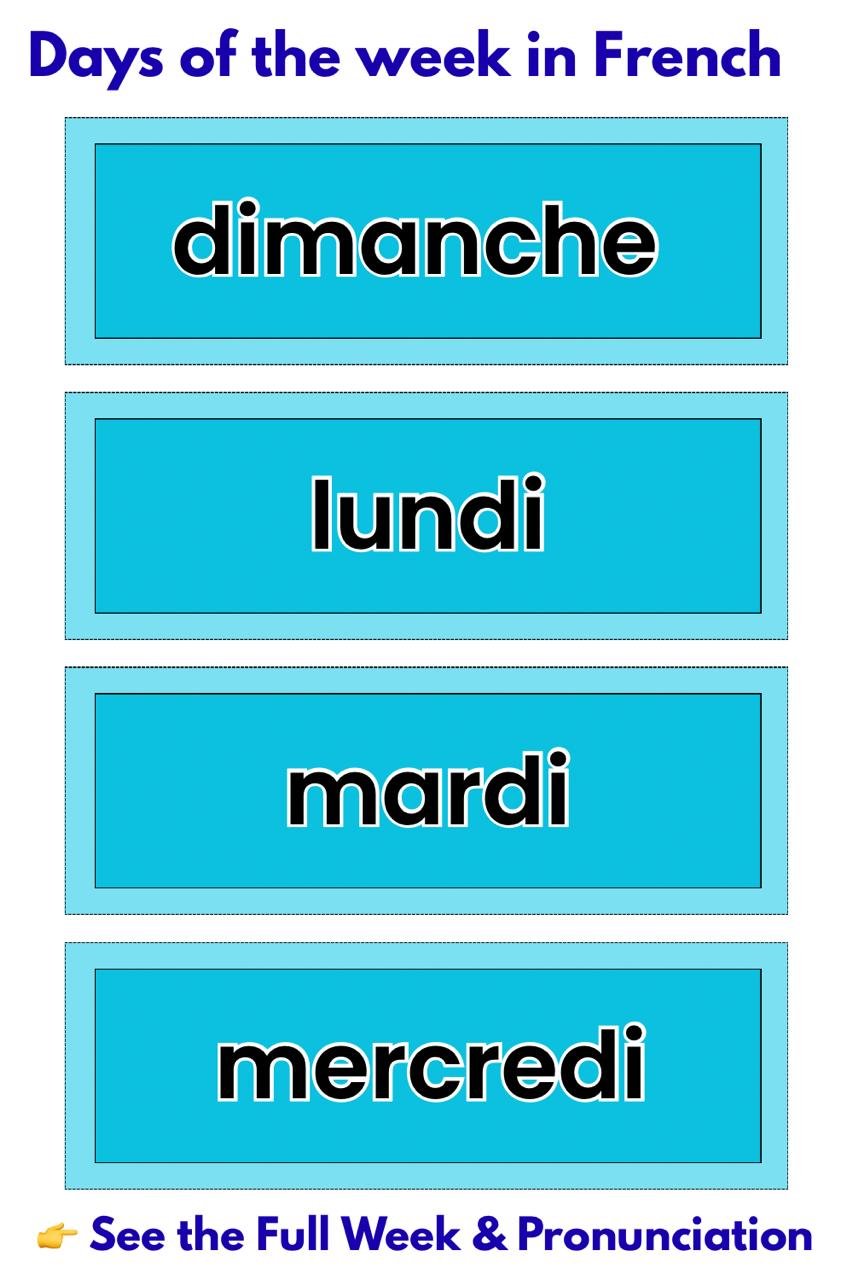
Here are all seven days:
English
French
Approximate Pronunciation
Monday
lundi
luhn-dee
Tuesday
mardi
mar-dee
Wednesday
mercredi
mehr-kruh-dee
Thursday
jeudi
zhuh-dee
Friday
vendredi
vahn-druh-dee
Saturday
samedi
sam-dee
Sunday
dimanche
dee-mahnsh
Important: The pronunciations above are only approximate English guides. French pronunciation is easier to learn by listening and repeating rather than reading the English spelling.
🔊 Pronunciation Practice
1. Monday = Lundi
- Pronunciation: Luhn-dee
Say it three times:
lundi — lundi — lundi
Je travaille lundi.= I work on Monday.
- 🔊 Listen to the audio below to practice
Welcome back to LingoMantra!
If you are learning French, one of the first things you should master is the days of the week.
Why? Because you will use them constantly.
You need French days of the week when talking about your schedule, making appointments, booking a hotel, planning a trip, talking about work or school, or simply telling someone what you are doing tomorrow.
In this complete beginner-friendly guide, you will learn:
- All 7 days of the week in French
- Their pronunciation
- How to use each day in a sentence
- Important French capitalization rules
- How to say today, tomorrow, and yesterday
- Useful expressions with French days
- Common mistakes beginners make
- A quick memory trick
- A mini French quiz to test yourself
So, let’s start!
So:
Days of the week = Les jours de la semaine
Here are all seven days:
| English | French | Approximate Pronunciation |
|---|---|---|
| Monday | lundi | luhn-dee |
| Tuesday | mardi | mar-dee |
| Wednesday | mercredi | mehr-kruh-dee |
| Thursday | jeudi | zhuh-dee |
| Friday | vendredi | vahn-druh-dee |
| Saturday | samedi | sam-dee |
| Sunday | dimanche | dee-mahnsh |
🔊 Pronunciation Practice
- Pronunciation: Luhn-dee
Say it three times:
lundi — lundi — lundi
Je travaille lundi.= I work on Monday.
- 🔊 Listen to the audio below to practice
- Pronunciation: Mar-dee
Example:
Je vais à Paris mardi.= I am going to Paris on Tuesday.
You may notice that mardi looks and sounds somewhat similar to the English word “Tuesday” only in meaning, not pronunciation.
Remember
mardi = Tuesday
Practice:
mardi — mardi — mardi
🔊 Listen to the audio below to practice:
- Pronunciation: mehr-kruh-dee
- 🔊 Listen to the audio below to practice:
This is one of the longer French day names, so beginners often find it difficult at first.
Break it into parts:
mer — cre — di
Then say it naturally:
mercredi
Example:
Nous avons un cours mercredi.= We have a class on Wednesday.
Pronunciation Tip
Don’t try to pronounce every letter exactly as you would in English. Listen to native French pronunciation and repeat the whole word.
Practice:
mercredi — mercredi — mercredi
- Pronunciation: Zhuh-dee
The beginning j has a soft sound similar to the sound in the middle of the English word “measure.”
Example:
Je joue au football jeudi.= I play football on Thursday.
Easy Pronunciation Trick
Think of:
jeu + di → jeudi
Practice:
jeudi — jeudi — jeudi
- 🔊 Listen to the audio below to practice
- Pronunciation: Vahn-druh-dee
This is another longer day name, so don’t worry if it feels difficult initially.
Break it into smaller parts:
ven — dre — di
Then combine them:
vendredi
Example:
Nous sortons vendredi soir.= We are going out Friday evening.
You will also hear:
vendredi soir= Friday evening
🔊 Pronunciation Practice
Friday → vendredi
Practice:
vendredi — vendredi — vendredi
- 🔊 Listen to the audio below to practice:
- Pronunciation: sam-dee
Example:
Je fais du sport samedi.= I exercise on Saturday.
You may hear native speakers pronounce the word quite quickly, which can make it sound shorter than the spelling suggests.
Remember
samedi = Saturday
Practice:
samedi — samedi — samedi
- 🔊 Listen to the audio below to practice:
- Pronunciation: dee-mahnsh
The final sound is different from what an English speaker might expect from the spelling.
Example:
Je me repose dimanche.= I rest on Sunday.
Another useful expression is:
dimanche matin= Sunday morning
🔊 Pronunciation Practice
Sunday → dimanche
Practice:
dimanche — dimanche — dimanche
- 🔊 Listen to the audio below to practice:
The 7 French Days — Quick Revision
Before moving on, see if you can remember all seven without looking at the English translations.
French → English
lundi → Monday
mardi → Tuesday
mercredi → Wednesday
jeudi → Thursday
vendredi → Friday
samedi → Saturday
dimanche → Sunday
Now try saying them from memory:
lundi → mardi → mercredi → jeudi → vendredi → samedi → dimanche
Great!
You have just learned all seven days in French.
There are two important rules beginners should remember.
Rule 1: French Days Are Not Usually Capitalized
This is one of the biggest differences between English and French.
In English:
Monday, Tuesday, Wednesday
In French:
lundi, mardi, mercredi
French days are normally written in lowercase.
✅ Correct:
Je travaille lundi.
❌ Usually incorrect:
Je travaille Lundi.
The day can be capitalized if it appears at the beginning of a sentence, just like any other word.
Rule 2: The French Week Starts on Monday
In French-speaking contexts, the week is generally organized from:
lundi → mardi → mercredi → jeudi → vendredi → samedi → dimanche
So Monday (lundi) comes first.
This is also why you will commonly see calendars in France beginning with Monday.
How to Say “Today” in French
Knowing the days is useful, but you also need a few basic time expressions.
Today
Aujourd’hui = Today
Example:
Aujourd’hui, c’est lundi.
= Today is Monday.
Tomorrow
Demain = Tomorrow
Example:
Demain, c’est mardi.
= Tomorrow is Tuesday.
Yesterday
Hier = Yesterday
Example:
Hier, c’était dimanche.
= Yesterday was Sunday.
Try remembering these three together:
hier → aujourd’hui → demain
yesterday → today → tomorrow
How to Say “On Monday” in French
Here’s another important point for beginners.
When you want to say that something happens on a particular day, French commonly uses the day name directly.
For example:
Je travaille lundi.
= I work on Monday.
Nous étudions mardi.
= We study on Tuesday.
Je vais au cinéma vendredi.
= I am going to the cinema on Friday.
You don’t need to translate the English word “on” separately.
Every Monday vs This Monday
French has an interesting distinction.
If you say:
lundi
it can mean Monday or on Monday, depending on context.
But if you want to talk about something that happens every Monday, you can use:
le lundi
= every Monday / on Mondays
Example:
Je travaille le lundi.
= I work on Mondays.
Compare:
Je travaille lundi.
= I am working on Monday.
Je travaille le lundi.
= I work on Mondays.
This small difference is extremely useful in everyday French.
Useful French Expressions With Days
Here are some expressions you can start using immediately.
| French | |
|---|---|
| lundi matin- Monday morning | |
| mardi soir- Tuesday evening | |
| mercredi après-midi- Wednesday afternoon | |
| vendredi soir- Friday evening | |
| samedi matin- Saturday morning | |
| dimanche- Sunday | |
| ce lundi- this Monday | |
| la semaine prochaine- next week | |
| la semaine dernière- last week |
Example Sentences
Je travaille lundi matin.
= I work Monday morning.
Nous sortons vendredi soir.
= We are going out Friday evening.
Je fais du sport samedi matin.
= I exercise Saturday morning.
À lundi !
= See you Monday!
À demain !
= See you tomorrow!
A Simple Memory Trick
Having trouble remembering the seven French days?
Try grouping them.
Group 1: Short Days
lundi
mardi
jeudi
Group 2: Longer Days
mercredi
vendredi
Group 3: Weekend
samedi
dimanche
And remember this sequence:
L M M J V S D
Or say it aloud:
lundi → mardi → mercredi → jeudi → vendredi → samedi → dimanche
Repetition is one of the easiest ways to make these words automatic.
Can You Match Them?
Test yourself before checking the answers.
Question 1
Which French word means Friday?
A. mardi
B. vendredi
C. dimanche
D. mercredi
Question 2
Which French word means Sunday?
A. samedi
B. jeudi
C. dimanche
D. lundi
Question 3
What does mercredi mean?
A. Wednesday
B. Monday
C. Tuesday
D. Saturday
Question 4
What does jeudi mean?
A. Friday
B. Thursday
C. Tuesday
D. Sunday
Answers
1. B — vendredi
2. C — dimanche
3. A — Wednesday
4. B — Thursday
How many did you get right?
4/4? Excellent! 🎉
3/4? Very good!
2/4? Review the table once more.
0–1/4? No problem. Practice makes progress!
Fill in the Blanks
Now let’s make it a little harder.
Complete each sentence with the correct French day.
1. Monday = _______
2. Tuesday = _______
3. Wednesday = _______
4. Thursday = _______
5. Friday = _______
6. Saturday = _______
7. Sunday = _______
Answers
- lundi
- mardi
- mercredi
- jeudi
- vendredi
- samedi
- dimanche
Don’t just read the answers.
Try writing the seven words yourself from memory.
That extra step helps you remember them much longer.
French Days in a Real Conversation
Let’s see how these words actually appear in a conversation.
Conversation
Marie: Tu travailles demain ?
Paul: Oui, je travaille lundi.
Marie: Et mardi ?
Paul: Non, je suis libre mardi.
English
Marie: Are you working tomorrow?
Paul: Yes, I work Monday.
Marie: And Tuesday?
Paul: No, I’m free Tuesday.
Notice how naturally the day names appear in everyday conversation.
Once you know the days, you can start building many useful sentences around them.
Days of the Week + French Question Words
Want to have a real conversation about days and schedules?
Then your next step should be learning French question words.
Words such as:
- Quand ? = When?
- Quel jour ? = Which day?
- Pourquoi ? = Why?
- Comment ? = How?
- Où ? = Where?
- Qui ? = Who?
For example:
Quand travailles-tu ?
= When do you work?
Quel jour est-ce ?
= What day is it?
Learning question words will help you move from simply memorizing vocabulary to actually asking and answering questions in French.
👉 Continue learning: Learn the most important French Question Words and start building real French questions.
Quick Cheat Sheet
Save this section for revision.
| Day | French |
|---|---|
| Monday | lundi |
| Tuesday | mardi |
| Wednesday | mercredi |
| Thursday | jeudi |
| Friday | vendredi |
| Saturday | samedi |
| Sunday | dimanche |
Essential Time Words
hier = yesterday
aujourd’hui = today
demain = tomorrow
Useful Expressions
ce lundi = this Monday
le lundi = every Monday / on Mondays
vendredi soir = Friday evening
samedi matin = Saturday morning
à lundi ! = see you Monday!
Final Practice Challenge
Without looking above, can you write all seven French days in the correct order?
Start here:
1. ________
2. ________
3. ________
4. ________
5. ________
6. ________
7. ________
Now say them aloud.
If you can remember all seven without looking, you’re ready to start using them in simple French conversations.
Final Thoughts
Learning the days of the week may seem simple, but these seven words are part of the foundation of everyday French.
Start by memorizing:
lundi → mardi → mercredi → jeudi → vendredi → samedi → dimanche
Then practice using them in complete sentences.
For example:
Je travaille lundi.
Je suis libre mardi.
Nous sortons vendredi soir.
Je fais du sport samedi.
The more you use these words in context, the faster they will become natural.
And remember: French is not learned by memorizing words once. It is learned by using them again and again.
🇫🇷 Keep practicing, keep speaking, and keep learning with LingoMantra!
Next lesson: Learn French Question Words and discover how to ask who, what, when, where, why, and how in French.