Category: French Grammar

  • French Indefinite Articles: How to Use Un, Une & Des Easily

    A fun, beginner-friendly way to stop guessing French articles

    Let’s be honest.

    French can be beautiful.
    French can be romantic.
    And sometimes French grammar can make you think:

    “Wait… what?” 😅

    Especially when you see:

    J’ai ___ livre.

    UN?
    UNE?
    DES?

    If you’ve ever paused at a sentence like this, you’re not alone.

    The good news?

    UN, UNE and DES are much easier than they look.

    You don’t need a giant grammar chart.

    You just need 3 simple rules.

    Ready?

    Let’s make French articles easy. 🇫🇷✨


    🎯 First, Take a Guess!

    Before we explain the rules, let’s play a quick game.

    1. ___ garçon

    UN • UNE • DES

    What’s your guess?


    2. ___ fille

    UN • UNE • DES

    Got one?


    3. ___ livres

    UN • UNE • DES

    Don’t worry if you’re unsure.

    Making mistakes is part of learning.

    Now let’s discover the pattern. 👇


    🧩 Meet the French Article Trio

    Think of UN, UNE and DES as three little helpers.

    Each has a different job.

    Once you know what each one does, choosing the right article becomes much easier.


    🔵 UN — One Masculine Noun

    Pronunciation: uhn

    Use UN with a masculine singular noun.

    Easy shortcut:

    One + masculine = UN

    Examples:

    un garçon — a boy-uhn gar-SOHN

    un livre — a book-uhn LEE-vruh

    un chien — a dog-uhn shee-EN

    un café — a coffee-uhn ka-FAY

    So when you’re talking about one masculine noun, think:

    👉 UN

    For example:

    J’ai un livre.

    “I have a book.”

    Easy, right? 😊


    🩷 UNE — One Feminine Noun

    Now meet UNE.

    Use UNE with a feminine singular noun.

    Pronunciation: ewn

    Easy shortcut:

    One + feminine = UNE

    Examples:

    une fille — a girl-ewn FEEL

    une maison — a house-ewn meh-ZOHN

    une table — a table-ewn TAH-bluh

    une voiture — a car-ewn vwah-TOOR

    For example:

    J’ai une maison.

    “I have a house.”

    So remember:

    👉 One feminine noun = UNE


    🟡 DES — More Than One

    Now comes the easiest part.

    When a noun is plural, use:

    DES

    And here’s an important point:

    DES works with both masculine and feminine plural nouns.

    Pronunciation: day

    For example:

    des garçons — some boys-day gar-SOHN

    des filles — some girls-day FEEL

    des livres — some books-day LEE-vruh

    des maisons — some houses-day meh-ZOHN

    So your shortcut is:

    👥 More than one = DES

    No gender panic required. 😄


    🧠 The Whole Rule — Super Simple

    Forget complicated grammar terms for a moment.

    Just remember:

    🔵 UN

    Masculine + singular

    un garçon

    🩷 UNE

    Feminine + singular

    une fille

    🟡 DES

    Plural

    des livres

    That’s your basic French article system.


    ⚡ Remember It in 3 Seconds

    Here’s the easiest version:

    👨 One masculine → UN

    👩 One feminine → UNE

    👥 More than one → DES

    That’s it.

    Three little words.

    Three simple patterns.


    ⏱️ The 1-Minute Rule for French Articles

    Whenever you see a French noun, don’t panic.

    Just ask yourself two questions.

    Question 1: Is it plural?

    If yes:

    👉 DES

    If no, ask:

    Question 2: Is it masculine or feminine?

    Masculine:

    👉 UN

    Feminine:

    👉 UNE

    So your quick decision path is:

    Plural → DES

    Singular + masculine → UN

    Singular + feminine → UNE


    🧠 A Small Trick Your Future Self Will Thank You For

    Here’s one habit that can make French vocabulary much easier.

    Don’t learn:

    livre = book

    Instead, learn:

    un livre = a book

    Don’t learn:

    maison = house

    Learn:

    une maison = a house

    And don’t just learn:

    livres = books

    Learn:

    des livres = some books

    Why?

    Because French nouns have grammatical gender.

    When you learn the article + noun together, your brain gets an extra clue.

    After seeing un livre again and again, you won’t need to keep asking:

    “Was livre masculine?”

    Eventually, it simply feels right:

    un livre

    Done. 🎯


    🎮 Mini French Challenge

    Okay, enough theory.

    Let’s see what you’ve actually learned!

    Try each one before looking at the answer.


    🐶 1. ___ chien

    UN • UNE • DES

    ✅ Answer: UN chien

    Chien is masculine and singular.

    So:

    Masculine + singular = UN


    🏠 2. ___ maison

    UN • UNE • DES

    ✅ Answer: UNE maison

    Maison is feminine and singular.

    So:

    Feminine + singular = UNE


    📚 3. ___ livres

    UN • UNE • DES

    ✅ Answer: DES livres

    Livres is plural.

    So:

    Plural = DES


    👧 4. ___ filles

    UN • UNE • DES

    ✅ Answer: DES filles

    Here’s the little trap! 😉

    Yes, fille is feminine.

    But filles is plural.

    And plural means:

    DES


    👦 5. ___ garçon

    UN • UNE • DES

    ✅ Answer: UN garçon

    One masculine noun?

    UN!

    If you got most of these right, you’re already getting the idea. 🎉


    🚨 3 Beginner Traps to Avoid

    French grammar sometimes makes simple things look harder than they really are.

    Let’s clear up three common mistakes.


    ❌ Trap #1: “DES is masculine plural.”

    Nope!

    DES works with both masculine and feminine plural nouns.

    For example:

    des garçons

    and:

    des filles

    Both are correct.

    So remember:

    Plural = DES


    ❌ Trap #2: Learning nouns by themselves

    Imagine learning 200 French nouns.

    Later, you want to make sentences.

    Suddenly:

    “Was it UN or UNE?” 😵‍💫

    There’s an easy way to reduce this problem.

    Learn:

    un livre

    une maison

    un chien

    une voiture

    You’re learning the noun and its article together.

    Much smarter.


    ❌ Trap #3: Expecting French to work exactly like English

    English doesn’t normally use grammatical gender for everyday nouns in the same way French does.

    So sometimes you may wonder:

    “Why is this noun masculine?”

    Don’t let that question stop you.

    As a beginner, focus on learning the correct combination:

    un + noun

    or

    une + noun

    The more French you read and hear, the more natural these combinations become.


    💡 Make Your Practice More Fun

    You don’t need to spend an hour staring at grammar notes.

    Try this instead.

    Pick 5 French nouns every day.

    For each one:

    1. Say the article + noun.

    2. Say the English meaning.

    3. Make a tiny sentence.

    For example:

    un livre

    A book.

    J’ai un livre.

    Or:

    une maison

    A house.

    J’ai une maison.

    That’s only a few minutes.

    But you’re not just memorizing a rule.

    You’re actually using French.

    And that’s where things start to stick.


    🧩 Can You Complete This Sentence?

    Let’s make it slightly harder.

    ___ garçons jouent avec ___ chiens.

    Think about both nouns.

    garçons → plural

    chiens → plural

    So what do we need?

    DES + DES

    The complete sentence is:

    Des garçons jouent avec des chiens. 🇫🇷

    Pronunciation: day gar-SOHN zhooh ah-VEK day shee-EN

    Nice! 🎉

    You just used the plural rule twice.


    ⚡ Your 10-Second French Cheat Sheet

    Need a quick reminder?

    Here it is.

    🔵 UN

    Masculine + singular

    un livre


    🩷 UNE

    Feminine + singular

    une maison


    🟡 DES

    Plural

    des livres


    ⭐ The Magic Formula

    UN → one masculine

    UNE → one feminine

    DES → more than one

    Screenshot this section if you want a quick reminder later. 📱


    🗣️ One More Smart Learning Trick

    Whenever you learn a new French noun, say it out loud with its article.

    Don’t say:

    “livre…”

    Say:

    “un livre.”

    Don’t say:

    “maison…”

    Say:

    “une maison.”

    And for the plural:

    “des livres.”

    It takes only a few seconds.

    But every repetition gives your brain another chance to remember the correct combination.

    Eventually, you’ll stop translating in your head.

    You’ll simply recognize it.

    un livre

    And that’s exactly what we want. 🎯


    📖 What Should You Learn Next?

    Now you know the basics of UN, UNE and DES.

    But grammar becomes much more useful when you see it inside real French sentences.

    That’s where reading can help.

    Instead of seeing grammar as a list of rules, you’ll start seeing how French actually works.

    And if you’re looking for a beginner-friendly French book, choosing the right one can make your learning journey much easier.


    📚 5 Best French Books for Beginners in 2026

    Choosing your first French book can be surprisingly confusing.

    Should you choose a book focused on:

    Grammar?

    Vocabulary?

    Reading?

    Exercises?

    Or a little bit of everything?

    We’ve created a separate guide covering 5 beginner-friendly French books for 2026, along with what each type of book can be useful for.

    👉 Read: [5 Best French Books for Beginners in 2026]

    The goal isn’t to find the book that simply looks impressive.

    It’s to find something you’ll actually:

    Open.

    Use.

    Practice with.

    And most importantly:

    Enjoy. ❤️


    🏆 Your Final French Test

    Ready for one last challenge?

    Complete this sentence:

    ___ filles lisent ___ livres.

    Don’t rush.

    Look at the two nouns.

    filles → plural

    livres → plural

    So…

    🇫🇷 Des filles lisent des livres.

    Pronunciation: day FEEL leez day LEE-vruh

    Boom! 💥

    You just used the same rule twice.

    And you didn’t need a 20-page grammar lesson.

    You simply remembered:

    Plural = DES


    🇫🇷 Before You Go…

    Let’s make sure the three words are locked in.

    🔵 UN

    Masculine + singular

    un garçon

    🩷 UNE

    Feminine + singular

    une fille

    🟡 DES

    Plural

    des livres

    And the easiest way to remember them?

    👨 One masculine → UN

    👩 One feminine → UNE

    👥 More than one → DES

    That’s your foundation.


    🚀 Ready for the Next French Step?

    You don’t need to master all of French grammar today.

    Seriously.

    One small rule at a time.

    Learn it.

    Practice it.

    Use it.

    Then move on.

    Today, it’s:

    UN • UNE • DES

    Tomorrow, you’ll recognize them a little faster.

    And after enough practice, you’ll stop thinking about them altogether.

    That’s when you know the rule has finally become natural. 🇫🇷✨

    Keep learning:

    👉 [Master the 1-Minute Rule for French Articles]

    👉 [Discover the 5 Best French Books for Beginners in 2026]
    ❤️ One small French rule today. A little more confidence tomorrow. 🇫🇷

  • The 1-Minute Rule for French Articles- The Secret Trick to Guess If a French Word Is Masculine or Feminine

    Have you ever learned a French word and immediately asked yourself:

    “Is it LE or LA?” 😵‍💫

    You are not alone.

    In French, nouns have a grammatical gender.

    So instead of simply learning:

    maison = house

    you need to remember:

    la maison = the house

    And instead of:

    livre = book

    you learn:

    le livre = the book

    But here’s the interesting part:

    You can often make a good guess just by looking at the ending of the word. 👀

    And it takes less than a minute to learn the basic pattern.

    Let’s test your French instinct.


    ⏱️ The 1-Minute Rule

    When you see an unfamiliar French noun, follow these 4 steps:

    1️⃣ Look at the ending.

    2️⃣ Identify a common pattern.

    3️⃣ Guess LE or LA.

    4️⃣ Check the word and remember it with its article.

    Think of it like:

    WORD → ENDING → CLUE → GUESS → CHECK

    It’s not magic.

    And it’s definitely not 100% accurate.

    But it can make French vocabulary much easier to remember.


    🔵 Common Masculine Endings

    Let’s start with some endings that are often masculine.

    When you see these endings, think:

    👉 LE


    🔵 1. Words ending in -age

    Many nouns ending in -age are masculine.

    le village — village
    Pronunciation: luh vee-LAHZH

    le fromage — cheese
    Pronunciation: luh froh-MAHZH

    le voyage — trip
    Pronunciation: luh vwah-YAHZH

    🧠 Memory clue:

    -age → often LE


    🔵 2. Words ending in -ment

    Examples:

    le gouvernement — government
    Pronunciation: luh goo-vair-nuh-MON

    le changement — change
    Pronunciation: luh shahnzh-MON

    le bâtiment — building
    Pronunciation: luh bah-tee-MON

    🧠 Memory clue:

    -ment → often LE


    🔵 3. Words ending in -isme

    This one is especially useful.

    le tourisme — tourism
    Pronunciation: luh too-reesm

    le réalisme — realism
    Pronunciation: luh ray-ah-LEESM

    le journalisme — journalism
    Pronunciation: luh zhoor-nah-LEESM

    🧠 Memory clue:

    -isme → often LE


    🔵 4. Words ending in -eau

    Examples:

    le bureau — office
    Pronunciation: luh byoo-ROH

    le château — castle
    Pronunciation: luh shah-TOH

    le cadeau — gift
    Pronunciation: luh kah-DOH

    🧠 Memory clue:

    -eau → often LE


    🔵 5. Words ending in -oir

    Examples:

    le miroir — mirror
    Pronunciation: luh mee-RWAHR

    le couloir — hallway
    Pronunciation: luh koo-LWAHR

    🧠 Memory clue:

    -oir → often LE


    🎯 Quick Challenge #1

    Don’t look at the answer yet.

    Which one is correct?

    ___ village

    A) la village
    B) le village

    Think about the ending.

    -age

    Got your answer?

    👇

    👇

    👇

    ✅ Answer: le village

    Because -age is commonly masculine.

    le village

    Did you get it right? 😎


    🔴 Common Feminine Endings

    Now let’s switch sides.

    These endings are often feminine.

    So your first guess should be:

    👉 LA


    🔴 1. Words ending in -tion

    This is one of the most useful patterns for beginners.

    la nation — nation
    Pronunciation: lah nah-SYON

    la situation — situation
    Pronunciation: lah see-too-ah-SYON

    la conversation — conversation
    Pronunciation: lah kon-vair-sah-SYON

    🧠 Memory clue:

    -tion → often LA


    🔴 2. Words ending in -sion

    Examples:

    la décision — decision
    Pronunciation: lah day-see-ZYON

    la télévision — television
    Pronunciation: lah tay-lay-vee-ZYON

    la discussion — discussion
    Pronunciation: lah dees-koo-SYON

    🧠 Memory clue:

    -sion → often LA


    🔴 3. Words ending in -té

    Examples:

    la liberté — freedom
    Pronunciation: lah lee-bair-TAY

    la beauté — beauty
    Pronunciation: lah boh-TAY

    la vérité — truth
    Pronunciation: lah vay-ree-TAY

    🧠 Memory clue:

    -té → often LA


    🔴 4. Words ending in -ette

    Examples:

    la baguette — baguette
    Pronunciation: lah bah-GET

    la bicyclette — bicycle
    Pronunciation: lah bee-see-KLET

    la serviette — towel
    Pronunciation: lah sair-vee-ET

    🧠 Memory clue:

    -ette → often LA


    🔴 5. Words ending in -ance or -ence

    Examples:

    la différence — difference
    Pronunciation: lah dee-fay-RAHNS

    la chance — luck
    Pronunciation: lah SHAHNS

    la patience — patience
    Pronunciation: lah pah-SYAHNS

    🧠 Memory clue:

    -ance / -ence → often LA


    🔴 6. Words ending in -ure

    Examples:

    la culture — culture
    Pronunciation: lah kool-TUR

    la voiture — car
    Pronunciation: lah vwah-TUR

    la nature — nature
    Pronunciation: lah nah-TUR

    🧠 Memory clue:

    -ure → often LA


    🎯 Quick Challenge #2

    Which one is correct?

    ___ décision

    A) le décision
    B) la décision

    Look at the ending:

    -sion

    What’s your guess?

    👇

    👇

    👇

    ✅ Answer: la décision

    Because -sion is commonly feminine.

    la décision


    ⚠️ But Wait… There’s a Catch!

    Before you start thinking you’ve discovered a perfect French gender formula…

    There’s something important you need to know.

    These are patterns, NOT absolute rules.

    French has exceptions.

    So don’t think:

    ❌ “-age ALWAYS means masculine.”

    Think:

    ✅ “-age is OFTEN masculine.”

    For example:

    le village → masculine ✅

    But:

    la plage → feminine ❗

    And:

    la page → feminine ❗

    So the ending is a clue, not a guarantee.

    That’s why you should always check unfamiliar words when you’re learning them.


    🤯 The Tricky Part: LE, LA… or L’?

    Here’s where things get even more interesting.

    Look at this word:

    organisation

    The ending is:

    -tion

    So our first clue suggests:

    👉 feminine

    You might think:

    la organisation

    But that’s not what French normally uses.

    Why?

    Because the word begins with a vowel sound.

    French often changes:

    le / la → l’

    before a vowel sound.

    So:

    🇫🇷 l’organisation

    This is why learning French is not just about memorising one rule.

    You’re learning how different clues work together.


    🧠 The 60-Second Method in Action

    Let’s say you discover a new word:

    situation

    You don’t remember its gender.

    Don’t panic.

    Step 1

    Look at the ending.

    situation → -tion

    Step 2

    Remember the pattern.

    -tion → often feminine

    Step 3

    Make your guess.

    👉 LA

    Step 4

    Check the actual word.

    ✅ la situation

    That’s it.

    You’ve just used the 1-Minute Rule.


    🎮 Mini Quiz: Can You Beat the Rule?

    Now it’s your turn.

    Try to answer these before checking the answers.

    1. ___ gouvernement

    2. ___ liberté

    3. ___ tourisme

    4. ___ culture

    5. ___ baguette

    Write your answers somewhere.

    Ready?

    Don’t scroll too quickly! 👀


    🎯 Answers

    1. le gouvernement ✅

    -ment → often masculine

    2. la liberté ✅

    -té → often feminine

    3. le tourisme ✅

    -isme → often masculine

    4. la culture ✅

    -ure → often feminine

    5. la baguette ✅

    -ette → often feminine


    🏆 What’s Your Score?

    🔥 5/5

    Excellent!

    You’re starting to recognise the patterns.

    👍 3–4/5

    Very good.

    You just need a little more practice.

    💪 1–2/5

    Don’t worry.

    These patterns become easier when you see them repeatedly.

    😅 0/5

    French wins this round!

    But now you know exactly what to practise.


    🧠 French Gender Cheat Sheet

    Save this section for later.

    🔵 Often Masculine → LE

    -age → le village
    -ment → le gouvernement
    -isme → le tourisme
    -eau → le bureau
    -oir → le miroir


    🔴 Often Feminine → LA

    -tion → la nation
    -sion → la décision
    -té → la liberté
    -ette → la baguette
    -ance / -ence → la différence
    -ure → la culture


    ⭐ The Golden Rule

    Here’s the habit that can make a huge difference:

    Don’t learn French nouns alone.

    Instead of:

    ❌ maison = house

    learn:

    ✅ la maison = house

    Instead of:

    ❌ livre = book

    learn:

    ✅ le livre = book

    Instead of:

    ❌ voiture = car

    learn:

    ✅ la voiture = car

    Your brain starts connecting the noun with its article.

    And after enough practice, choosing LE or LA becomes much more natural.


    ⏱️ Your 5-Second French Habit

    Every time you learn a new French noun, take just 5 extra seconds.

    Ask:

    “LE or LA?”

    Then:

    Look at the ending.

    Make your guess.

    Check the answer.

    Remember the noun with its article.

    That’s it.

    You don’t need to memorise hundreds of grammar rules at once.

    You just need to notice patterns.


    🇫🇷 Want to Learn More French?

    If you’re building your basic French vocabulary, these two guides are great next steps:

    👉 [Top 5 Essential French Conversation Phrases for Beginners]

    Learn simple French expressions you can actually use in everyday conversations.

    👉 [Days of the Week in French]

    Learn Monday to Sunday in French and make everyday vocabulary easier to remember.


    📚 Want to Improve Your French Reading?

    If you’re ready to start reading simple French, beginner-friendly books can help you build vocabulary naturally.

    👉 [Top 5 French Reading Books for Beginners]

    You’ll find beginner-friendly recommendations and ideas for choosing a French book at the right level.

    🎯 One Last Challenge

    Before you leave, try this:

    ___ conversation

    Don’t look it up.

    Think about the ending.

    conversation → -tion

    So what’s your answer?

    👇

    👇

    👇

    🇫🇷 LA conversation ✅

    If you got it right, congratulations!

    You’ve just used the 1-Minute Rule.


    ❤️ Final Reminder

    French gender can feel confusing at first.

    But you don’t have to memorise everything at once.

    Look for patterns.

    Use the ending as a clue.

    Make your best guess.

    Then check.

    And most importantly:

    🇫🇷 Don’t learn French nouns alone.

    Learn them with their article.

    le livre 📘
    la maison 🏠
    le voyage ✈️
    la liberté 🗽
    la conversation 💬

    The more you see them, the more natural French starts to feel.

    Bon courage!

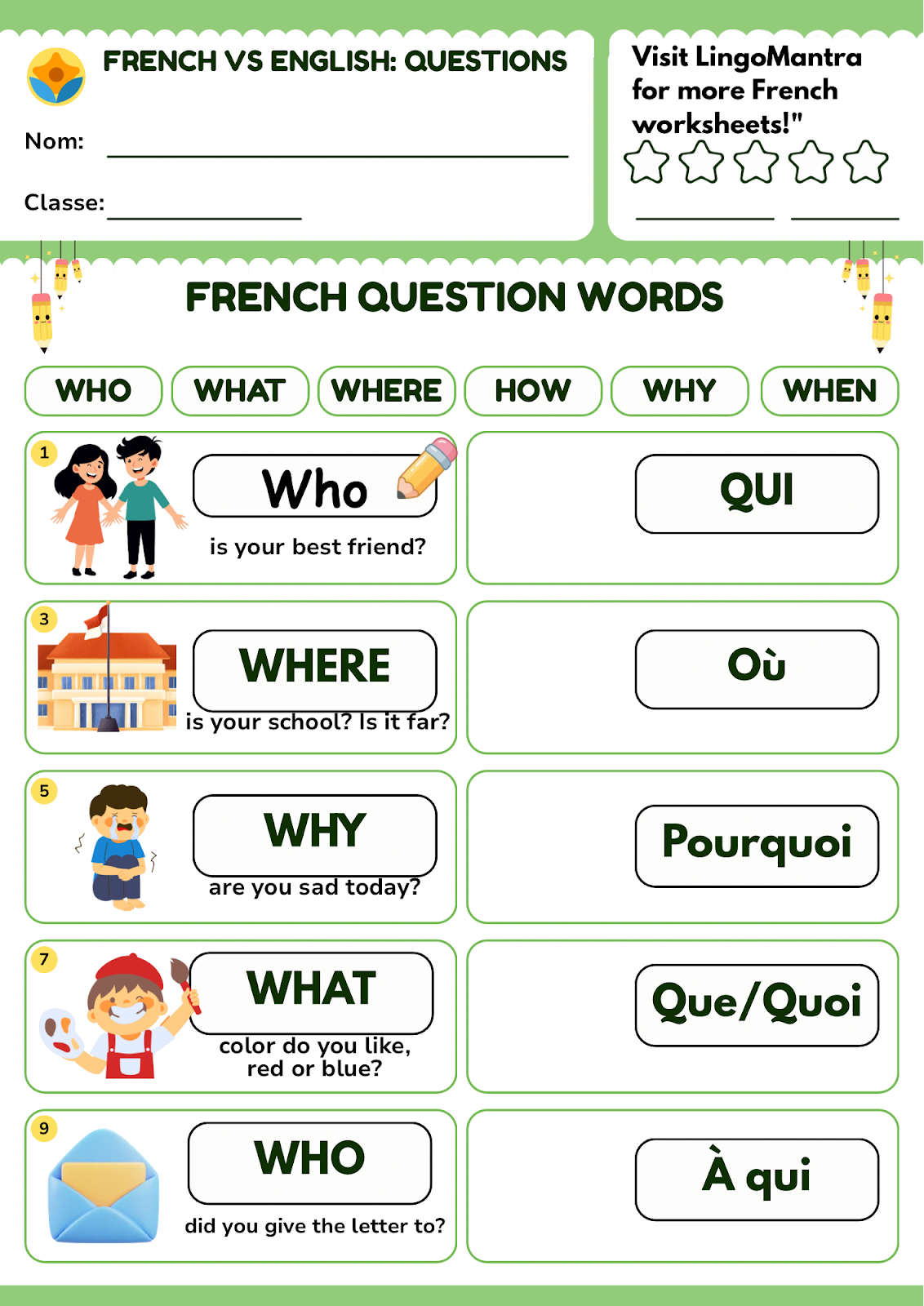
  • French Question Words: 7 Essential Words You Need to Know

    French Question Words: 7 Essential Words You Need to Know

    Welcome to LingoMantra! If you are aiming to speak French fluently, learning how to ask questions is one of your first important steps. Questions keep conversations going, help you navigate new places, and allow you to clarify things when you don’t understand.


    Imagine you are in France and want to ask:

    “Where is the train station?”

    “When does the train leave?”

    “Why is it closed?”

    You don’t need hundreds of French words to start asking useful questions. You first need a few powerful words:

    Qui · Que · Où · Comment · Pourquoi · Quand · Quel

    Master these question words, and you’ll be able to build dozens of everyday French questions.

    In this guide, you’ll learn their meanings, pronunciation, grammar, real-life examples, and how to build your own French questions.

    🎯 Quick Challenge: Can you guess what Où means before you continue?

    A. Who
    B. Where
    C. Why
    D. When

    Don’t worry if you don’t know yet. You’ll find the answer below.

    French Question Words: Quick Reference

    Let’s start with the basics. These are the most important French question words every beginner should know.

    English French

    Who

    Qui- kee


    What

    Que / Quoi- kuh/kwah


    Where

    Où- oo


    How

    Comment- Koh-mahn


    Why

    Pourquoi- poor-kwah


    When

    Quand- Kahn


    Which / What

    Quel / Quelle- kel


    🧠 Quick Memory Check

    Before moving on, try these:

    1. Which French word means “Where”?

    A. Qui
    B. Où
    C. Quand
    D. Pourquoi

    Answer: B — Où

    2. Which French word means “When”?

    A. Comment
    B. Qui
    C. Quand
    D. Quoi

    Answer: C — Quand

    If you got both right, you’re ready for the next level.


    1. Qui = Who?

    Imagine you meet someone new and want to ask:

    “Who is your teacher?”

    In French:

    Qui est ton professeur ?

    💡 Qui = Who

    Qui is used when asking about a person.

    Real-Life Examples

    Qui est ton meilleur ami ?
    = Who is your best friend?

    Qui est cette personne ?
    = Who is this person?

    Qui vient ce soir ?
    = Who is coming tonight?

    🧩 Try It Yourself

    How would you ask:

    “Who is your French teacher?”

    A. Qui est ton professeur de français ?
    B. Où est ton professeur de français ?
    C. Quand est ton professeur de français ?

    Take a guess before checking.

    ✅ Answer: A


    2. Que / Quoi = What?

    Now let’s talk about one of the most useful French question words: What.

    French has two common forms:

    Que
    Quoi

    They can both mean “what”, but their positions in a sentence are different.

    Que

    Que is commonly used at the beginning of a question.

    Example:

    Que fais-tu ?
    = What are you doing?

    Another example:

    Que veux-tu ?
    = What do you want?

    Quoi

    Quoi is often used at the end of an informal question or after a preposition.

    Example:

    Tu fais quoi ?
    = What are you doing?

    De quoi parles-tu ?
    = What are you talking about?

    🚨 Spot the Difference

    Which one sounds correct?

    _____ fais-tu ?

    A. Que
    B. Quoi

    Think first…

    ✅ Answer: Que

    Que fais-tu ?

    Now try this one:

    Tu fais _____ ?

    A. Que
    B. Quoi

    ✅ Answer: Quoi

    Tu fais quoi ?

    💡 Beginner Tip: Don’t worry about mastering every exception immediately. Start by remembering Que for questions like Que fais-tu ? and Quoi for common informal questions like Tu fais quoi ?


    3. Où = Where?

    Imagine you’re visiting Paris and you can’t find the train station.

    You want to ask:

    “Where is the train station?”

    In French:

    Où est la gare ?

    💡 Où = Where

    Real-Life Examples

    Où habites-tu ?
    = Where do you live?

    Où est l’hôtel ?
    = Where is the hotel?

    Où allez-vous ?
    = Where are you going?

    ⚠️ Important: Où vs Ou

    Be careful with the accent.

    Où = where
    Ou = or

    Compare:

    Où est ton école ?
    = Where is your school?

    Tu veux du thé ou du café ?
    = Do you want tea or coffee?

    That small accent changes the meaning completely.

    🧠 Quick Check

    Which sentence means “Where do you live?”

    A. Où habites-tu ?
    B. Ou habites-tu ?
    C. Quand habites-tu ?

    ✅ Answer: A — Où habites-tu ?


    4. Comment = How?

    Comment is used when asking how something happens or how someone does something.

    💡 Comment = How

    For example:

    Comment vas-tu ?
    = How are you?

    Comment tu t’appelles ?
    = What is your name?

    Comment fais-tu cela ?
    = How do you do that?

    🇫🇷 Real Conversation

    A: Comment vas-tu ?
    B: Je vais bien, merci !

    =
    A: How are you?
    B: I’m doing well, thank you!

    🎯 Your Turn

    How would you ask:

    “How do you learn French?”

    A. Pourquoi apprends-tu le français ?
    B. Comment apprends-tu le français ?
    C. Où apprends-tu le français ?

    ✅ Answer: B — Comment apprends-tu le français ?


    5. Pourquoi = Why?

    Sometimes you don’t just want information—you want a reason.

    That’s when you use:

    💡 Pourquoi = Why

    Example:

    Pourquoi apprends-tu le français ?
    = Why are you learning French?

    Pourquoi es-tu triste aujourd’hui ?
    = Why are you sad today?

    Pourquoi est-il fermé ?
    = Why is it closed?

    The Magic Answer: Parce que

    When answering a question that starts with Pourquoi, you will often use:

    Parce que = Because

    Example:

    Pourquoi apprends-tu le français ?

    Parce que j’aime la France.

    = Why are you learning French?

    = Because I love France.

    🧩 Complete the Answer

    Pourquoi étudies-tu le français ?

    Parce que ____________.

    Try creating your own answer.

    For example:

    Parce que j’aime le français.


    6. Quand = When?

    Quand is used when asking about time, dates, or when something will happen.

    💡 Quand = When

    Examples:

    Quand arrives-tu ?
    = When are you arriving?

    Quand commence le cours ?
    = When does the class start?

    Quand est ton anniversaire ?
    = When is your birthday?

    📅 Use Quand With Days

    This is where knowing the days of the week becomes especially useful.

    For example:

    Quand travailles-tu ?
    = When do you work?

    Je travaille lundi.
    = I work on Monday.

    Want to learn all seven days in French?

    👉 Continue with our guide to French Days of the Week.

    [LINK “French Days of the Week” TO YOUR DAYS ARTICLE HERE]

    🧠 Quick Challenge

    How would you ask:

    “When do you arrive?”

    A. Où arrives-tu ?
    B. Pourquoi arrives-tu ?
    C. Quand arrives-tu ?

    ✅ Answer: C


    7. Quel / Quelle = Which / What?

    Now let’s move to a slightly more advanced question word.

    Quel and Quelle are used when asking about a specific noun.

    They change according to the gender and number of the noun.

    For example:

    Quel livre lis-tu ?
    = Which book are you reading?

    Quelle couleur aimes-tu ?
    = Which color do you like?

    Notice that couleur is feminine, so we use:

    Quelle

    🧠 Remember

    Quel → masculine singular
    Quelle → feminine singular

    You will also see:

    Quels → masculine plural
    Quelles → feminine plural

    Don’t worry if this seems difficult at first. Focus on recognizing the pattern, and you’ll become more comfortable with practice.

    🎯 Quick Quiz

    Which sentence is correct?

    A. Quel couleur aimes-tu ?
    B. Quelle couleur aimes-tu ?

    ✅ Answer: B


    How to Form Questions in French

    Knowing the question word is only half the battle.

    You also need to know how to build the question.

    French commonly uses three structures.

    1. Formal: Inversion

    In formal French, the subject and verb can switch places.

    Où vas-tu ?
    = Where are you going?

    Quand arrives-tu ?
    = When are you arriving?

    This structure is common in formal writing and more formal speech.


    2. Standard: Est-ce que

    For beginners, Est-ce que is one of the easiest structures to learn.

    You place it after the question word.

    Où est-ce que tu vas ?
    = Where are you going?

    Quand est-ce que tu arrives ?
    = When are you arriving?

    Pourquoi est-ce que tu apprends le français ?
    = Why are you learning French?

    💡 Beginner Tip: If you’re unsure how to form a question, question word + est-ce que + subject + verb is a very useful pattern to remember.


    3. Informal: Intonation

    In everyday conversation, French speakers can also keep the normal sentence structure and use their voice to turn it into a question.

    Tu vas où ?
    = Where are you going?

    Tu fais quoi ?
    = What are you doing?

    Tu arrives quand ?
    = When are you arriving?

    This is common in casual spoken French.


    🧩 Build Your Own French Questions

    Now it’s your turn.

    Don’t look at the answer immediately.

    Challenge 1

    Arrange these words:

    Où + tu + habites

    Can you make a complete question?

    ↓

    Où est-ce que tu habites ?

    = Where do you live?


    Challenge 2

    Arrange these:

    Quand + tu + travailles

    ↓

    Quand est-ce que tu travailles ?

    = When do you work?


    Challenge 3

    Try this one yourself:

    Pourquoi + tu + apprends + le français

    Think for a few seconds.

    ↓

    Pourquoi est-ce que tu apprends le français ?

    = Why are you learning French?

    🎯 Can you create one French question of your own?

    Use any question word from this lesson.


    🚨 Can You Spot the Mistake?

    Let’s see if you really understand the difference.

    Question 1

    Which is correct?

    A. Ou est la gare ?
    B. Où est la gare ?

    ✅ Answer: B


    Question 2

    Which is correct?

    A. Que fais-tu ?
    B. Quoi fais-tu ?

    ✅ Answer: A


    Question 3

    Which sentence asks “Why are you learning French?”

    A. Quand apprends-tu le français ?
    B. Pourquoi apprends-tu le français ?
    C. Où apprends-tu le français ?

    ✅ Answer: B


    🇫🇷 French You Can Actually Use

    Here are some questions you can use in real-life situations.

    🚆 At a Train Station

    Où est la gare ?
    = Where is the train station?

    Quand part le train ?
    = When does the train leave?


    🍽️ At a Restaurant

    Qu’est-ce que vous recommandez ?
    = What do you recommend?

    Quel plat est populaire ?
    = Which dish is popular?


    🏨 At a Hotel

    Où est ma chambre ?
    = Where is my room?

    Quand est le petit-déjeuner ?
    = When is breakfast?


    👋 Meeting Someone

    Comment tu t’appelles ?
    = What is your name?

    D’où viens-tu ?
    = Where are you from?

    🗣️ Starting a Conversation

    Once you know these question words, you can use them to start simple conversations in French.

    For example, when meeting someone who is learning French, you can ask:

    Comment tu t’appelles ?
    = What is your name?

    D’où viens-tu ?
    = Where are you from?

    Pourquoi apprends-tu le français ?
    = Why are you learning French?

    Quand as-tu commencé à apprendre le français ?
    = When did you start learning French?

    You can also keep the conversation going by asking:

    Tu habites où ?
    = Where do you live?

    Tu fais quoi dans la vie ?
    = What do you do?

    Tu apprends le français depuis combien de temps ?
    = How long have you been learning French?

    💡 Tip: Don’t try to memorize all of these sentences at once. Choose two or three questions, practice saying them aloud, and then try using them in your own conversation.

    🎯 Mini Conversation Challenge

    Imagine you have just met a French speaker.

    Can you ask these three questions?

    1. What is your name?
    → Comment tu t’appelles ?

    2. Where are you from?
    → D’où viens-tu ?

    3. Why are you learning French?
    → Pourquoi apprends-tu le français ?

    Now try answering them yourself in French.

    For example:

    Je m’appelle Alex.
    Je viens d’Inde.
    J’apprends le français parce que j’aime la langue française.

    This is how individual question words become real French conversation.

    Free French Worksheet Preview
    👉 Continue learning with our guide to French Question Words