Category: French vocabulary

  • 5 French Words Almost Identical to English 🇫🇷

     Think you don’t know any French? You may already know more than you think!

    If you speak English, some French words will look surprisingly familiar. In this quick lesson, you’ll discover 5 French words that are identical or very similar to English—and learn how to pronounce and use them in real French sentences.

    Learn → Listen → Repeat → Test Yourself

    🇫🇷 Can You Recognize These French Words?

    Before we start, see how many you can recognize:

    Restaurant → Restaurant

    Passeport → Passport

    Hôtel → Hotel

    Important → Important

    Minute → Minute

    If you recognized most of them, you’re already off to a great start!

    But there’s a catch…

    Similar spelling doesn’t always mean similar pronunciation.

    That’s what we’re going to practice in this lesson.


    📚 What You’ll Learn

    In the next few minutes, you’ll learn:

    • 5 familiar French words
    • Their English meanings
    • Easy French pronunciation
    • Simple real-life examples
    • Useful memory tips
    • A quick vocabulary challenge

    ⏱️ Learning time: about 5 minutes


    🇫🇷 1. Restaurant — Restaurant

    French: restaurant

    English: restaurant

    Pronunciation: res-toh-rahn

    💬 How to Use It

    Just like in English, restaurant refers to a place where you go to eat.

    You’ll see this word frequently when travelling, reading French signs, or looking at menus.

    🗣️ Example

    🇫🇷 Je vais au restaurant.

    🇬🇧 I am going to the restaurant.

    🧠 Easy Memory Tip

    The spelling is almost exactly the same.

    The main thing to remember is:

    Same-looking word → French pronunciation

    ❓ Quick Check

    You’re looking for a place to eat in France.

    Which word should you look for?

    A) Passeport
    B) Restaurant
    C) Minute

    Answer: B — Restaurant ✅


    🇫🇷 2. Passeport — Passport

    French: passeport

    English: passport

    Pronunciation: pass-por

    💬 How to Use It

    Passeport means passport.

    It’s especially useful to recognize when travelling through airports or other places where travel documents are checked.

    🗣️ Example

    🇫🇷 Voici mon passeport.

    🇬🇧 Here is my passport.

    🧠 Easy Memory Tip

    Look at the two words:

    passeport → passport

    They’re not exactly the same, but they’re close enough that an English speaker can recognize the meaning quickly.

    ✈️ Travel Tip

    When travelling in a French-speaking country, recognizing familiar words like passeport can make signs and instructions easier to understand.


    🇫🇷 3. Hôtel — Hotel

    French: hôtel

    English: hotel

    Pronunciation: oh-tel

    💬 How to Use It

    Hôtel means hotel.

    You’ll notice one small difference in the spelling:

    hôtel

    The French word has a circumflex accent over the o.

    🗣️ Example

    🇫🇷 L’hôtel est près de la gare.

    🇬🇧 The hotel is near the train station.

    🧠 Easy Memory Tip

    Think:

    hôtel → hotel

    The meaning is easy to remember. Your main job is to learn the French pronunciation.

    ❓ Quick Check

    You’re looking for a place to stay.

    Which French word are you likely to see?

    A) Hôtel
    B) Restaurant
    C) Minute

    Answer: A — Hôtel ✅


    🧠 Quick Check #1

    Let’s see how well you remember the first three.

    1. What does passeport mean?

    A) Passport
    B) Restaurant
    C) Hotel

    2. Which French word means “hotel”?

    A) restaurant
    B) hôtel
    C) minute

    3. Complete the sentence:

    Je vais au ________.

    A) passeport
    B) restaurant
    C) hôtel

    ✅ Answers

    1. A — Passport

    2. B — hôtel

    3. B — restaurant

    3/3? Excellent! You’re recognizing French vocabulary already. 🇫🇷


    🇫🇷 4. Important — Important

    French: important

    English: important

    Pronunciation: an-por-tahn

    💬 How to Use It

    Here’s another French word that looks very familiar to English speakers.

    The spelling is almost identical, but the French pronunciation is different.

    🗣️ Example

    🇫🇷 C’est important.

    🇬🇧 It’s important.

    🧠 Easy Memory Tip

    Don’t automatically pronounce a familiar-looking French word the English way.

    Remember:

    important → familiar spelling, French pronunciation

    ✍️ Try It Yourself

    How would you say:

    “It’s important.”

    Think for a moment.

    🇫🇷 C’est important.


    🇫🇷 5. Minute — Minute

    French: minute

    English: minute

    Pronunciation: mee-nüt

    💬 How to Use It

    The French word minute is spelled exactly like the English word.

    It is commonly used when talking about time.

    🗣️ Example

    🇫🇷 Une minute, s’il vous plaît.

    🇬🇧 One minute, please.

    🧠 Easy Memory Tip

    The spelling is exactly the same:

    minute = minute

    But remember that the pronunciation is different from the English word.

    ❓ Quick Check

    What does minute mean?

    A) Morning
    B) Minute
    C) Month

    Answer: B — Minute ✅


    🔊 Listen & Repeat

    Now you’ve learned all five words.

    It’s time to hear them together.

    🎧 Listen to the complete recording and repeat each word aloud.

    🗣️ Your Pronunciation Practice

    restaurant

    passeport

    hôtel

    important

    minute

    First, listen normally.

    Then play the recording again and try to repeat immediately after each word.

    Don’t worry about getting the pronunciation perfect on your first attempt.


    🧠 The Secret: Familiar Words Can Still Sound French

    This is one of the most useful things to understand as a beginner.

    You may see a French word and think:

    “I already know this word!”

    Sometimes that’s true.

    But there are two things you still need to learn:

    👀 Recognition

    Can you understand the word when you see it?

    🔊 Pronunciation

    Can you say it correctly in French?

    For example:

    restaurant

    hôtel

    important

    They may look familiar, but you still need to learn their French pronunciation.

    That’s how you turn recognition into real vocabulary.


    🎯 Final 5-Word Challenge

    No looking back!

    Can you match each French word with its English meaning?

    1. restaurant

    2. passeport

    3. hôtel

    4. important

    5. minute

    A) Hotel

    B) Important

    C) Passport

    D) Restaurant

    E) Minute

    Take a few seconds and make your choices before checking the answers.


    🔓 Check Your Answers

    1 → D — Restaurant

    2 → C — Passport

    3 → A — Hotel

    4 → B — Important

    5 → E — Minute

    ⭐ How Did You Do?

    5/5 → 🇫🇷 Excellent!

    4/5 → 👏 Great job!

    3/5 → 👍 You’re making progress!

    0–2/5 → 🔄 Review the five words and try again.


    🗣️ Can You Use One of Them?

    Let’s take the easiest one:

    restaurant

    Now look at this sentence:

    🇫🇷 Je vais au restaurant.

    🇬🇧 I am going to the restaurant.

    You already recognize restaurant.

    That means you don’t have to learn every French sentence from zero.

    As you continue learning, you’ll start recognizing more and more familiar words—and understanding complete sentences will become easier.


    📚 Ready to Learn More French Words?

    You’ve just discovered 5 French words that are familiar to English speakers.

    Want to expand your beginner vocabulary?

    👉 Top 5 Essential French Phrases Every Beginners Should Know →

    Learn five more useful French words and start building your everyday French vocabulary step by step.


    🇫🇷 What Should You Learn Next?

    You’ve started building your French vocabulary. Now choose your next step.

    🗣️ Build Your French Sentences

    👉 Top 10 Essential French Verbs for Beginners →

    Learn essential French verbs such as être, avoir, aller, faire, pouvoir, and vouloir with simple everyday examples.

    📖 Start Reading in French

    👉 Top 5 French Reading Books for Beginners →

    Discover beginner-friendly French books to improve your vocabulary, reading skills, and confidence step by step.


    🇫🇷 Final Takeaway

    Learning French doesn’t always mean starting from zero.

    As an English speaker, you may already recognize more French words than you realize.

    Start by noticing familiar words, then learn their French pronunciation and usage.

    The more connections you make, the easier French vocabulary becomes.

    Keep exploring—you may know more French than you think! 🇫🇷

    À bientôt ! 👋🇫🇷
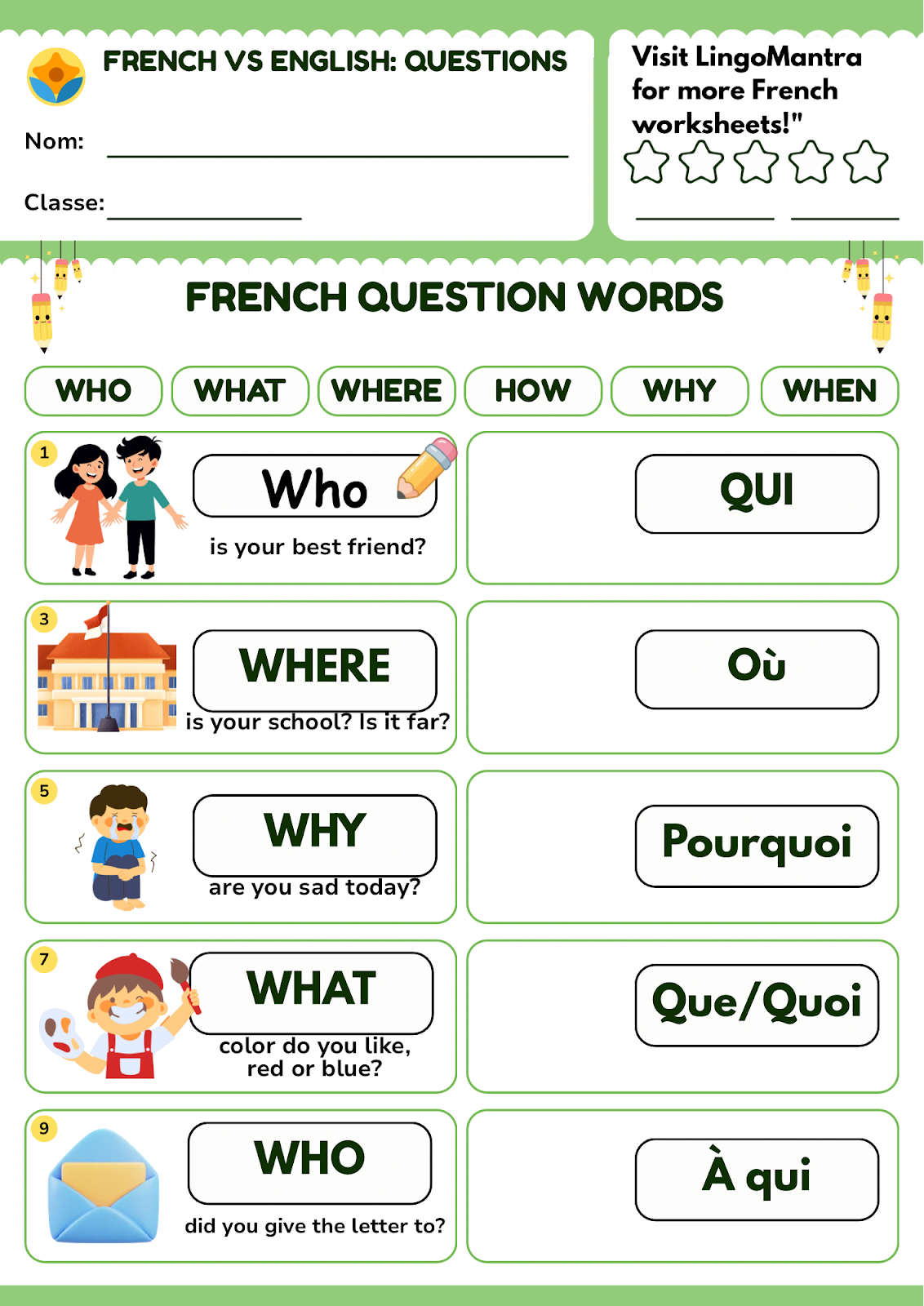
  • French Question Words: 7 Essential Words You Need to Know

    French Question Words: 7 Essential Words You Need to Know

    Welcome to LingoMantra! If you are aiming to speak French fluently, learning how to ask questions is one of your first important steps. Questions keep conversations going, help you navigate new places, and allow you to clarify things when you don’t understand.


    Imagine you are in France and want to ask:

    “Where is the train station?”

    “When does the train leave?”

    “Why is it closed?”

    You don’t need hundreds of French words to start asking useful questions. You first need a few powerful words:

    Qui · Que · Où · Comment · Pourquoi · Quand · Quel

    Master these question words, and you’ll be able to build dozens of everyday French questions.

    In this guide, you’ll learn their meanings, pronunciation, grammar, real-life examples, and how to build your own French questions.

    🎯 Quick Challenge: Can you guess what Où means before you continue?

    A. Who
    B. Where
    C. Why
    D. When

    Don’t worry if you don’t know yet. You’ll find the answer below.

    French Question Words: Quick Reference

    Let’s start with the basics. These are the most important French question words every beginner should know.

    English French

    Who

    Qui- kee


    What

    Que / Quoi- kuh/kwah


    Where

    Où- oo


    How

    Comment- Koh-mahn


    Why

    Pourquoi- poor-kwah


    When

    Quand- Kahn


    Which / What

    Quel / Quelle- kel


    🧠 Quick Memory Check

    Before moving on, try these:

    1. Which French word means “Where”?

    A. Qui
    B. Où
    C. Quand
    D. Pourquoi

    Answer: B — Où

    2. Which French word means “When”?

    A. Comment
    B. Qui
    C. Quand
    D. Quoi

    Answer: C — Quand

    If you got both right, you’re ready for the next level.


    1. Qui = Who?

    Imagine you meet someone new and want to ask:

    “Who is your teacher?”

    In French:

    Qui est ton professeur ?

    💡 Qui = Who

    Qui is used when asking about a person.

    Real-Life Examples

    Qui est ton meilleur ami ?
    = Who is your best friend?

    Qui est cette personne ?
    = Who is this person?

    Qui vient ce soir ?
    = Who is coming tonight?

    🧩 Try It Yourself

    How would you ask:

    “Who is your French teacher?”

    A. Qui est ton professeur de français ?
    B. Où est ton professeur de français ?
    C. Quand est ton professeur de français ?

    Take a guess before checking.

    ✅ Answer: A


    2. Que / Quoi = What?

    Now let’s talk about one of the most useful French question words: What.

    French has two common forms:

    Que
    Quoi

    They can both mean “what”, but their positions in a sentence are different.

    Que

    Que is commonly used at the beginning of a question.

    Example:

    Que fais-tu ?
    = What are you doing?

    Another example:

    Que veux-tu ?
    = What do you want?

    Quoi

    Quoi is often used at the end of an informal question or after a preposition.

    Example:

    Tu fais quoi ?
    = What are you doing?

    De quoi parles-tu ?
    = What are you talking about?

    🚨 Spot the Difference

    Which one sounds correct?

    _____ fais-tu ?

    A. Que
    B. Quoi

    Think first…

    ✅ Answer: Que

    Que fais-tu ?

    Now try this one:

    Tu fais _____ ?

    A. Que
    B. Quoi

    ✅ Answer: Quoi

    Tu fais quoi ?

    💡 Beginner Tip: Don’t worry about mastering every exception immediately. Start by remembering Que for questions like Que fais-tu ? and Quoi for common informal questions like Tu fais quoi ?


    3. Où = Where?

    Imagine you’re visiting Paris and you can’t find the train station.

    You want to ask:

    “Where is the train station?”

    In French:

    Où est la gare ?

    💡 Où = Where

    Real-Life Examples

    Où habites-tu ?
    = Where do you live?

    Où est l’hôtel ?
    = Where is the hotel?

    Où allez-vous ?
    = Where are you going?

    ⚠️ Important: Où vs Ou

    Be careful with the accent.

    Où = where
    Ou = or

    Compare:

    Où est ton école ?
    = Where is your school?

    Tu veux du thé ou du café ?
    = Do you want tea or coffee?

    That small accent changes the meaning completely.

    🧠 Quick Check

    Which sentence means “Where do you live?”

    A. Où habites-tu ?
    B. Ou habites-tu ?
    C. Quand habites-tu ?

    ✅ Answer: A — Où habites-tu ?


    4. Comment = How?

    Comment is used when asking how something happens or how someone does something.

    💡 Comment = How

    For example:

    Comment vas-tu ?
    = How are you?

    Comment tu t’appelles ?
    = What is your name?

    Comment fais-tu cela ?
    = How do you do that?

    🇫🇷 Real Conversation

    A: Comment vas-tu ?
    B: Je vais bien, merci !

    =
    A: How are you?
    B: I’m doing well, thank you!

    🎯 Your Turn

    How would you ask:

    “How do you learn French?”

    A. Pourquoi apprends-tu le français ?
    B. Comment apprends-tu le français ?
    C. Où apprends-tu le français ?

    ✅ Answer: B — Comment apprends-tu le français ?


    5. Pourquoi = Why?

    Sometimes you don’t just want information—you want a reason.

    That’s when you use:

    💡 Pourquoi = Why

    Example:

    Pourquoi apprends-tu le français ?
    = Why are you learning French?

    Pourquoi es-tu triste aujourd’hui ?
    = Why are you sad today?

    Pourquoi est-il fermé ?
    = Why is it closed?

    The Magic Answer: Parce que

    When answering a question that starts with Pourquoi, you will often use:

    Parce que = Because

    Example:

    Pourquoi apprends-tu le français ?

    Parce que j’aime la France.

    = Why are you learning French?

    = Because I love France.

    🧩 Complete the Answer

    Pourquoi étudies-tu le français ?

    Parce que ____________.

    Try creating your own answer.

    For example:

    Parce que j’aime le français.


    6. Quand = When?

    Quand is used when asking about time, dates, or when something will happen.

    💡 Quand = When

    Examples:

    Quand arrives-tu ?
    = When are you arriving?

    Quand commence le cours ?
    = When does the class start?

    Quand est ton anniversaire ?
    = When is your birthday?

    📅 Use Quand With Days

    This is where knowing the days of the week becomes especially useful.

    For example:

    Quand travailles-tu ?
    = When do you work?

    Je travaille lundi.
    = I work on Monday.

    Want to learn all seven days in French?

    👉 Continue with our guide to French Days of the Week.

    [LINK “French Days of the Week” TO YOUR DAYS ARTICLE HERE]

    🧠 Quick Challenge

    How would you ask:

    “When do you arrive?”

    A. Où arrives-tu ?
    B. Pourquoi arrives-tu ?
    C. Quand arrives-tu ?

    ✅ Answer: C


    7. Quel / Quelle = Which / What?

    Now let’s move to a slightly more advanced question word.

    Quel and Quelle are used when asking about a specific noun.

    They change according to the gender and number of the noun.

    For example:

    Quel livre lis-tu ?
    = Which book are you reading?

    Quelle couleur aimes-tu ?
    = Which color do you like?

    Notice that couleur is feminine, so we use:

    Quelle

    🧠 Remember

    Quel → masculine singular
    Quelle → feminine singular

    You will also see:

    Quels → masculine plural
    Quelles → feminine plural

    Don’t worry if this seems difficult at first. Focus on recognizing the pattern, and you’ll become more comfortable with practice.

    🎯 Quick Quiz

    Which sentence is correct?

    A. Quel couleur aimes-tu ?
    B. Quelle couleur aimes-tu ?

    ✅ Answer: B


    How to Form Questions in French

    Knowing the question word is only half the battle.

    You also need to know how to build the question.

    French commonly uses three structures.

    1. Formal: Inversion

    In formal French, the subject and verb can switch places.

    Où vas-tu ?
    = Where are you going?

    Quand arrives-tu ?
    = When are you arriving?

    This structure is common in formal writing and more formal speech.


    2. Standard: Est-ce que

    For beginners, Est-ce que is one of the easiest structures to learn.

    You place it after the question word.

    Où est-ce que tu vas ?
    = Where are you going?

    Quand est-ce que tu arrives ?
    = When are you arriving?

    Pourquoi est-ce que tu apprends le français ?
    = Why are you learning French?

    💡 Beginner Tip: If you’re unsure how to form a question, question word + est-ce que + subject + verb is a very useful pattern to remember.


    3. Informal: Intonation

    In everyday conversation, French speakers can also keep the normal sentence structure and use their voice to turn it into a question.

    Tu vas où ?
    = Where are you going?

    Tu fais quoi ?
    = What are you doing?

    Tu arrives quand ?
    = When are you arriving?

    This is common in casual spoken French.


    🧩 Build Your Own French Questions

    Now it’s your turn.

    Don’t look at the answer immediately.

    Challenge 1

    Arrange these words:

    Où + tu + habites

    Can you make a complete question?

    ↓

    Où est-ce que tu habites ?

    = Where do you live?


    Challenge 2

    Arrange these:

    Quand + tu + travailles

    ↓

    Quand est-ce que tu travailles ?

    = When do you work?


    Challenge 3

    Try this one yourself:

    Pourquoi + tu + apprends + le français

    Think for a few seconds.

    ↓

    Pourquoi est-ce que tu apprends le français ?

    = Why are you learning French?

    🎯 Can you create one French question of your own?

    Use any question word from this lesson.


    🚨 Can You Spot the Mistake?

    Let’s see if you really understand the difference.

    Question 1

    Which is correct?

    A. Ou est la gare ?
    B. Où est la gare ?

    ✅ Answer: B


    Question 2

    Which is correct?

    A. Que fais-tu ?
    B. Quoi fais-tu ?

    ✅ Answer: A


    Question 3

    Which sentence asks “Why are you learning French?”

    A. Quand apprends-tu le français ?
    B. Pourquoi apprends-tu le français ?
    C. Où apprends-tu le français ?

    ✅ Answer: B


    🇫🇷 French You Can Actually Use

    Here are some questions you can use in real-life situations.

    🚆 At a Train Station

    Où est la gare ?
    = Where is the train station?

    Quand part le train ?
    = When does the train leave?


    🍽️ At a Restaurant

    Qu’est-ce que vous recommandez ?
    = What do you recommend?

    Quel plat est populaire ?
    = Which dish is popular?


    🏨 At a Hotel

    Où est ma chambre ?
    = Where is my room?

    Quand est le petit-déjeuner ?
    = When is breakfast?


    👋 Meeting Someone

    Comment tu t’appelles ?
    = What is your name?

    D’où viens-tu ?
    = Where are you from?

    🗣️ Starting a Conversation

    Once you know these question words, you can use them to start simple conversations in French.

    For example, when meeting someone who is learning French, you can ask:

    Comment tu t’appelles ?
    = What is your name?

    D’où viens-tu ?
    = Where are you from?

    Pourquoi apprends-tu le français ?
    = Why are you learning French?

    Quand as-tu commencé à apprendre le français ?
    = When did you start learning French?

    You can also keep the conversation going by asking:

    Tu habites où ?
    = Where do you live?

    Tu fais quoi dans la vie ?
    = What do you do?

    Tu apprends le français depuis combien de temps ?
    = How long have you been learning French?

    💡 Tip: Don’t try to memorize all of these sentences at once. Choose two or three questions, practice saying them aloud, and then try using them in your own conversation.

    🎯 Mini Conversation Challenge

    Imagine you have just met a French speaker.

    Can you ask these three questions?

    1. What is your name?
    → Comment tu t’appelles ?

    2. Where are you from?
    → D’où viens-tu ?

    3. Why are you learning French?
    → Pourquoi apprends-tu le français ?

    Now try answering them yourself in French.

    For example:

    Je m’appelle Alex.
    Je viens d’Inde.
    J’apprends le français parce que j’aime la langue française.

    This is how individual question words become real French conversation.

    Free French Worksheet Preview
    👉 Continue learning with our guide to French Question Words