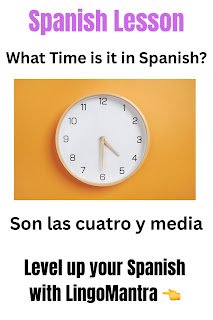
Look at the clock in the image: it shows 4:30. Which Spanish sentence correctly tells the time?
A Son las cuatro y media.
Can you tell the time in Spanish without translating every word in your head?
If you saw the clock above showing 4:30, would you immediately know what to say?
Son las cuatro y media.
If you got it right, great! But if you hesitated, don’t worry. Telling time in Spanish becomes much easier once you understand a few simple patterns.
The good news? You do not need to memorize dozens of sentences.
You mainly need to understand how Spanish talks about:
the hour
minutes
half past
quarter past
quarter to
and a few useful everyday expressions
Let’s make it simple.
🕐 First: How Do You Ask “What Time Is It?” in Spanish?
The most common question is:
¿Qué hora es?
It literally asks:
“What hour is it?”
You can use it when asking someone for the current time.
For example:
¿Qué hora es?
What time is it?
A natural answer might be:
Son las cuatro.
It is four o’clock.
Or:
Son las cuatro y media.
It is 4:30.
A tiny detail to remember
You may notice something interesting:
¿Qué hora es?
uses es, but the answer often uses:
Son las…
That’s because Spanish treats the time expression differently depending on the hour.
There is one important exception that beginners should remember.
🌅 Morning, Afternoon, or Night? Spanish Can Tell You
Spanish doesn’t always need to say whether a time is AM or PM.
Often, the situation makes it obvious.
But when you want to be specific, you can add:
de la mañana
= in the morning
de la tarde
= in the afternoon / evening
de la noche
= at night
So the same clock time can be described differently depending on the part of the day.
4:30 AM
Son las cuatro y media de la mañana.
That’s 4:30 in the morning.
4:30 PM
Son las cuatro y media de la tarde.
That’s 4:30 in the afternoon.
This is especially useful when the listener might otherwise be unsure which 4:30 you mean.
⏰ What Does “Son las cuatro y media” Mean?
Let’s look at the exact sentence from your pin:
Son las cuatro y media.
Break it into two useful parts:
las cuatro = four o’clock
y media = and a half / half past
Together:
Son las cuatro y media.
= It is 4:30.
If you want to specify the time of day:
Son las cuatro y media de la mañana.
= 4:30 AM
Son las cuatro y media de la tarde.
= 4:30 PM
So don’t worry if you initially wondered, “How do I know whether it’s AM or PM?”
You often don’t know from the clock expression alone. Context tells you, or Spanish adds de la mañana, de la tarde, or de la noche.
⭐ The Special Case: One O’Clock
For 1:00, Spanish uses the singular:
Es la una.
Not:
Son las una.
So:
Es la una.
It is one o’clock.
But:
Son las dos.
It is two o’clock.
Son las tres.
It is three o’clock.
Son las cuatro.
It is four o’clock.
A simple way to remember it:
1:00 → Es la una
2:00–12:00 → Son las…
That’s one of those small patterns that becomes automatic with practice.
Now let’s come back to the clock from the pin.
The clock shows:
4:30
In Spanish:
Son las cuatro y media.
Here is the useful part:
y media = half past
So:
Son las cuatro y media.
= It is half past four.
= It is 4:30.
You don’t need to think:
“Four… thirty… Spanish… how do I translate this?”
Instead, recognize the pattern:
hour + y media
And you’re done.
Try a few more:
2:30 → Son las dos y media.
6:30 → Son las seis y media.
9:30 → Son las nueve y media.
See the pattern?
Only the hour changes.
🕒 What About :15?
Now imagine the clock shows 3:15.
Spanish commonly uses:
Son las tres y cuarto.
The expression:
y cuarto
means:
quarter past
So:
3:15 → Son las tres y cuarto.
Here are some examples:
1:15 → Es la una y cuarto.
5:15 → Son las cinco y cuarto.
8:15 → Son las ocho y cuarto.
This is useful because cuarto literally relates to a quarter.
Think of an hour as four equal parts:
15 minutes = one quarter
30 minutes = half
45 minutes = three quarters
That makes the expressions easier to remember.
🕘 What About :45?
Now things get a little more interesting.
For 9:45, Spanish can say:
Son las diez menos cuarto.
This literally means:
It is a quarter before ten.
Instead of focusing on the hour that has already passed, Spanish counts backward from the next hour.
So:
9:45 → Son las diez menos cuarto.
This pattern is:
next hour + menos cuarto
where:
menos cuarto = quarter to
A few examples:
2:45 → Son las tres menos cuarto.
6:45 → Son las siete menos cuarto.
10:45 → Son las once menos cuarto.
At first, this can feel strange if you’re used to simply saying “ten forty-five.”
But after hearing it a few times, your brain starts recognizing the pattern naturally.
🧩 A Simple Spanish Time Formula
You can think of telling time as a little building game.
Start with:
1. The hour
Son las cuatro…
Then add:
2. The minutes
For example:
Son las cuatro y diez.
= 4:10
Or:
Son las cuatro y veinte.
= 4:20
Or use a special expression:
Son las cuatro y cuarto.
= 4:15
Son las cuatro y media.
= 4:30
And when you’re at :45:
Son las cinco menos cuarto.
= 4:45
That’s the basic system.
🎯 Quick Practice: Can You Read These?
Don’t look for a translation word by word.
Try to recognize the pattern.
1. 5:10
Son las cinco y diez.
2. 7:20
Son las siete y veinte.
3. 8:30
Son las ocho y media.
4. 11:15
Son las once y cuarto.
5. 12:45
Es la una menos cuarto.
Notice the last one carefully.
The clock says 12:45, but Spanish can describe it as a quarter before one.
That’s why the next hour appears.
💡 A Trick That Makes Spanish Time Easier
Instead of memorizing complete sentences, memorize these four building blocks:
y diez → :10
y cuarto → :15
y media → :30
menos cuarto → :45
Now imagine you see a clock.
You identify the hour.
Then identify which pattern you need.
For example:
6:30
You see:
6 + half
So:
Son las seis y media.
That’s much easier than memorizing the entire sentence as one giant piece of information.
🗣️ Time Expressions You’ll Actually Use
Knowing how to tell the time is useful, but you’ll often hear time inside everyday conversations.
Imagine a friend asks:
¿Qué hora es?
You answer:
Son las cuatro y media.
Your friend says:
¡Gracias!
You might also hear:
A las cuatro.
This means:
At four o’clock.
This is important because the time something happens is expressed differently from simply saying what time it is.
For example:
La clase es a las cinco.
The class is at five.
Trabajo a las ocho.
I work at eight.
Cenamos a las nueve.
We have dinner at nine.
So remember this useful difference:
¿Qué hora es?
What time is it?
Son las cinco.
It is five.
¿A qué hora…?
At what time…?
A las cinco.
At five.
Once you learn this difference, conversations about schedules become much easier.
🎮 Turn It Into a 30-Second Game
Here’s a simple way to practice Spanish time without sitting down for a long study session.
Look at any clock around you.
Don’t translate.
Just say the time in Spanish.
If it’s:
2:00
say:
Son las dos.
If it’s:
3:30
say:
Son las tres y media.
If it’s:
7:15
say:
Son las siete y cuarto.
If it’s:
8:45
say:
Son las nueve menos cuarto.
Do this whenever you naturally look at a clock.
You’re turning something you already do every day into a tiny Spanish lesson.
🔥 One More Challenge
Imagine you’re meeting a Spanish-speaking friend.
You want to say:
“Let’s meet at 4:30.”
You already know that 4:30 is:
Son las cuatro y media.
But when talking about the time of an event, you use a las:
Nos vemos a las cuatro y media.
That means:
See you at 4:30.
Now you’ve moved from simply recognizing the time to actually using it in a conversation.
That’s the real goal of learning vocabulary.
🧠 Remember These 5 Spanish Time Patterns
Before you leave, keep these patterns in your memory:
1:00
Es la una.
4:00
Son las cuatro.
4:15
Son las cuatro y cuarto.
4:30
Son las cuatro y media.
4:45
Son las cinco menos cuarto.
You don’t need to memorize a huge list.
Learn the pattern, change the hour, and practice.
🌟 Can You Now Tell the Time in Spanish?
If the clock shows 04:30, your answer is:
Son las cuatro y media. ⏰🇪🇸
And now you know why.
You can ask:
¿Qué hora es?
You can tell someone the time:
Son las cuatro y media.
You can talk about a schedule:
A las cuatro y media.
And you can describe common times using:
y cuarto, y media, and menos cuarto.
The next time you look at a clock, give yourself a tiny Spanish challenge.
Don’t just see the time—say it in Spanish.
That’s how a simple everyday moment can become a language-learning habit.
Level up your Spanish with LingoMantra.
🧠 Don’t Learn Spanish Words in Isolation
Here’s another important lesson that goes beyond telling time.
Sometimes a Spanish phrase looks like the English structure in your head—but Spanish uses a completely different pattern.
For example, an English speaker might think:
“I am hungry.”
and try to translate it word by word as:
Estoy hambre. ❌
But Spanish says:
Tengo hambre. ✅
Literally, it uses tener (“to have”) rather than estar (“to be”).
If you’ve ever caught yourself thinking “Did I just say ‘Estoy hambre’ instead of ‘Tengo hambre’?”, check out our guide:
Did I just say “Estoy hambre” instead of “Tengo hambre”?
That kind of mistake is completely normal when learning Spanish. The trick is not to memorize isolated English-to-Spanish translations. Learn the Spanish pattern as a whole.
The same idea applies to telling time.
Don’t memorize:
“4:30 = this giant sentence.”
Instead, recognize:
four + half past → four y media
That’s much easier to reuse.
Leave a Reply