Welcome to LingoMantra!
If you’re learning French, two verbs will follow you everywhere:
Être = to be
Avoir = to have
At first, they look simple. But here’s where things get confusing.
In English, we say:
“I am hungry.”
But in French, you don’t say Je suis faim.
You say:
J’ai faim. ✅
= I am hungry.
So why does French use avoir (to have) instead of être (to be)?
That’s exactly what you’ll learn in this guide.
By the end, you’ll know when to use être, when to use avoir, how to conjugate both verbs, and how to avoid common beginner mistakes.
🧠 Before You Learn: Can You Guess?
Let’s start with a quick challenge.
Which sentence is correct?
A. Je suis faim.
B. J’ai faim.
Take a few seconds before checking the answer.
✅ Answer: B — J’ai faim.
In French, hunger is expressed with avoir faim.
Don’t worry if you got it wrong. By the end of this lesson, you’ll understand exactly why.
Être vs Avoir: The Basic Difference
The easiest way to remember the two verbs is:
| Verb | Meaning |
|---|---|
| Être | to be |
| Avoir | to have |
Think of it like this:
Être = To Be
Use être when talking about what someone or something is, describing a state, or saying where someone or something is.
Je suis étudiant.
= I am a student.
Je suis fatigué.
= I am tired.
Elle est française.
= She is French.
Nous sommes à Paris.
= We are in Paris.
Avoir = To Have
Use avoir when talking about what someone has, including possession, age, and certain expressions.
J’ai un livre.
= I have a book.
Tu as une voiture.
= You have a car.
J’ai vingt ans.
= I am twenty years old.
💡 Important: French does not always use these verbs in exactly the same way as English.
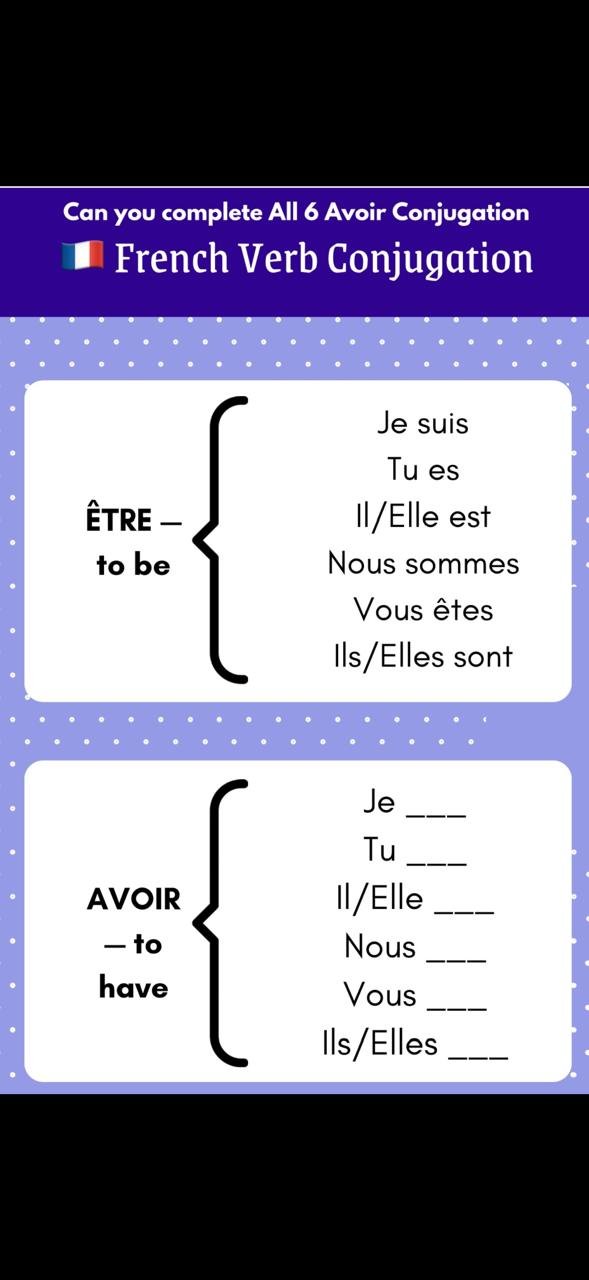
🇫🇷 Être Conjugation
Je → suis
Tu → es
Il / Elle → est
Nous → sommes
Vous → êtes
Ils / Elles → sont
Examples With Être
Je suis étudiant.
= I am a student.
Tu es gentil.
= You are kind.
Elle est française.
= She is French.
Nous sommes prêts.
= We are ready.
Vous êtes fatigués.
= You are tired.
Ils sont à Paris.
= They are in Paris.
🎯 10-Second Être Challenge
Don’t look back at the table.
Complete these sentences:
1. Je ___ français.
2. Nous ___ étudiants.
3. Ils ___ fatigués.
Think about your answers.
✅ Answers
1. Je suis français.
2. Nous sommes étudiants.
3. Ils sont fatigués.
How many did you get right?
🇫🇷 Avoir Conjugation
Now let’s learn the present-tense forms of avoir.
| Subject | Avoir |
|---|---|
| Je | ai |
| Tu | as |
| Il / Elle | a |
| Nous | avons |
| Vous | avez |
| Ils / Elles | ont |
Examples With Avoir
J’ai un livre.
= I have a book.
Tu as une voiture.
= You have a car.
Elle a un frère.
= She has a brother.
Nous avons une maison.
= We have a house.
Vous avez une question.
= You have a question.
Ils ont deux enfants.
= They have two children.
🧠 Avoir Quick Challenge
Complete these sentences:
1. J’___ un chien.
2. Tu ___ une question.
3. Nous ___ une voiture.
4. Ils ___ deux enfants.
✅ Answers
1. J’ai un chien.
2. Tu as une question.
3. Nous avons une voiture.
4. Ils ont deux enfants.
🚨 French Doesn’t Always Think Like English
This is where many beginners make mistakes.
Sometimes English uses “to be”, but French uses avoir.
Look at these examples:
| English | Correct French |
|---|---|
| I am hungry. | J’ai faim. |
| I am thirsty. | J’ai soif. |
| I am cold. | J’ai froid. |
| I am afraid. | J’ai peur. |
| I am 20 years old. | J’ai 20 ans. |
🧠 Easy Memory Trick
Remember these common expressions as complete phrases:
J’ai faim.
J’ai soif.
J’ai froid.
J’ai peur.
J’ai 20 ans.
Don’t translate them word-for-word from English.
🎂 How to Say Your Age in French
This is a very common beginner mistake.
English:
I am 20 years old.
French:
J’ai vingt ans.
French uses avoir when expressing age.
You can ask:
Quel âge as-tu ?
= How old are you?
And answer:
J’ai vingt ans.
= I am twenty years old.
💡 Remember: Don’t say Je suis vingt ans.
Say:
J’ai vingt ans. ✅
🍽️ Common Expressions With Avoir
Here are some useful expressions you should memorize as complete phrases.
avoir faim = to be hungry
avoir soif = to be thirsty
avoir froid = to be cold
avoir chaud = to be hot
avoir peur = to be afraid
avoir besoin de = to need
avoir envie de = to feel like / want
Learning these as complete expressions will make them easier to remember.
🎯 Être or Avoir? Choose the Correct Verb
Now let’s test your understanding.
1. Je ___ fatigué.
A. suis
B. ai
2. J’___ faim.
A. suis
B. ai
3. Tu ___ une voiture.
A. es
B. as
4. Nous ___ étudiants.
A. sommes
B. avons
5. J’___ vingt-cinq ans.
A. suis
B. ai
6. Elle ___ française.
A. est
B. a
7. Nous ___ froid.
A. sommes
B. avons
8. Ils ___ une maison.
A. sont
B. ont
9. Tu ___ peur.
A. es
B. as
10. Vous ___ prêts.
A. êtes
B. avez
🚨 Can You Spot the Mistake?
Let’s make it a little harder.
Each sentence contains a mistake. Can you fix it?
1. Je suis faim.
❌ Incorrect
✅ J’ai faim.
2. Je suis 18 ans.
❌ Incorrect
✅ J’ai 18 ans.
3. J’ai étudiant.
❌ Incorrect
✅ Je suis étudiant.
4. Nous avons fatigués.
❌ Incorrect
✅ Nous sommes fatigués.
5. Elle a française.
❌ Incorrect
✅ Elle est française.
💡 Tip: Ask yourself: Are you describing what someone is, or something they have?
🇫🇷 Être vs Avoir in Real-Life French
Now let’s see how these verbs appear in everyday conversations.
👋 Meeting Someone
Je suis étudiant.
= I am a student.
Je suis français.
= I am French.
🍽️ At a Café
J’ai faim.
= I’m hungry.
J’ai soif.
= I’m thirsty.
🎂 Talking About Age
J’ai 25 ans.
= I am 25 years old.
🏠 Talking About Possessions
J’ai une voiture.
= I have a car.
J’ai une maison.
= I have a house.
😊 Talking About Your State
Je suis heureux.
= I am happy.
Je suis fatigué.
= I am tired.
Notice the pattern:
Je suis… → describing yourself
J’ai… → saying what you have or using a common avoir expression.
🧩 Build Your Own French Sentences
Now it’s your turn.
Challenge 1
Use these words:
Je + être + étudiant
↓
Je suis étudiant.
Challenge 2
Use these words:
J’ + avoir + 20 ans
↓
J’ai 20 ans.
Challenge 3
Complete this sentence:
Je ___ faim.
Think before checking.
↓
J’ai faim.
Challenge 4
Now create your own sentence using être.
For example:
Je suis fatigué.
Now create one using avoir.
For example:
J’ai un livre.
🎯 Can you create two French sentences—one with être and one with avoir?
🧠 Easy Way to Remember Être vs Avoir
If you’re still confused, use this simple starting rule:
Être → What or Who You ARE
Je suis étudiant.
Je suis français.
Je suis fatigué.
Avoir → What You HAVE
J’ai un livre.
J’ai une voiture.
J’ai un chien.
But remember that French also uses avoir in several common expressions:
J’ai faim.
J’ai soif.
J’ai peur.
J’ai froid.
J’ai 20 ans.
The more you practice these expressions, the more natural they will become.
🏆 Final Être vs Avoir Challenge
You’ve learned the rules. Now let’s see if you can use them without looking back.
1. I am tired.
Je ___ fatigué.
2. I am hungry.
J’___ faim.
3. She is French.
Elle ___ française.
4. I am 20 years old.
J’___ vingt ans.
5. We are students.
Nous ___ étudiants.
6. They have a car.
Ils ___ une voiture.
7. You are afraid.
Tu ___ peur.
8. We are cold.
Nous ___ froid.
9. I have a book.
J’___ un livre.
10. He is tired.
Il ___ fatigué.
✅ Answers
1. Je suis fatigué.
2. J’ai faim.
3. Elle est française.
4. J’ai vingt ans.
5. Nous sommes étudiants.
6. Ils ont une voiture.
7. Tu as peur.
8. Nous avons froid.
9. J’ai un livre.
10. Il est fatigué.
📊 How Did You Score?
9–10 correct: Excellent! 🇫🇷 You have a strong understanding of être vs avoir.
7–8 correct: Very good! 👏 Review the expressions with avoir once more.
5–6 correct: Keep practicing! 💪 You’re getting there.
Below 5: Don’t worry. Go back to the examples and try the challenge again.
📄 Free Être vs Avoir Worksheet
Think you’ve mastered the difference?
Now put your knowledge to the test with our Free Être vs Avoir Worksheet.
The worksheet is useful for:
- Self-study
- French class practice
- Homeschooling
- Revision
👉 [DOWNLOAD THE FREE ÊTRE VS AVOIR WORKSHEET]
📚 Want More French Learning Resources?
If you’re building your French vocabulary and grammar step by step, you may also enjoy our guide to the Top French Books for Beginners.
These resources can help you continue practicing French beyond this lesson.
👉 [“Top 5 French Books for Beginners”]
💡 Tip: Don’t try to study everything at once. Choose one topic, practice it, and then move to the next lesson.
🚀 What’s Next?
Now that you know the difference between être and avoir, it’s time to use them in more everyday French sentences.
Continue your French learning journey with our guide to:
👉 [“French Question Words”]
Learn how to ask:
Qui ? = Who?
Que / Quoi ? = What?
Où ? = Where?
Comment ? = How?
Pourquoi ? = Why?
Quand ? = When?
Keep practicing, keep building sentences, and keep learning French with LingoMantra! 🇫🇷
Leave a Reply